

Riding Unruly Waves: The Philippines’ Military Modernisation Effort
nalberti
Tue, 08/12/2025 – 00:00
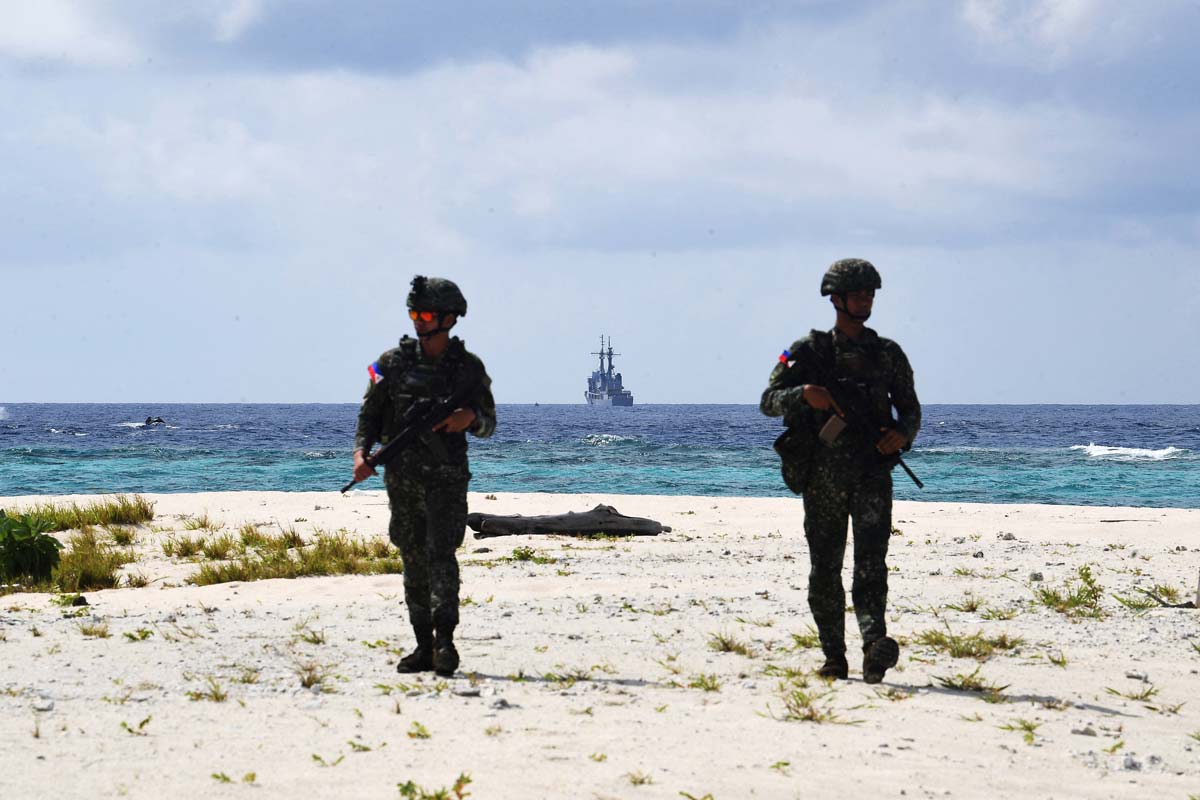
Riding Unruly Waves: The Philippines’ Military Modernisation Effort
This report is part of our special series on Asia’s Military Modernisation.
What’s new? Under President Ferdinand Marcos, Jr., the Philippines is modernising its military capabilities and accelerating efforts to shift focus from internal to external threats. Manila is increasing its defence acquisitions, augmenting its military partnerships and deepening its alliance with Washington – including by expanding U.S. troops’ access to Philippine bases.
Why does it matter? Manila’s military modernisation effort is unfolding amid growing tensions with Beijing in the South China Sea; worries about a confrontation between the U.S. and China over Taiwan; shifting geopolitics; and uncertainty surrounding the second Trump administration’s policies. Increasingly dangerous confrontations at sea risk more strategic distrust and even armed conflict.
What should be done? In balancing deterrence with diplomacy, Manila should continue military modernisation; work to enhance its alliance with the U.S.; and cultivate other defence partners. As friction with China threatens to increase, Manila should bolster crisis management channels and avoid acts that might be perceived as provocative.
The Philippines is at a strategic inflection point. For almost six decades, its military has focused on domestic security challenges. But the insurgencies that once occupied so much of its attention are diminishing, while external conflict risks are increasing. In recent years, Philippine leaders have watched a rising China become more assertive in the South China Sea – expanding its territorial claims, inhibiting the Philippines’ access to its own Exclusive Economic Zone (EEZ) and creating friction with the United States (a treaty ally of the Philippines). Frictions around Taiwan also create growing worries. As its threat perceptions have spiked, Manila has accelerated efforts to modernise its military, while also cultivating its security partnerships with Washington and others. While the Philippines should continue down these roads, it will also need to balance deterrence with diplomacy, maintaining open channels of communication with China to defuse tensions at sea and keeping its dealings with Taiwan as low-profile as possible, so that it is not perceived as threatening the island’s fragile status quo.
The U.S. withdrawal from its long-held Philippine bases in the 1990s, following the Cold War’s end, forced Manila to begin reconsidering its strategic posture. It continued to grapple with domestic insurgencies, but maritime disputes in the South China Sea were also on the rise. Since then, successive presidents have pursued programs aimed at modernising the military, but inconsistent funding, political squabbles, corruption and oscillating priorities has often kept progress slow.
Since launching the three-phase Horizon defence modernisation initiative in 2012, Manila has worked within that framework to upgrade its defence capabilities, both to keep pace with its neighbours and to respond to Beijing’s increasing incursions into the Philippine EEZ. Former President Rodrigo Duterte (2016-2022) undertook some modernisation reforms, but his geopolitical affinity with Beijing and a distracting surge in internal conflict limited cooperation with Washington during his tenure. Duterte’s successor Ferdinand Marcos, Jr., who is more closely aligned with the U.S., has set his sights on both modernisation and improvements to Manila’s defence partnerships.
Pushing forward with Manila’s military modernisation means catching up on decades of neglect and pivoting from internal security to territorial defence.
He has his work cut out for him. Pushing forward with Manila’s military modernisation means catching up on decades of neglect and pivoting from internal security to territorial defence. Fortunately, domestic conditions are increasingly conducive to the shift: after decades of conflict, the Bangsamoro region in Mindanao is slowly moving toward stability and the Maoist insurgency across the archipelago has been largely subdued. The government thus has space for reforms that will better position the armed forces to meet external defence needs. Among other things, the air force is acquiring modern aircraft, the navy is upgrading its fleet, so that it does not have to rely on decommissioned U.S. coast guard vessels for patrols, and the marines are getting a battery of BrahMos missiles. The military’s largest service, the army, has begun to reorient itself away from a counter-insurgency mission toward external threats.
But challenges remain. Procurement is slow, funding is inadequate and the Philippines lacks a strong industrial base to develop its own defence capabilities. Acquisition plans tend to focus on big-ticket hardware such as jet fighters or submarines, which many analysts see as costly and less useful than the asymmetric systems that are likely to pack a bigger punch when it comes to deterrence.
Manila’s alliances also require constant tending. Perhaps its most important defensive asset is the 1951 mutual defence treaty under which it and Washington promise to come to each other’s aid in the event of an attack. But China’s “grey zone” activities – ie, operations intended to test, provoke and fatigue Philippine forces without crossing the line into acts of war – raise questions about what this pledge means. Under the Biden administration, U.S. officials offered perspective on what sort of Chinese actions would and would not trigger a forceful response from Washington, but there was significant room for interpretation. The election of U.S. President Donald Trump, who is famously wary of alliances and the prospect of entanglement in foreign wars, injects further uncertainty into the alliance.
For the moment at least, both countries are projecting unity. During the Biden administration, Marcos, Jr. granted the U.S. access to four military bases in northern Luzon and Palawan, which could be of strategic importance in a conflict over Taiwan, in addition to five previously agreed-upon locations. Under Trump, top U.S. officials have continued to stress the centrality of the alliance. In July, Trump received Marcos, Jr. for a cordial meeting in the Oval Office. The main agenda item was tariffs, but alliance solidarity was a sub-theme.
Against this backdrop, Manila is increasingly expanding security ties with other countries both to draw even with its more militarily advanced neighbours and to hedge against scenarios in which the White House downgrades its commitment to its Asian allies (perhaps as part of some “grand bargain” that Trump strikes with Chinese President Xi Jinping). Come what may, Manila wants greater deterrent and defensive capabilities to help it discourage Chinese expansionism in the South China Sea – where Beijing blocks Manila from enjoying fishing rights and drilling for oil in its own EEZ – and to prepare for the prospect that China gives up on the notion of peaceful unification with Taiwan, tries to take it by force and triggers a conflict that could embroil the Philippines.
As it works to protect its interests – including in peace and security – Manila will need to walk a careful line between diplomacy and deterrence. Deterrence will require Marcos, Jr. and his successors to press forward with the work that is under way; building up the navy and air force and regearing the army so that the military is more trained on territorial defence; reforming glacial procurement procedures; improving joint planning and operations among the armed services; and deepening relationships in both Washington and other capitals. With respect to diplomacy, ensuring good communications with Beijing is vital, including by strengthening crisis channels to help manage escalatory risks when incidents occur. That does not mean Manila should stop exploring ways to counter Beijing’s grey zone tactics, but calibration is key. Similarly, if Manila continues to expand its quiet cooperation with Taipei, a careful, low-key approach will be essential to managing the risk of a counterproductive and dangerous reaction by Beijing.
Manila/Washington/Brussels, 12 August 2025

Loading Video
Located between the South China Sea and the Pacific Ocean, the Philippines sits at the fulcrum of Asian geopolitics.[1] As a former military commander in Manila put it, the archipelagic state is a strategic “chokepoint” for both the United States and China.[2] Because the Philippine islands are situated in China’s path to the Pacific, Beijing wants to exert influence over them or, barring that, deny its adversaries access to them.[3] Conversely, Washington sees the country as a vital part of the “first island chain”, serving as a natural barrier to Chinese naval expansion and a potential base of operations in defence of Taiwan, which sits less than 200km away.[4]
Manila has learned to live with a constant level of threat in the waters around the archipelago, as Chinese ships challenge its ships and fisherfolk in the South China Sea and make other incursions into its Exclusive Economic Zone (EEZ).[5] Adding to the stakes, the mutual defence treaty that has bound Washington and Manila since 1951 means that even minor skirmishes between Philippine and Chinese vessels have the potential to escalate quite significantly.
[1] See Crisis Group Asia Report N°316, The Philippines’ Dilemma: How to Manage Tensions in the South China Sea, 2 December 2021; and Crisis Group Commentary, “Philippines: Calming Tensions in the South China Sea”, 23 May 2004.
[2] Crisis Group interview, retired Philippine military chief, Manila, 20 May 2024.
[3] Crisis Group telephone interview, diplomat, 9 July 2020.
[4] The “first island chain” refers to the connecting line of archipelagos around China’s coast, stretching from Indonesia to Russia’s Kamchatka peninsula via the Philippines, Taiwan and Japan.
[5] The 1982 UN Convention on the Law of the Sea (UNCLOS) states that a country’s territorial waters extend twelve nautical miles from its coast, and its exclusive economic zone, 200 miles. Maritime disputes in the South China Sea are about competing sovereignty claims over maritime features and the entitlements these features generate. Most of the Philippine entitlements are around the Spratly Islands. China, Brunei, Malaysia, Taiwan and Vietnam are also parties to the dispute.
The Philippines has long been aware of the need to recalibrate its military to deal with external … threats, but for decades it took little action.
Against this backdrop, the Philippines has long been aware of the need to recalibrate its military to deal with external (rather than internal) threats, but for decades it took little action. Having achieved independence after World War II, the Philippines looked to its former colonial overlord, the United States, for protection, relying heavily on the 1951 treaty throughout the Cold War.[1] Manila’s threat perceptions during this period were in any case more internally focused, and it directed the bulk of its efforts toward quelling insurgencies, including both Muslim Moro rebels fighting for secession (and later autonomy) in Mindanao and the nationwide communist movement with its armed wing, the New People’s Army.
The threat landscape began changing for Manila with the Cold War’s end, however. In 1995, just a few years after U.S. troops were pushed out of the country by the Philippine legislature, China seized Mischief Reef, which lies in the Philippine EEZ in the South China Sea.[2] This episode set off alarm bells in Manila, leading to a first attempt to modernise the country’s military under President Fidel Ramos (1992-1998).[3]
But change was difficult. Economic woes in the wake of the 1997 Asian financial crisis, insurgencies, corruption and lack of foresight all distracted the country’s leadership and derailed modernisation plans.[4] Successive presidents then failed to substantially boost capabilities for territorial defence.[5] Indeed, there was backsliding after the 11 September 2001 attacks in New York and Washington, when conflicts with Moro and Maoist insurgents in Mindanao escalated and jihadist threats such as the Abu Sayyaf Group and Jemaah Islamiyah emerged. The army was then able to pull resources away from other services for its counter-insurgency campaigns. Against this backdrop, Philippine leaders were slow to develop what some have described as “archipelagic consciousness”, ie, a mindset focused on defending an island on all the requisite fronts.[6] The navy and air force remained weak, placing the country at a disadvantage in deterring external threats.[7]
Roughly a decade later, Manila’s focus shifted outward again. Elected in 2010, President Benigno Aquino called for faster military modernisation in light of China’s increasingly assertive moves in the South China Sea. These were epitomised by two incidents that occurred in quick succession near the Reed Bank and the Scarborough Shoal, both in Manila’s EEZ.[8] In 2011, the Chinese coast guard expelled a Philippine survey vessel assessing gas reserves in the Reed Bank. Then, in 2012, a confrontation between Philippine fishermen and Chinese fishing and later maritime surveillance vessels at Scarborough Shoal led to Beijing occupying the reef. As talks with Beijing on the disputes hit a roadblock, Aquino took legal action to challenge Beijing’s territorial claims.[9] Fortuitously, as tensions with China mounted, the domestic situation was calming down. In 2014, the government signed a major peace deal with the Moro rebels, allowing it to pay more attention to external challenges.[10]
Under Aquino, military modernisation finally began to take off. The Philippines launched the Horizon Program, which established a blueprint for building up naval and aerial capacities while strengthening the army (see Section III.B.3). Manila also allocated more funds to the Philippine coast guard to boost its capacity.[11] Then, in 2014, the Philippines signed the Enhanced Defence Cooperation Agreement (EDCA) with the U.S., giving U.S. troops rotational access to five Philippine bases.[12] Amid shifting geopolitics, and as explored in Section II, Aquino’s successors Rodrigo Duterte and Ferdinand “Bongbong” Marcos, Jr. continued to acquire new capabilities, with Marcos, Jr. – the current president – making a particular point of accelerating the modernisation push.
This report examines the Philippines’ military modernisation efforts amid the growing tensions in the South China Sea and around Taiwan. It assesses how the country is positioning itself to defend its interests by updating its military capabilities and expanding security partnerships, while offering recommendations for how Manila can balance diplomacy with deterrence in the service of a more stable neighbourhood. The report is part of a series looking at how U.S. allies in Asia are responding to a changing and increasingly tense security landscape.[13] It is based on dozens of interviews in Manila, central Luzon, Mindanao, Sulu and Palawan between February 2024 and July 2025, with current and former government officials, military officers, diplomats, journalists, academics, analysts and peace activists. It also draws on open-source literature and interviews conducted as part of previous research from 2020 to 2023. Given gender dynamics in the security sector, most interviews were with men.
[1] The two main bases hosting U.S. troops during the Cold War were Subic Bay and Clark, both on Luzon island.
[2] The Philippines refers to its EEZ as the West Philippine Sea.
[3] Renato Cruz De Castro, “Adjusting to the Post-U.S. Bases Era: The Ordeal of the Philippine Military’s Modernisation Program”, Armed Forces and Society, vol. 26, no. 1 (1999).
[4] Ibid.
[5]10 Rosalie Arcala Hall, “Exploring New Roles for the Philippine Military: Implications for Civilian Supremacy”, Philippine Political Science Journal, vol. 25 (2004).
[6] Crisis Group interview, naval analyst, 19 June 2024.
[7] Renato Cruz de Castro, “The Twenty-first Century Armed Forces of the Philippines: Orphan of Counter-insurgency or Military Geared for the Long War of the Century?”, Contemporary Politics, vol. 16, no. 2 (2010).
[8] See Crisis Group Report, The Philippines’ Dilemma: How to Manage Tensions in the South China Sea, op. cit., p. 40.
[9] The Philippines relied on Annex VII of the UN Convention on the Law of the Sea to initiate proceedings that took place at the Permanent Court of Arbitration.
[10] Crisis Group interview, former Philippine navy commander, 22 May 2024.
[11] Crisis Group telephone interview, Philippine coast guard official, 11 September 2020.
[12] Four of the sites are air force bases (Antonio Bautista in Palawan; Basa in Pampanga; Benito Ebuen in Cebu; and Lumbia airport in Cagayan de Oro) and the fifth is an army base, Fort Magsaysay (on the boundary of Nueva Ecija and Aurora).
[13] See the introductory instalment in this series: Crisis Group Asia Report N°347, Asia in Flux: The U.S., China and the Search for a New Equilibrium, 15 May 2025.
Interactive map above: In 2014, Manila signed the Enhanced Defence Cooperation Agreement with Washington, giving U.S. troops rotational access to five Philippine bases. In 2023, it gave the U.S. access to four more bases. Source: Asia Maritime Transparency Initiative (CSIS) / CRISIS GROUP
The Philippines has been committed to modernisation since the Aquino administration was in office, but shifting politics and competing priorities have created obstacles to rapid progress. Managing tensions with China over the South China Sea and (to a lesser extent) Taiwan is the Philippines’ main external security challenge and one that the country’s political and military leaders know they will have to do more to meet. At the same time, incomplete peace processes, flare-ups on the island of Mindanao and a continuing (if flagging) insurgency in pockets of the archipelago will likely continue to command scarce resources and attention, at least in the short term.
Over the past decade, the Philippine government has pursued two distinct approaches to boosting the country’s defence posture and navigating big-power competition in the Asia Pacific. The switch has reflected the generally different orientations of President Duterte (2016-2022) and his successor Marcos, Jr.
Rodrigo Duterte came to power in 2016 after decades of experience as a small-town mayor and with ingrained scepticism toward the U.S. Particularly at the beginning of his term, Duterte worked to develop stronger ties with Beijing. When the Permanent Court of Arbitration in The Hague ruled in 2016 that China’s claim to vast swathes of the South China Sea has no legal basis, Duterte declared he would “set aside” the ruling, a posture that dovetailed with Beijing’s rejection of the opinion. The following year, he and Chinese President Xi Jinping agreed to the creation of a Bilateral Consultative Mechanism to manage their disputes in the South China Sea.[1] This step was in line with Beijing’s preference for settling such disagreements bilaterally without outside input, including from other South China Sea claimants.
As he tilted toward Beijing, Duterte simultaneously decreased the Philippines’ reliance on the U.S., reducing defence cooperation and the number of military exercises the treaty allies conducted together. Duterte also expanded ties with non-traditional allies, such as Russia and India, while continuing defence cooperation with Japan and expanding ties with South Korea. While some analysts called this strategy a form of hedging, others suggested that Duterte may not have been consciously trying to hedge; rather, he made a bet on Beijing’s support early on and, as a general principle, he tended to work with countries he did not consider difficult.[2]
While he cultivated good relations with Beijing, perhaps hoping to lower the risk of Chinese provocations in the Philippines’ near seas, Duterte had his hands full internally. Manila faced a months-long jihadist uprising in Marawi City, Mindanao in 2017 and launched an “all-out war” on communist rebels in the rest of the archipelago. He also launched a controversial campaign against drugs that tested ties with Western countries.[3] These developments strained the Philippine armed forces but elevated the military’s importance to the government.
Maintaining good relations with the military remained a key objective for Duterte, even (or perhaps especially) as he drew closer to China, and he was generally successful in doing so. For instance, Duterte appointed retired officers to political and administrative positions and increased the pensions of soldiers and police officers.[4] This desire to please, however, also created openings for the U.S.-oriented defence establishment to counter some of the president’s overtly anti-U.S. policies, even before Duterte himself began to pivot back toward Washington at the end of his term. Manifestations of the latter included his willingness to allow more public criticism of Beijing’s actions at sea (which the government had suppressed during Duterte’s early years), tone down his anti-U.S. rhetoric and create space to repair fraying defence ties.
Duterte’s swing back to the U.S. can best be explained as the function of four overlapping considerations. First, the investment Beijing had promised in exchange for a realignment toward China did not meet the Philippine government’s expectations, as only a few infrastructure projects were undertaken.[5] Secondly, after 2019 China became more assertive in ways that increased Philippine threat perceptions and made it more difficult for Duterte to resist pressure from the military and the public to bolster the archipelago’s defensive capabilities.[6] Thirdly, though Duterte remained personally hostile to the U.S., the strong ties between the Philippine armed forces and their U.S. counterparts exerted a gravitational pull that Duterte struggled to resist, particularly when complemented by diplomacy that began in President Donald Trump’s first term and accelerated during President Joe Biden’s administration.[7]
A final reason for Duterte’s pivot was electoral realities: as the 2022 elections neared, repeated Chinese maritime incursions were making China particularly unpopular with Filipinos. Though he was legally barred from seeking another presidential term, Duterte had skin in the game, as he first considered running for vice president and later backed his daughter, Sara, who won that office on the ticket with Marcos, Jr.
When Ferdinand Marcos, Jr. became president in July 2022, he was eager to maintain good relations with both Washington and Beijing amid an agenda focused on domestic priorities.[8] He was much less reflexively antagonistic toward the U.S. than Duterte, but he had also developed ties with China during his time as governor of Ilocos Norte province and when serving in the Senate. He visited China in January 2023, emerging with agreements promising more than $20 billion in Chinese foreign investment to the Philippine economy.
[1] The mechanism foresees meetings between high-level officials from the two countries to defuse maritime tensions and to discuss potential cooperation.
[2] Crisis Group interviews, Manila, June-October 2020.
[3] See Georgi Engelbrecht, “Philippines: The International Criminal Court Goes After Duterte’s Drug War”, Crisis Group Commentary, 17 September 2021. The drug war and human rights issues were some of the biggest sticking points between Duterte and Western countries. Duterte also developed a personal animosity to some Western officials; he did not hesitate to curse former U.S. President Barack Obama and the former U.S. ambassador in Manila, Philip Goldberg. At present, Duterte is awaiting trial at the International Criminal Court in The Hague for alleged crimes against humanity. He was arrested on 11 March.
[4] Duterte’s declaration of martial law in Mindanao and creation of an anti-communist task force helped solidify the armed forces’ support.
[5] Richard Heydarian, “Pledge trap: How Duterte fell for China’s bait and switch”, Asia Times, 1 April 2022.
[6] Crisis Group correspondence, retired Philippine navy commander, 13 November 2020. Crisis Group interviews, retired and active Philippine military officers, July-August 2024. See also “Competition in the Gray Zone”, Rand Corporation, 2022, p. 146.
[7] Managing the tumultuous relationship with Duterte was a challenge for Washington, particularly after the president abrogated the Visiting Forces Agreement, which the U.S. saw as an essential complement to the Mutual Defence Treaty, in February 2020. Washington managed to salvage ties, thanks not just to an increase in weapons sales and continued security and development cooperation, but also to symbolic measures designed to demonstrate good-will, particularly the 2018 return of the Balangiga bells, which U.S. troops had taken as trophies during the 1899-1902 Philippine-U.S. war, to Manila.
[8] Crisis Group interviews, foreign observers and diplomats, Manila, June-July 2022.
[President] Marcos, Jr. … made clear from the start his intention to stand up to China in the South China Sea.
But Marcos, Jr. also made clear from the start his intention to stand up to China in the South China Sea. In his first state-of-the-nation address, he declared that he would not abandon “one square inch of Philippine territory”.[1] The Chinese government soon forced him to demonstrate that this pledge was more than empty rhetoric. Shortly after his January 2023 trip to Beijing, China began a series of provocations in the South China Sea.[2] In response, Manila edged closer to its traditional ally, the U.S., by granting Washington additional access to four bases around the country (an initiative that had been under discussion dating back to Duterte’s administration).[3] The Chinese, in turn, were frustrated.[4]
Marcos, Jr. also introduced a “transparency initiative” that created friction with Beijing. It involved releasing videos documenting incidents with Chinese vessels in the South China Sea and embedding journalists on coast guard ships to report on Chinese actions. Manila has framed this initiative and related efforts as rooted in defending international law, hence saying it is acting in the spirit of the 2016 arbitral tribunal ruling.[5] But together these manifestations of Manila’s newfound assertiveness ruffled feathers not just in Beijing, but also in the capitals of neighbours from the Association of Southeast Asian Nations (ASEAN) and fellow South China Sea claimant states, some of which chided the Philippines for poking the regional behemoth.[6] Though the transparency effort helped ensure that altercations at sea regularly made international headlines, some questioned its effectiveness, suggesting that the actual costs imposed on Beijing were not all that great. Taking this criticism on board, Manila toned down the initiative in late 2024, though it was not necessarily convinced that its approach had been wrong.[7]
From the perspective of domestic politics, Marcos, Jr. appears to be on solid ground with his approach to international affairs. Surveys suggest that Filipinos want their country both to be more assertive and to develop a stronger defence posture.[8] There is, however, a possibility that Manila’s geopolitical outlook will change if Sara Duterte assumes power in 2028; like her father, she appears to lean toward China more than Marcos, Jr.[9]
[1] Nestor Corrales, “PH won’t give up even a square inch of territory – Bongbong Marcos”, Inquirer, 26 July 2022.
[2] One incident in particular – in which the Chinese coast guard pointed a military-grade laser at a Philippine ship – was particularly damaging to Beijing’s image.
[3] Discussions about base access accelerated under Marcos, Jr., but initial conversations were already happening during the last year of Duterte’s administration. Crisis Group interview, former Philippine defence official, 6 September 2024.
[4] Crisis Group interviews, U.S. official, 17 July 2024; Chinese analysts, Manila, 14 September 2024. Crisis Group telephone interview, Philippine security analyst, 16 April 2025.
[5] Crisis Group interviews, Philippine coast guard and navy officials, June 2024.
[6] Crisis Group interviews, diplomats, Manila, 27 May, 1 August and 13 September 2024.
[7] From the perspective of many civilian and security officials, a unilateral, assertive approach was necessary in part because ASEAN had proven ineffective in managing regional disputes that involved China. Manila was particularly frustrated with the body’s drawn-out, inconclusive negotiations with Beijing to develop a Code of Conduct for the South China Sea, which began in 2013. The code aims to develop mechanisms for managing maritime tensions through a specific set of rules. Both parties hope to conclude the talks in 2026 at the latest. The Philippines will chair ASEAN that year.
[8] See, for example, Jason Gutierrez, “Survey: Most Filipinos prefer candidates who will defend Philippines over disputed waters”, Benar News, 7 March 2025. At the same time, Filipinos also applaud the use of diplomatic channels to peacefully resolve disputes.
[9] Crisis Group interview, former government official, Manila, 6 June 2025. See also John Eric Mendoza, “Palace on Sara Duterte’s foreign policy remarks: Expected from a pro-China”, Inquirer, 24 June 2025. On 6 August, the Philippine Senate voted to set aside the impeachment case against Sara Duterte, putting her trial on hold.
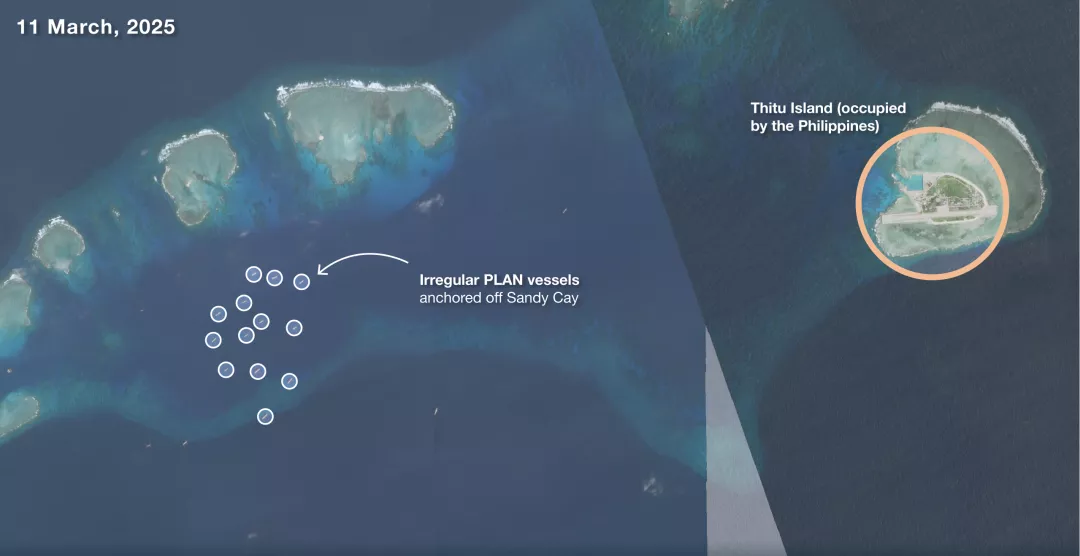
Source: Planet Labs PBC / CRISIS GROUP
Slider above: A before and after comparison of the facilities on Thitu Island, compared from 2019 to 2025. Source: Planet Labs PBC / CRISIS GROUP
Though Philippine leaders have since the 1990s set their caps on building up the armed forces to face external threats, they have struggled for years to balance this strategic objective with shorter-term priorities. Until the 2020s, internal threats trumped the need to reorient the armed forces toward territorial defence. The latter project requires increasing navy and air force capabilities in the traditionally army-centric military. While Beijing’s growing pressure in the South China Sea has prompted Manila to put more time, resources and strategic thinking into territorial defence, domestic security remains on the agenda, and the government’s attention is still divided.
One way for Manila to deconflict its internal and external security priorities would be for it to finally resolve the former. In practice, it would need to see the Bangsamoro peace process to fruition and quell the Maoist insurgency that it has been fighting for almost six decades.[1] These goals seem within reach. As regards the Bangsamoro, the peace process between Moro ex-guerrillas and the government is moving ahead, though concerns remain about persistent violence in parts of the newly created autonomous region in Muslim Mindanao.[2] The communist insurgency, meanwhile, appears to be on its last legs, thanks to intensified counter-insurgency operations, though there are still pockets of instability.[3]
[1] For background on these conflicts, see Crisis Group Asia Reports N°331, Southern Philippines: Making Peace Stick in the Bangsamoro, 1 May 2023; and N°338, Calming the Long War in the Philippine Countryside, 19 April 2024.
[2] The peace agreement foresees “redeployment” of the military outside the Bangsamoro. The ex-rebels appear to be pressing the issue, but the military is hesitant to withdraw for several reasons, including incomplete former rebel disarmament, other armed groups and local conflict in parts of the region.
[3] Crisis Group interview, Philippine military officer, 13 June. In Mindanao, communist insurgents remain mostly on the fringe. Hostilities continue on a lower scale in the Visayas region and parts of Luzon.
CRISIS GROUP / Georgi Engelbrecht
But while conflict resolution trends in the Philippines are generally positive, the military is unlikely to reposition all its troops from Mindanao and other insurgency-affected areas, at least in the short or medium term, even if some redeployment is possible.[1] As it is uncertain whether the police can assume control of security in these areas, some troops may need to stay behind. A foreign diplomat working with Philippine defence counterparts said Manila will need a “minimum amount of force presence” in Mindanao.[2] The government will require a mix of residual infantry to deter renewed rebellion, coupled with more flexible, specialised units for counter-terrorism and a police force able to keep communal conflict in check. Until those capabilities are in place, it cannot pull out more troops.
Nevertheless, the modernisation effort is not stuck. To the contrary, defence officials highlight that change is accelerating at the policy level, with new guidance on strategy, the acquisition of new assets, the creation of new units and more attention and funding for the navy and air force.[3] Yet altering force structure, in particular transforming the army so that it is arrayed for territorial defence rather than counter-insurgency, is proving more challenging. So, too, is developing a new doctrine to accompany these changes. A foreign adviser to the Philippine military told Crisis Group that changes might very well backfire internally if they are perceived as being too drastic and coming at the expense of domestic security.[4] As a result, Philippine planners are trying to work on two tracks – moving away from internal security to boost external defence needs to happen side by side.[5]
[1] Crisis Group interviews, Philippine military officers and security analysts, March-June 2023; August-September 2023; May-June 2024.
[2] Crisis Group interview, diplomat, 14 June 2024.
[3] For details, see Section III.
[4] Crisis Group interview, Manila, 9 October 2024.
[5] Crisis Group interview, Philippine defence official, Manila, 17 May 2024.
Philippine officials’ threat perceptions relating to China, though nuanced, are the key driver of the modernisation effort. Manila’s view of Beijing remains multi-layered: officials often highlight that maritime disputes are only one aspect of the bilateral relationship, which is not all contentious. Trade between the countries, for example, continues to flourish.[1] Nonetheless, defence officials and military officers think that Beijing’s actions at sea are the biggest threat to national security, and there is consensus among policymakers on the need for Manila to strengthen its defence posture. “They [the Chinese] have constantly validated our fears”, an army officer said.[2] Officials are also concerned by what they consider “influence operations” on Beijing’s part.[3] While Manila understands that it stands little chance of matching China’s firepower, it seeks a military that will be better positioned to counter China asymmetrically should the need arise, relying on capabilities such as anti-ship cruise missiles and air defence systems.
Meanwhile, China perceives the Philippines as working hand in glove with the U.S. to thwart its efforts at power projection beyond the first island chain.[4] It finds U.S.-Philippine cooperation vexing. The Chinese military has increased its incursions into the Philippine EEZ, which have led to more encounters at sea.[5] The tensions came to a boiling point on 17 June 2024, when an altercation between the Chinese coast guard and a Philippine navy resupply mission to the Second Thomas Shoal resulted in a Filipino sailor losing a finger.[6] Maritime provocations have also increased around other Philippine land features in the South China Sea.[7] In recent months, Chinese warships have also ventured much closer to Philippine shores than in the past.[8]
[1] China is the Philippines’ largest trading partner and its second largest source of imports.
[2] Crisis Group interview, Manila, 21 July 2024.
[3] Crisis Group interviews, Manila, December 2024-February 2025.
[4] Zhou Xin, “To the Philippines: Don’t be a ship lost at sea in foreign policy”, Global Times, 13 March 2025.
[5] Chinese manoeuvres around the Second Thomas Shoal intensified in September 2023, months after Manila agreed to expanded base access for U.S. troops. The number of incidents at sea has steadily risen since then. Crisis Group telephone interview, 5 August 2024.
[6] A Chinese vessel rammed a Philippine boat, and Chinese coast guard personnel proceeded to board the Philippine vessels, confiscating firearms. A Filipino sailor got his thumb cut off during the brawl. Weeks later, the two sides engaged in talks and crafted an agreement.
[7] These include Scarborough Shoal, Sabina Shoal, Thitu island and Sandy Cay. A foreign observer said the Chinese incursions were becoming “unnecessarily robust”. Crisis Group interview, 3 July 2024.
[8] Chinese vessels have ventured particularly close to Sulu, Palawan, Mindoro and Mindanao. Crisis Group interviews, Philippine navy and coast guard officers, Puerto Princesa, 23 October 2024; observers and diplomats, Manila, December 2024.
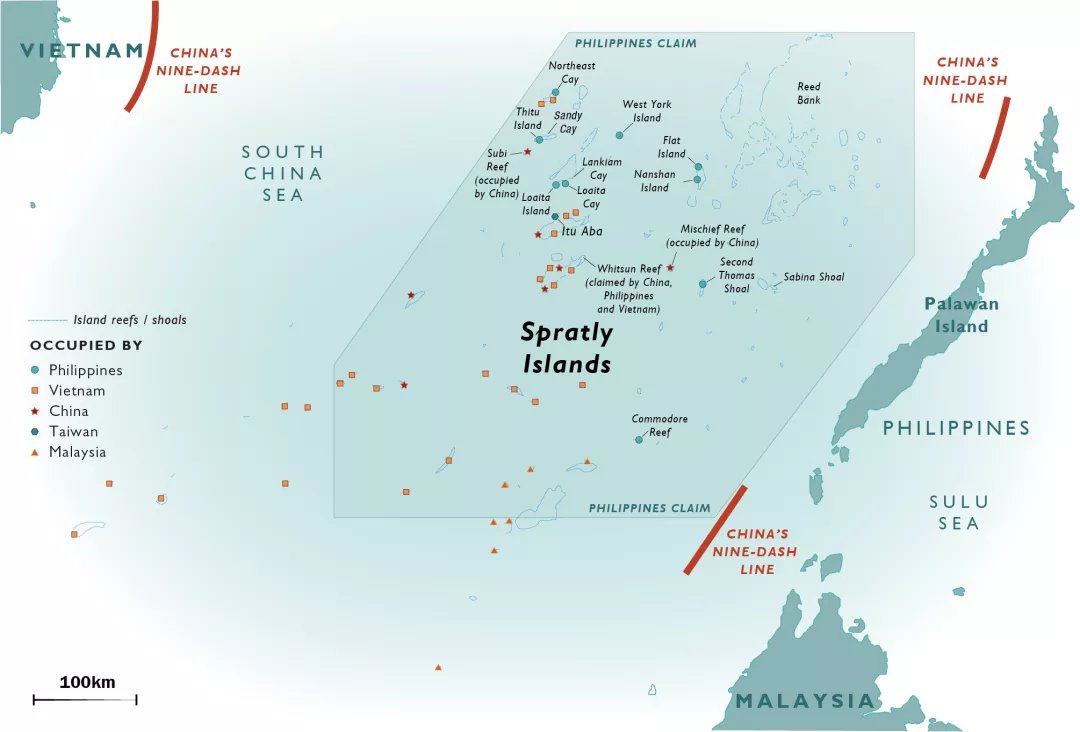
Source: Updated from Crisis Group’s 2021 map by Mike Shand, August 2025. CRISIS GROUP
Taiwan is increasingly a sore point as well. While maritime disputes in the South China Sea have long been a core Philippine national security concern that directly affects Filipinos, Taiwan has tended to be a secondary issue. But it has slowly become more prominent over the last year amid increasing U.S.-China tensions and confrontations with Beijing at sea.[1] The reason owes both to the Philippines’ geography and to its commitments under the 1951 mutual defence treaty. The archipelago’s northernmost island of Itbayat is less than 160km from Kaosiung in Taiwan, and Manila lies closer to Taipei than to any other capital. As for the Philippines’ treaty obligations to the U.S., they create a basis for Washington to ask Manila for assistance in case of conflict in the Indo-Pacific.[2] A request seems highly likely in that contingency: three of the four military bases to which U.S. troops have been granted rotational access are in Cagayan and Isabela – the provinces nearest to Taiwan.[3] In the event of conflict, the Philippines would also need to evacuate some 150,000 Filipinos who work in Taiwan.[4]
Manila understands the risks. Marcos, Jr. has stated that, should war break out in the Taiwan Strait, the Philippines “would necessarily be involved”.[5] To date, Manila has trodden carefully, adhering to a “one China” policy, which recognises the People’s Republic of China as the sole legal government of China, and generally avoiding high-profile cooperation with Taipei. That said, a mid-July article in the Washington Post described a deepening security relationship between the Philippines and Taiwan, enabled in part by Marcos, Jr.’s easing of constraints on exchanges between Philippine and Taiwanese officials in April. Indicia of the closer ties reportedly include expert dialogues, joint coast guard patrols in the strategic Bashi Channel, which runs between the northernmost Philippine islands and Taiwan’s Orchid Island, and the presence of Taiwanese observers at the annual U.S.-Philippine Balitakan military exercises in April, which (as noted below) simulated a Taiwan war contingency and included the participation of Japan and Australia.[6]
[1] Crisis Group interview, diplomat, Manila, 24 July 2025.
[2] Some observers think that in case of a Taiwan conflict, Beijing would try to pre-empt assistance from the Philippines, for example by closing off the Luzon Strait or otherwise projecting power in order to deter the U.S. from entering the Bashi Channel. Crisis Group interview, security expert, 11 December 2024.
[3] While both Manila and Washington deny it, it seems obvious that these bases would be instrumental for the U.S. should a conflict over Taiwan erupt. Some analysts even consider the U.S. rotational presence at the bases and during military exercises part of a U.S. strategy to deter a Taiwan invasion. Benjamin van Horrick, “A strait too far: How a deliberate campaigning approach in the Pacific can make Beijing think twice”, War on the Rocks, 5 June 2023.
[4] Crisis Group interview, senior Philippine official, Manila, 4 June 2024; analyst, Manila, 25 July 2025.
[5] “Philippines caught in the line of fire”, Financial Times (podcast), 26 January 2023.
[6] “The Philippines is quietly working with Taiwan to counter China”, Washington Post, 14 July 2025.
The Philippines’ main objective with its defence posture is “minimal credible deterrence”.[1] Manila has long had this aim but only recently come closer to achieving it.[2] For the Philippine military, deterrence refers to the ability to impose costs sufficient to dissuade a potential foe – whether China or another country – from staging either an attack on the archipelago or an armed confrontation on the high seas.[3] Manila is slowly making progress toward having this capacity, but it is not yet there. The Philippines has difficulty deterring Chinese grey zone activities and without the U.S. backstop it would likely struggle even more.[4]
While Manila is unlikely to wean itself entirely from dependence on the U.S., it can acquire new military assets that would allow it to be more self-reliant. Over the last ten years, the Philippine defence budget has steadily increased to close the gap with those of its neighbours.[5] As he presses forward with modernisation in the service of deterrence, President Marcos, Jr. has repeatedly highlighted that these steps are purely “defensive” in nature.[6]
[1] Crisis Group interviews, Philippine defence officials and military officers, Manila, 30 May 2024, 17 July 2024 and 3 July 2025.
[2] The idea of having “credible” armed forces dates back to the original military modernisation law in 1995. The term “credible deterrence”, undefined, appears in the Philippine National Security Strategy of 2018. The current National Security Policy (2023-2028) document of the Marcos, Jr. administration also discusses deterrence but not in detail. Philippine interlocutors brought up the subject regularly, however. Crisis Group interviews, senior navy commander, Manila, 30 July 2020; retired senior air force officer, Manila, 25 June 2024.
[3] Crisis Group interview, Philippine government official, 11 September 2024.
[4] Grey zone tactics is the term widely used to describe China’s actions in the South China Sea.
[5] SIPRI Data. On average, Philippine defence spending in the last ten years was 1.25 per cent of GDP. It peaked in 2021 at 1.41 per cent, which is the ASEAN average. It is, however, the lowest level of defence spending as a percentage of GDP by a U.S. ally in Asia, except for that of Thailand.
[6] “Marcos to China: Stop aggressive acts, I’ll return US missile system”, Inquirer, 30 January 2025.
At the core of Manila’s effort to modernise its armed forces is the Horizon Program, launched by President Aquino in late 2012. Divided into three phases, frequently referred to as Horizons One, Two and Three, the program has the overarching goal of developing greater cohesion among the various armed services and shoring up Philippine external defence capabilities. It also aims to bring the Philippines’ capabilities in line with those of other Asian countries, including immediate neighbours such as Indonesia and Vietnam. The program is the military’s main source of funds for arms purchases and equipment upgrades.
Horizon One (2013-2017) concentrated on maritime domain awareness, humanitarian/disaster relief and internal security operations.[1] The first phase’s main output was the development of a modest naval capability through small acquisitions of ships and aircraft. The U.S. provided three decommissioned patrol vessels, and Manila purchased twelve Korean-made FA50 jet fighters to replace its air force’s failing old equipment.[2] The Aquino administration also announced the Frigate Acquisition Project (an initiative to buy two modern warships) and commissioned two amphibious landing craft.[3] Other acquisitions included aircraft for inter-island transport, helicopters, air search radars and radio communications systems. The plan is behind schedule, however: as of late 2023, the military had completed only 36 of 53 Horizon One projects.[4]
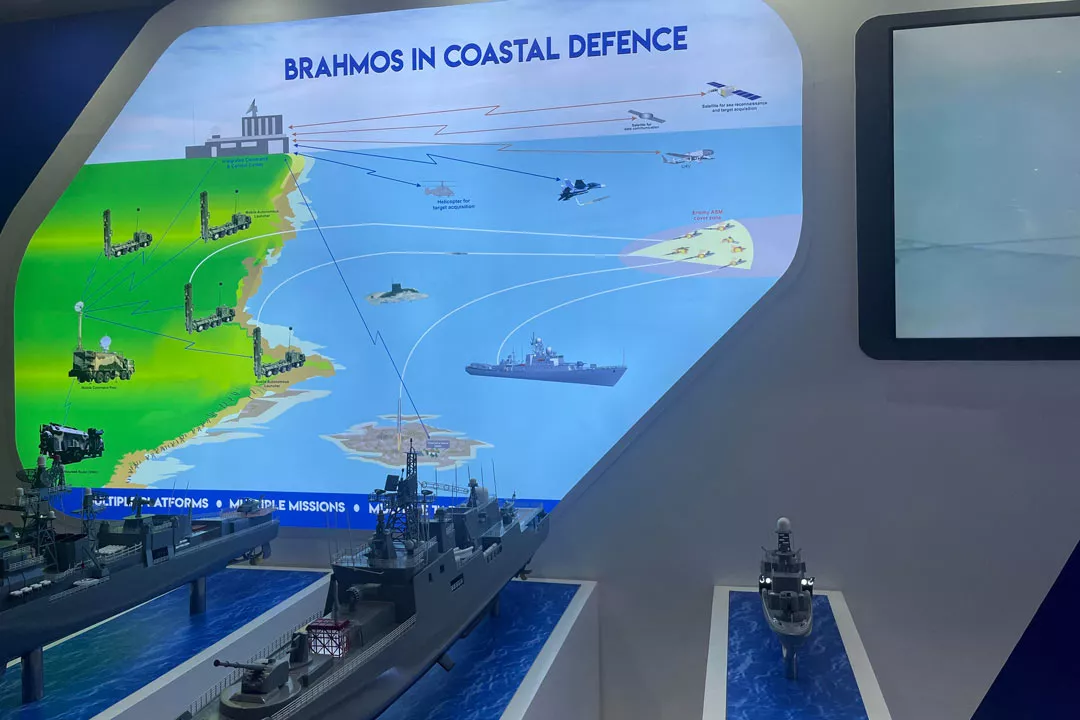
Horizon Two (2017-2022) started during the Duterte presidency, at a time when Manila was focused on balancing internal and external security needs.[5] Most of the acquisitions were for the army, as they coincided with ground offensives against jihadists and communist guerrillas.[6] They also, however, included two frigates and one corvette for the navy, as well as air defence systems.[7] From India, Manila acquired shore-based anti-ship BrahMos cruise missiles, at a cost of approximately $375 million, which have given the Philippines a new, if modest, deterrence capability.[8] Given Duterte’s strained relationship with Washington, other non-U.S. partners such as South Korea and Israel provided much of the other equipment procured by Manila. Like Horizon One, Horizon Two has proceeded in fits and starts, with only about half the projects completed so far, in part because the COVID-19 pandemic led to slimmed-down budgets and delays.[9]
[1] Around 80 per cent of the proposed acquisitions and upgrades were for internal security operations, making up 35 per cent of Horizon’s budget. Twenty per cent of the projects were for external defence, making up 65 per cent of the funds.
[2] These jets, which constitute the air force’s core capacity, can patrol the airspace along the coast but not very far out to sea.
[3] Commissioned in 2016 and 2017, the BRP Tarlac and BRP Davao del Sur are the largest ships in the Philippine naval fleet. They are used primarily to transport troops, tanks and artillery.
[4] “Agency Budget Notes for Financial Year 2024”, Congressional Policy and Budget Research Department (CPBRD), p. 10. Other sources suggest that the completion rate is between 80 and 90 per cent. Joviland Rita, “AFP modernisation’s Horizon 1 80% completed, Horizon 2 at 10% –Bacarro”, GMA News, 6 September 2022.
[5] Two thirds of the projects were for internal security and one third for external defence.
[6] For example, the military procured helicopters and riverine boats.
[7] The two frigates are Incheon-class vessels, BRP Jose Rizal and BRP Antonio Luna, built by South Korean Hyundai Heavy Industries. The SPYDER-MR air defence system was acquired from Israel.
[8] The deal, announced in January 2022, includes three batteries that have four launchers with three missiles each, capable of flying at thrice the speed of sound, which makes it one of the world’s fastest missiles, and striking up to 290km away. India delivered the first batch of missiles in April 2024. Manila has been constructing a naval base, reportedly to house the missile batteries, in western Luzon’s Zambales province.
[9] Incomplete projects were transferred to the next phase. “Fortifying External Defence”, press release, Senate of the Philippines, 27 September 2023.
[President] Marcos, Jr. approved a redesign of the third phase of the Horizon project … to better respond to escalating tensions in the South China Sea.
In January 2024, Marcos, Jr. approved a redesign of the third phase of the Horizon project (2023-2028) to better respond to escalating tensions in the South China Sea. The Re-Horizon Three “wish list” of acquisitions is not public, but officials Crisis Group spoke to indicated that the government is aiming to bolster the navy and, to a lesser extent, the air force.[1] Big-ticket items include air defence and missile systems, jet fighters and ships.[2] Another emphasis is on cyber radar and surveillance capabilities.[3] Interlocutors from the Philippine defence department and armed forces told Crisis Group that anti-access weapons and long-range missiles capable of reaching potential adversaries at sea would be particularly useful assets, as would asymmetric capabilities such as drones and more mobile missile batteries.[4] Many naval officers also hope to get submarines, though their utility is a subject of debate.[5] As of July, the defence department still needs to approve some of these items.
In sum, more than a decade into the modernisation program, it is beginning to show results, but challenges remain. Some defence analysts suggest that it would have been hugely difficult to finance military modernisation without a specific budget allocation, adding that the Horizons initiative has proven key because its basis was a law mandating modernisation.[6] As mentioned, Horizon Three has led to efforts to procure assets designed for external defence. Alignment among the services also appears to be getting better.[7]
Still, critics suggest that acquisitions are driven first and foremost by “shopping lists” designed to secure expensive equipment without a clear strategy or theory of success.[8] “We need to ask ourselves what we need to perform first”, noted a military officer.[9] In some cases, the procurement process itself has proven flawed. For example, some ships were purchased lacking sophisticated weapon systems that had to be obtained afterward, significantly increasing the cost.[10] Another challenge is to ensure maintenance for acquired hardware, which tends to be highly technical and costly for naval and air assets.[11]
[1] Crisis Group interviews, senior Philippine defence officials, Manila, 17 July 2024.
[2] Reports indicate that Manila may want to procure as many as 40 more jet fighters, going beyond the initial objective of twelve. The Swedish Gripen seems to be the preferred choice, but Lockheed Martin’s F-16 jets are also being considered, particularly after Washington approved a proposed sale of twenty aircraft to the Philippines. “Philippines eyes mid-range missiles, 40 fighter jets to modernise military”, Reuters, 29 August 2024. For its part, the navy expects to acquire eight to ten more vessels by 2030, including corvettes, frigates and offshore patrol vessels.
[3] Crisis Group interviews, Palawan, October 2024. See also Joviland Rita, “AFP needs to modernise radar and surveillance systems first, Brawner says”, GMA News, 2 July 2024.
[4] Crisis Group interviews, senior army officer, 22 June 2023; air force officer, 28 May 2024. Crisis Group interviews, June-September 2024.
[5] The Philippines does not have submarines at present, but the navy has been talking about acquiring some since 2011, and it already has a submarine group tasked with studying matters related to subsurface capabilities. Those in favour of subsurface assets highlight not just their advantages such as surveillance abilities and stealth, but also that, in today’s world, they should be part of any maritime nation’s navy. Critics stress the high cost of submarines and their maintenance; they also question submarines’ utility in the shallow reaches of the South China Sea. At present, it remains unclear if Manila will go ahead with acquiring these assets. Crisis Group telephone interviews, defence analysts, Manila, 17 May, 5 June and 5 July 2024.
[6] Crisis Group interview, defence analyst, 10 July 2024.
[7] For instance, tanks and mortar artillery no longer appear on wish lists. Crisis Group telephone interview, defence analyst, 14 September 2024.
[8] Crisis Group interviews, defence analysts, Manila, 14 and 16 September 2024. An analyst described the status of Horizon 3 as “chaotic”. Crisis Group interview, 5 June 2024.
[9] Crisis Group telephone interview, 9 July 2024.
[10] Crisis Group interviews, foreign defence official, Manila, 13 September 2024; diplomat, Manila, 22 May 2025.
[11] Crisis Group interviews, Philippine navy and air force officers, Tarlac City and Manila, May-July 2024. Not all purchases include sustainment arrangements and often only a training package is included.
CRISIS GROUP / Georgi Engelbrecht
Making the ambitious defence upgrades planned under the Horizons program is difficult for several reasons. For one thing, the government’s budget is limited, as the constitution puts a priority on education spending and the legislature often cuts funding earmarked for defence. In addition, procurement is sometimes cumbersome as it features complicated bidding processes that often bring delays.[1] Other issues revolve around defence budget allocation: drawing from finite resources, military planners must balance the desire in some quarters for large-scale acquisitions such as submarines and new combat aircraft with more asymmetric capabilities, such as aerial and naval drones, or second-hand assets – for example, used ships.[2]
Exact numbers on government expenditure are hard to come by, but estimates point to Manila having spent roughly $3.89 billion on Horizon One and Two.[3] Given the goals laid out for Horizon Three, which include several big-ticket items such as jets and possibly submarines, the government will need to part with much more silver, with estimates reaching $36 billion over ten years.[4] But that figure will likely be hard or impossible to reach. Funds approved by Congress are often less than the military’s requested annual budgets. In 2025, the military asked for $4.38 billion for modernisation but received only $1.34 billion.[5]
[1] Even minor errors in the procurement documentation can result in a failed bid and throw acquisitions off track. On average, equipment for internal security needs up to two years for delivery while territorial defence assets can take three to five years. See Rommel Jude Ong and Sheena Valenzuela, “Toward Increased and Stable Investments in National Security in the Philippines: An Analysis of Trends, Allocations, and Policy Options in Philippine Defense Spending”, working paper, December 2023, p. 37.
[2] An analyst suggested that the navy consider buying submarines second hand, for example from Japan, rather than getting brand-new ones. Crisis Group interview, 21 May 2025.
[3] Lade Kabani, “Teodoro sounds off on AFP modernization shift”, Daily Tribune, 12 September 2023.
[4] Nestor Corrales, “AFP chief eyes more ‘deterrent’ weapons”, Inquirer, 6 April 2025. The figure is a defence department projection.
[5] Paige Javier, “More funding sought for AFP modernization amid West PH Sea tension”, ABS-CBN News, 24 September 2024. The total defence budget for 2025 is around $5.4 billion.
Washington may press Manila to allocate more funds to military modernisation in coming years.
Smaller budgets could cause friction with Washington. Given recent statements by Trump and his top advisers about the need for U.S. allies to spend more on defence, Washington may press Manila to allocate more funds to military modernisation in coming years. For now, however, U.S. officials are not pushing Manila for a major increase.[1] For their part, Philippine security experts and military officers recognise the need to spend more, but they are also aware that a boost would have to be proportionate to domestic expenditures so as not to alienate the electorate.[2]
Additionally, two structural factors pose major challenges to the furtherance of the modernisation program. First, a significant chunk of the defence budget goes to pensions – for retired military personnel – and is therefore unavailable for other expenditures.[3] Servicemembers do not contribute to their pensions, adding to the burden borne by the state. For many observers, this issue is the “elephant in the room”, one that the government has repeatedly failed to address given the political sensitivity of reducing a benefit on which servicemembers have come to rely.[4]
Another issue is the absence of an Indigenous defence industry, which forces the Philippines to rely on foreign acquisitions. Non-commercial domestic shipbuilding, steelwork and aircraft manufacturing are rudimentary.[5] In October 2024, the legislature passed a law promoting a self-reliant defence posture, which identifies developing an industrial base as a priority. Some analysts caution that the law is unlikely to have much impact, due to its vague language.[6] Still, it could help foster domestic weapons production over the long term.
[1] Crisis Group interviews, U.S. security expert, 10 February 2025; U.S. journalist, 19 May 2025.
[2] Crisis Group telephone interview, former government official, Manila, 8 July 2025.
[3] Based on data from 2020-2023, military pensions amount to 20 per cent of the total defence budget – roughly the same proportion as salaries of active personnel. A 2019 study found that, without reforms, the government would need to pay almost $14.3 billion annually for the next twenty years to cover the pensions of soldiers and police personnel. “Promoting Sustainability through Reform in the Pension System for Military and Uni-formed Personnel”, CPBRD Brief, No. 2021-01., p. 2. Economists assert that without reforms the Philippines would need to increase its debt. Ralf Rivas, “Public debt to rise unless military pension overhauled, warns Diokno”, Rappler, 8 May 2023.
[4] Crisis Group interviews, defence analysts and retired Philippine officers, June-July 2024.
[5] Most of the domestic defence capacities are oriented toward gun and bullet production.
[6] Crisis Group interview, journalist, 19 May 2025. The law offers financial incentives to local defence companies and arms manufacturers, promotes research and development, and sets up public-private partnerships.
CRISIS GROUP / Georgi Engelbrecht
A major challenge for Philippine strategists wishing to strengthen the country’s external defence has been shifting away from the longstanding priority given the army in both the military command structure and expenditures. The military was built primarily to deal with internal threats to the state, with regional commands focused on Moro and Maoist insurgencies.[1] For 2024, the army received 51.8 per cent of the defence budget, the air force 19.1 per cent and the navy 17.5 per cent. [2]
But things are slowly changing. Although an army general has almost always occupied the position of chief of staff, an appointment made by the president, top jobs such as the operational heads at military headquarters and regional commanders in northern Luzon and Palawan have gone to others in recent years, including air force and navy officers.[3] Moreover, even the army leadership knows its responsibilities are increasingly in realms beyond counter-insurgency.[4] It has actively encouraged the army’s infantry branches to think beyond internal threats.[5] Consistent with these admonitions, the army is positioning itself to guard national security infrastructure and key waterways, so as to be involved in coastal defence in the event of invasion.[6] To this end, it has begun to form bigger units, such as the Brigade Combat Teams now in the making, to cover Luzon, the Visayas and Mindanao.[7] (Bigger units are better adapted to multi-faceted tasks because of their capacity to include specialised formations such as artillery, reconnaissance and signal corps.)
Beyond the army, the Philippine military has started making organisational shifts, for instance putting stronger emphasis on the need to improve the major services’ capacity to conduct joint operations.[8] It is also creating and strengthening new cyber and psychological operations units, better aligning special forces (both with one another and the respective services), and trying to expand the reserves.[9] It also seeks to activate new entities such as a Strategic Defence Command, which would coordinate military exercises but also be in charge of interoperability with partner nations.[10] All these steps suggest that the armed forces aim to reduce residual inter-service rivalry – but whether the leadership has reached this goal is open to question.[11]
Given the Philippines’ geography, a defence upgrade necessarily entails strengthening maritime capabilities. In 2024, the Marcos, Jr. administration created the National Maritime Council (NMC), which took control of the West Philippine Sea task force that was previously in charge of patrolling waters near the Spratlys. The NMC’s role is to develop and coordinate maritime governance policies and promote coherence among government branches, which is a broader and more strategic mandate than its predecessors’, which was more operational.[12] Another step in the same direction was Defence Secretary Gilberto Teodoro’s proposal for a Comprehensive Archipelagic Defence Concept (CADC), a strategic framework to enhance the country’s territorial defence by projecting power into the Philippine EEZ.[13]
In 2024, the military started rolling out the CADC.[14]In practice, this policy involves more naval and aerial patrols and exercises in littoral areas, while trying to position Manila for more ambitious goals such as reopening access to fishing grounds and hydrocarbon deposits in the EEZ. At present, Philippine fisherfolk are kept out of traditional fishing grounds around Scarborough Shoal, and Philippine businesses are unable to exploit oil and gas reserves in the Reed Bank, north west of Palawan, which was the site of maritime incidents with China in 2011 and 2019.[15] To date, however, Manila has been hesitant to challenge Beijing over the status quo, and given the power differential between the two, it could well remain so.
[1] Crisis Group interview, army officers, 1 June 2024.
[2] See “Agency Budget Notes for Financial Year 2024”, p. 4.
[3] Since 1991, only three air force generals and one marine corps commander have made it to chief of staff rank.
[4] Crisis Group interviews, Philippine military officers, June 2024-May 2025.
[5] For example, the Philippine special forces are looking into ways of mobilising the population for territorial defence. Crisis Group interview, former special forces officer, 11 June 2024.
[6] Crisis Group interview, Philippine navy officer, 14 June 2024.
[7] These combat teams, equipped with armour and artillery, are to conduct combined operations as a mobile contingency force suited for territorial defence. Crisis Group interviews, army officers, Manila, May-June 2024. See also Priam Nepomuceno, “AFP chief eyes more mobile, powerful brigade combat teams”, Philippine News Agency, 10 October 2023.
[8] Crisis Group interview, senior Philippine military officer, 13 June 2024. Another officer highlighted that while the military put a lot of emphasis on joint operations, there is still work to be done to ensure genuine interoperability. Crisis Group telephone interview, 9 July 2024.
[9] The push to revitalise the military reserves gained momentum in 2023. For instance, Manila started training local reservists in Batanes, in the northern part of the country. Defence Secretary Teodoro said Batanes is the Philippine “spearhead”. Chad de Guzman, “Why the Philippines is increasingly keeping a close eye on Taiwan”, Time, 6 February 2024.
[10] Crisis Group telephone interview, security analyst, 29 June 2025.
[11] Navy and air force officers were slightly more critical in their assessments then army officers. Crisis Group interviews, April-June 2024; May-July 2025.
[12] The NMC makes policy, while the task force carries it out. Crisis Group interview, official, Manila, 2 August 2024.
[13] Crisis Group interviews, Philippine defence and military officials, July 2024.
[14] Crisis Group interviews, Philippine defence and military officials, May 2024. For example, the western Mindanao command created Task Force Poseidon, charged with protecting borders and curbing smuggling, and organised new training.
[15] The latest incident near Scarborough Shoal occurred on 11 August, when a Chinese coast guard vessel, pursuing a Philippine ship that had been delivering fuel and supplies to local fisherfolk, collided with a Chinese warship. Kelly Ng, “China rams own warship while chasing Philippine vessel”, BBC, 11 August 2025.
The [Philippine] navy plans to modernise its facilities and build new ones.
The Philippine navy is also upgrading its capabilities. “At any given time, three and a half ships patrol our seas”, noted a senior commander, implying that things have improved but still have some way to go.[1]The navy plans to modernise its facilities and build new ones, for example ports and bases in Cebu, Zambales, Palawan and Aurora.[2] The navy has also increased monitoring of sensitive locations, such as the straits between various Philippine islands, which would be of great strategic importance in a conflict.[3]
Beyond the navy, the marine corps – the only armed service that has both counter-insurgency and maritime capabilities – also has an important role to play in the shift to territorial defence. Three fourths of the force is now deployed in coastal areas, evidence of its ambition to rediscover its “maritime soul” after fighting land-based insurgencies for decades.[4] The corps’ coastal defence regiment, founded in 2021, is responsible for handling the anti-ship BrahMos missiles acquired from India, which are intended to deter would-be attackers. While the missiles are primarily defensive, they are also a serious instrument of force projection because of their range beyond the Philippine coastline.
The final piece of the puzzle is the coast guard, which is seeking to become more streamlined, more agile and better equipped.[5] Marcos, Jr. has followed his predecessors’ lead in increasing funding for the service.[6] Under his administration, the coast guard also boosted its presence in the South China Sea, where it remains primarily responsible for resupplying the Spratlys (where it has posts on seven features), and where it comes into confrontation with both the Chinese navy and coast guard (which is under military control).[7] Proponents of this approach argue that deploying the civilian coast guard as the main service conducting patrols – albeit in coordination with the navy – is a helpful form of non-escalatory signalling toward China.[8] Others favour the navy taking the lead, due to the coast guard’s perceived lack of results and since the contested areas at sea are far from territorial waters.[9] For the time being, however, the coast guard is likely to continue being a key actor in Philippine waters, particularly in the South China Sea.
The Philippines’ efforts to boost its navy and coast guard aim to secure its maritime borders and enable Manila to project power into the South China Sea, but some defence planners and analysts worry that the country is unprepared for the possibility of a conflagration over Taiwan. They say the focus on the South China Sea trains the government’s attention on the archipelago’s west, instead of its largest island, Luzon, which lies in the north.[10]
Manila began taking steps to address this concern under previous presidents, and under Marcos, Jr., it has picked up the pace. In an April policy statement, Philippine military chief Romeo Brawner, Jr. urged his troops to prepare for the impact of a possible Chinese invasion of Taiwan. The April and May military exercises with the U.S. focused on such a scenario, and (as noted above) quiet security cooperation with Taipei is on the rise.[11]
[1] Crisis Group interview, senior Philippine navy officer, 31 May 2024.
[2] A bill filed by Senator Francis N. Tolentino identified key areas for future naval basing. The NMC has also announced projects aiming to slowly build up the features Manila controls in the Spratlys, such as Thitu, which has an airfield, and Nanshan island, where a fishing port is planned. Delon Porcalla, “Government allots P800 million for new port in Kalayaan”, Philippine Star, 15 January 2024.
[3] Rebecca Tan, “Philippines pivots from battling militants to projecting power at sea”, Washington Post, 16 November 2024.
[4] Crisis Group interview, Manila, 21 June 2024. Crisis Group interview, Philippine navy officer, 23 May 2024. Only one marine brigade is still deployed in central Mindanao.
[5] The coast guard wants to boost its maritime surveillance capacities, upgrade its basing infrastructure and acquire more patrol vessels. A bill to introduce more organisational reforms is in the Philippine Congress. Ellson Quismorio, “Bill reforming Philippine coast guard hurdles House panel”, Manila Bulletin, 19 March 2025.
[6] The coast guard is a civilian agency and formally under the transportation department. Its budget quadrupled from 2018 to 2024, and several bills to further increase its funding are pending. See also Josiah Gottfried, “The Philippine Coast Guard’s Modernization: An International Joint Effort”, Center for Strategic and International Studies, 5 March 2024.
[7] Crisis Group interview, former Philippine navy commander, 22 March 2024.
[8] Crisis Group interviews, government official, Manila, 13 May 2024; navy officer, 30 May 2024; coast guard officer, 19 June 2024.
[9] While the services are not at odds with one another, some observers think that in practice they compete for resources. Crisis Group interview, defence analyst, Manila, 3 July 2024.
[10] Crisis Group interviews, Manila, 8-9 July 2024. Many field commanders also see Taiwan as a powder keg. Crisis Group interviews, Palawan, Sulu and Mindanao, October 2024-May 2025.
[11] Nestor Corrales, “AFP chief tells troops: Be ready if Taiwan is invaded”, Inquirer, 2 April 2025.

CRISIS GROUP / Georgi Engelbrecht
A key aspect of the Philippines’ strategy for modernising its military has been nurturing foreign partnerships. In addition to reinvigorating its partnership with the country’s main ally – the U.S. – Manila is expanding its defence network with regional partners.
The central pillar of the U.S.-Philippines alliance is the 1951 mutual defence treaty.[1] The treaty stipulates that any attack on one party is to be treated as an attack on both, yet past U.S. actions have created uncertainty in Manila about how committed Washington is to its defence and whether U.S. administrations consider the treaty applicable to attacks that take place in the South China Sea.[2] The Biden administration, building on U.S. efforts to improve the relationship during Trump’s first term, worked hard to demonstrate that in Washington’s view the alliance is “ironclad”, through dozens of high-level visits and exchanges.[3]
It was amid this diplomatic offensive that the parties negotiated new treaty guidelines, which were signed by the two defence secretaries of the time, Lloyd Austin and Carlito Galvez, in 2023. The guidelines laid out ways for the two nations to cooperate to strengthen the alliance in salient respects.[4]
The U.S. also shared through various channels (with both Manila and Beijing) additional information about how it would approach the mutual defence commitment. As regards encounters with China in the South China Sea, the Biden administration said the U.S. response (which is not specifically prescribed by the 1951 treaty) would depend on the circumstances under which Manila triggered the treaty – and might stop short of the use of force.[5] In deciding whether to respond militarily, Biden’s team said, the U.S. would take into account considerations like whether a deadly incident was the result of intentional action or an accident.[6] On one end of the spectrum, Washington communicated to Chinese officials that seizing Second Thomas Shoal would remain a red line.[7] But elsewhere along the spectrum, the nature of Washington’s likely response remains unclear, as do questions about whether Beijing’s grey zone tactics would qualify as “armed attacks” that trigger the mutual defence commitment under the treaty’s Article IV.
Whether or not they would, both Manila and Washington are choosing not to treat many of China’s grey zone provocations as Article IV events.[8] To take a recent example, on 20 June, a Chinese flotilla blocked and used water cannons against Philippine vessels distributing aid to fishermen around Scarborough Shoal.[9] While such incidents are naturally unwelcome in Manila, Philippine leaders appear ready to swallow a considerable amount of frustration.[10] The Marcos, Jr. administration has avoided reciprocating with acts that China would perceive as escalatory.[11] For example, Manila did not take up the Biden administration’s offers to undertake joint resupply missions to its troops on Second Thomas Shoal in 2024. Indeed, officials show every sign of wanting to avoid a situation that could escalate beyond their control and force Washington’s hand, not least because they are not certain how the U.S. might respond.[12] In his 28 July state-of-the-nation address, Marcos, Jr. emphasised that the Philippines continues “to exercise restraint and remain patient”.[13]
[1] The treaty stipulates that “an armed attack on either of the Parties is deemed to include an armed attack on the metropolitan territory of either of the Parties, or on the island territories under its jurisdiction in the Pacific or on its armed forces, public vessels or aircraft in the Pacific”.
[2] Filipinos remember the events of 2012, when the U.S. declined to intervene as the Philippines was “losing” Scarborough Shoal to China. The lack of a U.S. response to Chinese island building in the Spratlys during the Obama administration also contributed to doubts about Washington’s commitment to the alliance. Crisis Group interview, retired government official, 14 May 2024.
[3] Crisis Group telephone interviews, U.S. analysts, 6 and 13 September 2024. See also Pia Ranada, “South China Sea covered by PH-U.S. mutual defense treaty – Pompeo”, Rappler, 1 March 2019; and Idrees Ali, “Austin discusses China threat, reiterates iron clad treaty with PH”, GMA News, 1 June 2024.
[4] In particular, the treaty’s Article II, which discusses “mutual aid” toward developing defence capabilities, and Article III, which stipulates periodic consultations.
[5] Crisis Group interview, Western diplomat, Manila, 17 July 2024. During the 2024 Shangri-La Dialogue, Secretary Austin refrained from explicitly addressing whether the death of a Philippine servicemember or other national at sea would trigger the treaty’s mutual defence provisions. He reiterated Washington’s “ironclad” commitment to the treaty, but he also said he “would not speculate on any hypothetical situation”. See “IISS Shangri-La Dialogue 2024, First Plenary Session: United States’ Strategic Partnership in the Indo-Pacific”, video, YouTube, 1 June 2024.
[6] Crisis Group interviews and telephone interviews, June-July 2024.
[7] Demetri Sevastopulo, “Biden to warn Beijing over aggressive South China Sea tactics”, Financial Times, 8 April 2024. Because the treaty makes any decision to use force subject to the parties’ constitutional processes, there is also a prospect that the U.S. Congress would not give its authorisation to the use of force under the treaty, though in practice the White House tends to give short shrift to congressional war powers and keep its own counsel.
[8] Crisis Group interview, Manila, 14 July 2025.
[9] “China coast guard water-cannons Philippine vessels in Scarborough Shoal”, Rappler, 21 June 2025.
[10] Crisis Group interviews, Philippine navy and army officers, July-August 2024.
[11] Crisis Group interviews, Puerto Princesa City, 22-23 October 2024.
[12] Crisis Group interviews, Manila, July 2024. Crisis Group interviews, U.S. and Philippine officials, June-July 2025.
[13] Cristina Chi, “‘Friend to all, enemy to none’: Marcos softens West Philippine Sea rhetoric but vows continued defense”, Philippine Star, 28 July 2025.
CRISIS GROUP / Georgi Engelbrecht
Another pillar of the U.S.-Philippines alliance is the 2014 Enhanced Defence Cooperation Agreement (EDCA), which provides U.S. troops, planes and ships with rotational – rather than permanent – access to Philippine military bases. Progress in fulfilling the agreement stalled under Duterte, but in early 2023, soon after Marcos, Jr.’s election, the allies agreed to expand the agreement to four new bases, bringing the total to nine.[1] According to the Pentagon, U.S. access to the sites – which remain under Philippine jurisdiction – would allow both allies’ troops to “respond more seamlessly to address a range of shared challenges in the Indo-Pacific region, including natural disasters”.[2] The agreement also allows the U.S. to build facilities such as runways, field storage units and housing, as well as to pre-position defence equipment.[3]
Washington has already started deploying assets at the EDCA sites to build airstrips, hangars and fuel depots.[4] But progress in refurbishing the bases is uneven.[5] Bureaucracy and financing are among the key reasons for delays. In August 2024, the U.S. promised $500 million to the Philippines, as a part of a defence package, and another $120 million for the sites.[6] Despite uncertainties about its alliance commitments in general, Manila seems confident that the Trump administration will honour this pledge.[7] Philippine analysts say the alliance could gain more traction once the EDCA sites are developed and looped into joint trainings or air exercises.[8] In March, the two sides committed to take “bold steps” in improving the sites, without providing details.[9] Work at the sites is under way, and the U.S. is also assisting its ally with building facilities outside the EDCA framework.[10]
In areas near EDCA sites, public sentiment about the U.S. military presence varies. Local politicians are mostly agnostic when it comes to their country’s geopolitical alignments, but they express hope that their constituents may benefit from defence investments. Other elites – some of whom have ties to China – consider “militarisation” a side effect of the pro-U.S. tilt that is detrimental to their business interests, given the danger of a possible conflict.[11] In interviews with Crisis Group, officials and residents in Palawan conveyed support for the two EDCA sites there, partly because of growing local concerns about Chinese intrusions into the Philippine EEZ, which lies nearby.[12] Others, however – particularly those residing in northern Luzon – voiced concern about the bases being too close for comfort should conflict break out.[13]
[1] Crisis Group interview, former Philippine defence official, 29 May 2024. Following a joint assessment, Manila had the final say in choosing the sites. Crisis Group interview, defence analyst, 12 May 2024. The four new sites are Naval Base Camilo Osias in Santa Ana, Cagayan; Camp Melchor Dela Cruz in Gamu, Isabela; Balabac Island in Palawan; and Lal-lo Airport in Cagayan.
[2] “Philippines, U.S. Announce Locations of Four New EDCA Sites”, press release, U.S. Department of Defence, 3 April 2023.
[3] Writings on defence planning and strategy by U.S. authors suggest that the Philippines’ strategic location makes it vital for force projection. Without access to the Philippines, the nearest land-based U.S. troops who could react to a South China Sea or Taiwan contingency would be in Okinawa, Japan. See “U.S. Major Combat Operations in the Indo-Pacific”, Rand Corporation, 2023.
[4] Crisis Group interviews, journalists, 26 September 2024. See also Lade Kabagani, “New Cebu fuel storage facility to boost Phil-US military ops”, Daily Tribune, 31 January 2025.
[5] Crisis Group interviews, Manila, May-June 2024. Most work has occurred at the Basa air base.
[6] The coast guard will also receive funds. See Bea Cupin, “Unpacking Washington’s ‘once-in-a-generation’ $500-M military funding”, Rappler, 6 August 2024.
[7] U.S. analysts and officials have confirmed as much. Crisis Group interviews, Manila, February 2025.
[8] Crisis Group telephone interview, U.S. analyst, 6 September 2024.
[9] Joviland Rita, “US, PH to enhance EDCA sites for logistical support”, GMA News, 28 March 2025.
[10] Aaron-Matthew Lariosa, “U.S. to construct Philippine fast boat base near South China Sea flashpoints”, USNI News, 14 July 2025.
[11] A case in point is the northern province of Cagayan, where the local government seems to appreciate Beijing’s drive to boost investment and provide disaster relief when cyclones hit. Cagayan vice governor Manuel Mamba, who has pushed for stronger economic ties with Beijing, has criticised the EDCA sites.
[12] In Palawan, local officials told Crisis Group they are concerned about Chinese incursions but do not perceive an imminent risk of conflict. Crisis Group interviews, 22 October 2024.
[13] Crisis Group interview, journalist, 10 February 2024.
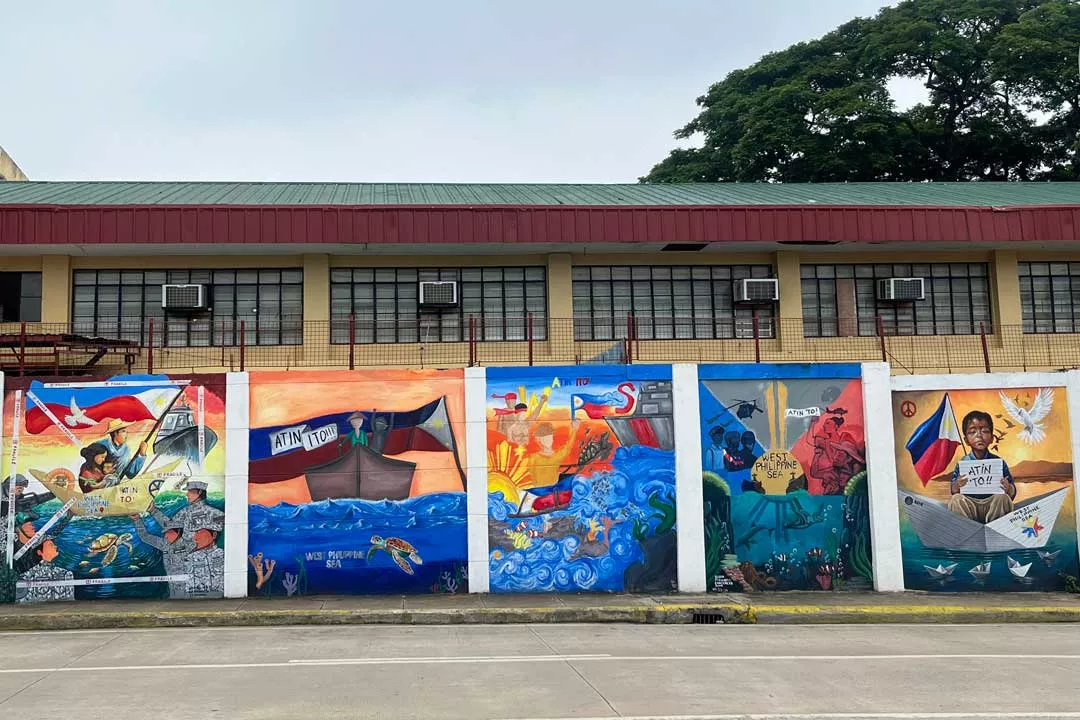
CRISIS GROUP / Georgi Engelbrecht
Another key element in the alliance are joint exercises involving the two militaries. In the last few years, the flagship Balikatan (Shoulder to Shoulder) exercises have grown in scope and scale. These drills are an opportunity not just for both countries to ensure inter-operability but also for the U.S. to deploy new assets in the region. During the 2024 exercise, Washington sent in the long-range Typhon missile system, which has both offensive and defensive capabilities, for the first time.[1] After the drills, the missile system remained at an undisclosed location in the Philippines, infuriating China.[2]
From the Philippine perspective, conducting exercises and having missile systems in place sends an important signal to Beijing.[3] The above-referenced 2025 exercises, which focused on the Philippine north and simulated a Taiwan contingency, included a “full battle test” with scenarios involving missile defence, maritime strikes and counteraction of an amphibious landing.[4] Philippine interlocutors stressed that, among other benefits, these exercises have been good for building mutual respect among the troops from the partner militaries.[5]
The U.S.-Philippines alliance continues to expand to other areas of collaboration as well. In November 2024, for example, Manila and Washington signed the General Security of Military Information Agreement to facilitate better intelligence sharing. Washington also committed to assisting its ally on both military restructuring and other aspects of modernisation, which could give Manila a boost in areas such as procurement reform.[6]
[1] The Typhon is a missile launcher usually loaded with mid-range projectiles like the Tomahawk.
[2] China claims that the U.S. instigated tensions by deploying the system. The decision appears to have come jointly from Manila and Washington, however, and Philippine officials emphasised their “sovereign prerogative”. Priam Nepomuceno, “Typhon missile system deployment for exercises legal – DND chief”, Philippine News Agency, 24 December 2024.
[3] Crisis Group interview, defence analyst, 17 May 2024.
[4] Mikhail Flores, “Philippines, US launch joint combat drills in full battle test”, Reuters, 21 April 2025.
[5] In the past, Philippine soldiers have expressed frustration about how their U.S. counterparts treated them, but they now feel that they are increasingly being treated as equals. Crisis Group interviews, Philippine military officers, 8 and 11 July 2024.
[6] Crisis Group interview, U.S. official, Manila, 3 September 2024. See also Ely Ratner, “Lunch Keynote during the Fourteenth Annual South China Sea Conference”, 11 July 2024.
Trump’s return to the White House has raised questions about Washington’s commitment to the U.S.-Philippines alliance. But Philippine officials appear sanguine, at least for now.[1] It is still early days, and Trump (perhaps distracted by crises in Ukraine and the Middle East) has not taken a big visible step concerning Asia beyond boosting tariffs on countries in the region. Many signals from Washington have been positive. Senior members of the Trump administration have reached out to their counterparts in Manila and underscored the importance of the alliance.[2] The Philippines was the first Asian country to get a visit from U.S. Secretary of Defense Pete Hegseth. During his stay, he affirmed that accelerating the defence partnership with the Philippines and “re-establishing deterrence” in the region were major U.S. policy objectives.[3]
Military cooperation has continued unhindered, and bilateral ties seem solid. While Trump’s tariff demands in early July raised concerns in Manila, Marcos, Jr.’s subsequent visit to Washington on 20-22 July, including a cordial Oval Office meeting, went smoothly (though it did not significantly reduce tariffs).[4] During the Oval Office meeting, Trump spoke pointedly of former President Duterte (noting that the latter reversed his tilt toward China after Trump first came into office) but also left space for Manila to engage with Beijing, telling the press, “I don’t mind if he [Marcos, Jr.] gets along with China because we’re getting along with China very well … He has to do what’s right for his country”.[5]
[1] Charlie Abarca, “America needs us, says PH Ambassador to US amid Trump presidency”, Inquirer, 22 January 2025. “Is a good relationship with both China and the U.S. possible? Philippine ambassador to Washington has some answers”, NPR, 19 May 2025.
[2] Historically, commitment to the Philippines alliance has been bipartisan in the U.S. Congress.
[3] Nestor Corrales, “US ‘reestablishing deterrence’ amid Chinese aggression in SCS”, Inquirer, 27 March 2025.
[4] Trump agreed to lower the rate he was requesting from 19 to 20 per cent. He also highlighted a plan to build a joint ammunition and storage facility at Subic Bay in Luzon. Marcos, Jr. also met Hegseth and Secretary of State Marco Rubio, who both underscored the importance of the alliance. Darylle Sarmiento, “Marcos brings home $21 billion in investment pledges after US visit”, ABS-CBN News, 24 July 2025.
[5] Helen Flores, “Trump: We get along with China”, Philippine Star, 24 July 2025.
The influential U.S. undersecretary of defense … emphasised that the alliance [with the Philippines] should remain “a top priority”.
While the trajectory of the U.S.-Philippines relationship under the second Trump administration is not easy to forecast, three scenarios present themselves.[1] In the first, the status quo would prevail, with Manila and Washington continuing to cooperate in several domains and strengthening their military alliance. Some evidence points in this direction. The influential U.S. undersecretary of defense, Elbridge Colby, who generally considers the U.S. overextended in its alliances and advocates for a more restrained U.S. approach to foreign policy, has nevertheless emphasised that the alliance should remain “a top priority”.[2] (That said, other advocates of restraint worry that deepening ties to the Philippines could raise tensions with China and increase the risk of the U.S. being drawn into a conflict between the world’s two biggest powers.[3])
A second possibility is that an increasingly inward-looking and risk-averse U.S. takes a dimmer view of its alliance with Manila. In this scenario, Washington would take a minimalist view of its 1951 treaty obligations both with respect to grey zone encounters and more broadly – calling into question its reliability should Manila trigger Article IV.[4] The Trump administration could do so as a concession to China (perhaps as part of a deal struck between Trump and Xi on economic and security issues) or simply as a reflection of Trump’s misgivings about entangling alliances.[5] For this reason, expressions of support for Manila, even when conveyed by top cabinet officials like Hegseth and Secretary of State Marco Rubio, always come with an implied asterisk: they cannot be assumed to correspond to Trump’s own views or to presage what he might say or do in U.S.-China trade talks and a possible summit with Xi in the autumn.[6]
A third scenario flips the second one on its head. It would see the U.S. becoming more aggressive in how it positions itself in the region, with the aim of containing China more decisively. This tack could lead to even stronger defence ties with the Philippines; more forceful U.S. actions in countering Beijing in the South China Sea; and ramped-up U.S. pressure on Manila to increase military spending. In this scenario, the risk of a direct U.S.-China conflict that involves the Philippines would likely increase – and for that reason moving too far in this direction could run afoul of Philippine public opinion. Some politicians, left-of-centre academics and civil society representatives, as well as some retired military officers, are already expressing concerns about “over-militarisation” heightening the risk of conflict.[7]
At this point, Manila would most likely prefer the first (status quo) scenario, hoping for a relationship in which it can look to Washington as a consistent partner willing to invest in strengthening the alliance.[8]
[1] See Carmela Fonbuena, “Trump: I fixed ties with PH, a ‘most prime real estate’ militarily”, Rappler, 15 November 2017.
[2] Raymund Antonio, “PH, US ‘doubling down’ alliance – Defense policy chief Colby”, Manila Bulletin, 18 May 2025. Colby also has not officially asked the Philippines – unlike Australia and Japan – to clarify its position in a Taiwan contingency.
[3] Lyle Goldstein, “US should look before it leaps into South China Sea”, Asia Times, 18 April 2025.
[4] Crisis Group interviews, diplomats and analysts, Manila, May-July 2024.
[5] See Crisis Group Report, Asia in Flux: The U.S., China and the Search for a New Equilibrium, op. cit.
[6] Ibid., pp.22-23.
[7] Crisis Group interview, Manila, 2 August 2024.
[8] Crisis Group interviews, February-July 2025.
Diversifying its security partnerships beyond the U.S. is a priority for Manila. This effort started when Aquino was president, continued under Duterte and has intensified during Marcos, Jr.’s administration.
Several factors drive the desire for diversification. Manila finds political value in the diplomatic support it receives from a wide range of countries in the aftermath of maritime incidents in the South China Sea (even if the impact on Beijing is less than it might hope) and strategic value in the more tangible contributions these partners make toward boosting Manila’s capabilities. The latter include both arms sales (see Sections III.B and IV.B) and opportunities to participate in joint military exercises with Singapore, Germany, Japan, Indonesia and Canada.[1] Defence chiefs from the Philippines and Indonesia have committed to defence industry cooperation, and Manila has also signed an agreement with Vietnam on incident prevention in the South China Sea (focusing on efforts to prevent and manage maritime issues involving both countries) and a defence pact with Singapore.[2]
[1] All these agreements cover defence cooperation in a broad sense, and a significant number of them foresee joint trainings.
[2] See Joviland Rita, “PH, Indonesia defense chiefs tackle deepening ties”, GMA News, 23 April 2025; Jim Gomez, “Philippines and Singapore broaden defense ties with a new agreement”, Associated Press, 24 July 2024; and John Eric Mendoza, “‘Revolutionary’: Vietnam coast guard sets first-time drills with PCG”, Inquirer, 5 August 2024.
Partnering with a wide array of countries … helps Manila avoid overreliance on Washington.
Partnering with a wide array of countries – including other U.S. allies – helps Manila avoid overreliance on Washington as it pursues its modernisation agenda.[1] Manila already enjoys close relations with Tokyo, which has been its largest provider of development assistance and remained a key partner in maritime security throughout the Duterte administration despite its foreign policy swings.[2] Concerns about Beijing’s grey zone activities have prompted Japan to ramp up coast guard cooperation with the Philippine coast guard and navy.[3] In July 2024, the two countries signed a Visiting Forces Agreement, allowing reciprocal access for their militaries and permitting Japanese forces to train alongside their Philippine counterparts.[4] Australia, which together with Japan joined the latest Balikatan exercises, and South Korea, as Manila’s main ship supplier, are also close defence partners.[5]
The Philippines also participates in the region’s evolving security architecture through multiple minilateral arrangements. This latticework of alliances – which aims to both unite like-minded governments and allow U.S. partners to reinforce their mutual defence ties – was a key feature of the Biden administration’s Indo-Pacific strategy. With Washington’s encouragement, several groupings have emerged over the last few years. One is the so-called Squad, a quadrilateral comprising the U.S., Japan, Australia and the Philippines, which had its first summit in June 2023.[6] Another important milestone in regional cooperation was the first trilateral summit of the U.S., South Korea and the Philippines in April 2024. The future of these (for now mainly ad hoc) nascent coalitions remains uncertain, especially given mixed messages from the Trump administration about whether it will continue nurturing them.[7] Regardless, Manila is likely to pursue deeper bilateral ties with each of the countries involved.
The Philippines also collaborates with countries outside the region. Many governments in the West share Manila’s perception that China poses a threat to the international order and are increasingly open to boosting defence ties with the Philippine government.[8] Canada, for example, has donated a vessel detection system, worked with maritime agencies, expanded its diplomatic presence in the Philippines and made port calls.[9] France, the only European country with a Pacific presence, has sent ships and conducted military exercises with the Philippines. Paris is also negotiating a Visiting Forces Agreement with Manila and will sell 40 ships to the Philippine coast guard.[10] The European Union has increasingly ventured into coast guard and maritime cooperation. That said, U.S. retrenchment, budgetary considerations and crises closer to home are likely to have an impact on how much help Euro-Atlantic states can offer Manila over the long term.[11]
[1] Crisis Group interview, Philippine defence official, Manila, 4 June 2025; Crisis Group correspondence, senior Philippine military officer, 2 June 2025.
[2] Japan has trained several Philippine experts in maritime affairs, as well as provided coast guard ships and equipment for maritime domain awareness. Crisis Group telephone interview, Philippine coast guard officer, 11 September 2020. See also Joviland Rita, “PH, Japan coast guards eye stronger capacity, maritime partnership”, 30 April 2025.
[3] Cooperation started under President Aquino, but Tokyo has increased its support in the last three years. Crisis Group interview, senior Philippine coast guard officer, 19 June 2024.
[4] Crisis Group interview, Philippine marine corps officer, Manila, 11 July 2024. The agreement also provides for Filipinos to train in Japan.
[5] Various South Korean companies have delivered ships and aircraft. “Philippines, South Korea boost defence cooperation, upgrades ties to strategic partnership”, Reuters, 7 October 2024.
[6] A second meeting occurred in May 2024. The Squad is a reference to the Quadrilateral Security Dialogue more commonly referred to as “the Quad”, a grouping which brings together the U.S., Australia, Japan and India.
[7] Defence Secretary Teodoro said the Philippines, together with Australia, Japan and the U.S., is also developing a “one-theatre concept” short of a formal alliance that will serve as a model for Asian countries. “RP, allies adopt ‘one theater’ concept”, Business Mirror, 1 July 2025.
[8] Crisis Group interviews, defence officials and diplomats, 10-11 December 2024.
[9] Crisis Group interviews, diplomats, July 2024.
[10] Kris Crismundo, “PCG awards purchase deal for 40 patrol boats to French firm”, Philippine News Agency, 16 April 2025. France will build twenty vessels, while the Philippines, assisted by Paris, will manufacture the same number locally.
[11] Crisis Group interviews, European experts, 17-18 September 2024.
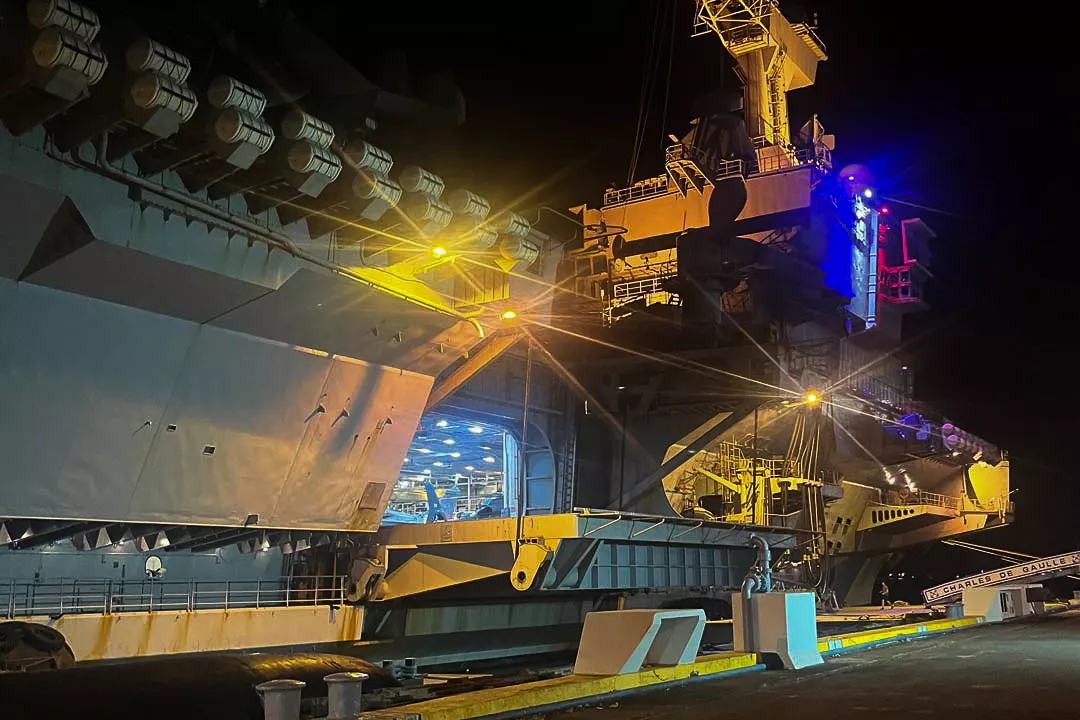
CRISIS GROUP / Georgi Engelbrecht
The Philippines, like many other countries in the Indo-Pacific, is simultaneously trying to manage external threats, by boosting its military capacity, and trying to avoid an escalatory spiral that will make it less safe. Meeting this challenge requires a careful balancing between diplomacy and deterrence.
Military modernisation is both necessary for effective deterrence and a major challenge for the Philippine government. While top political and military leaders appear committed to the policy, they face major practical obstacles. These range from the persistent need to manage domestic conflicts, to procurement inefficiencies and funding shortfalls that are weighing down the Horizon program, to the difficulty of helping the under-developed navy and air force catch up with the army.
In considering these challenges, resolving the Philippines’ internal conflicts belongs at or near the top of the list of priorities, given the need to free up resources and bandwidth to focus on external threats. To this end, Manila needs to boost the Bangsamoro peace initiative by speeding up “normalisation” – ie, the process by which Moro rebels and other outfits are disarmed, their former compounds are transformed into safe and prosperous communities, and stability is entrenched through the integration of these individuals and communities into civic life.[1] Not everything about the peace process is in the government’s control, but investing Manila’s attention and resources in stabilising Mindanao is key. As it moves in this direction, Manila will also need to divide responsibilities between the military and the police, so that law enforcement agencies can take over more tasks the military has been carrying out in insurgency-affected areas in Mindanao and beyond.
[1] See Crisis Group Report, Making Peace Stick in the Bangsamoro, pp. 27-32.
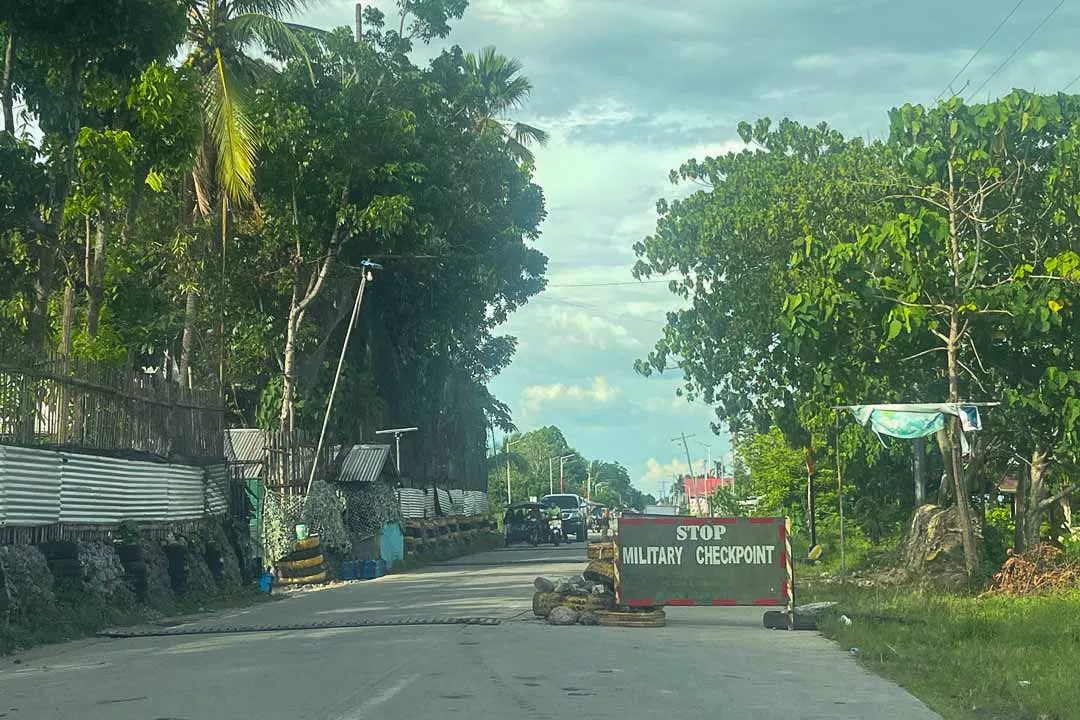
CRISIS GROUP / Georgi Engelbrecht
Concerning the Horizon program, which has struggled with delays, the defence department should try to winnow the list of projects that are in the queue, discarding or putting to one side those that are not at the core of military necessity. It should focus on procuring asymmetric military capabilities, which offer better value for the money and take into account the power disparity between Manila and Beijing. Creating a two-tiered system of acquisitions, with some that need to be completed before the end of Marcos, Jr.’s term in 2028, and others that can wait until afterward, will help relieve bottlenecks.
Changes within the military are also needed. The navy and air force require resources and equipment to assume the role they should be playing in territorial defence.[1] The army has begun retooling, but it is not optimally configured. It has redeployed special forces units to Palawan in order to be better positioned for territorial defence. But it should also consider reassigning more infantry from the largely stable interior to coastal locations near the Luzon Strait and other strategic waterways.[2] Army training should focus more on marine manoeuvres and protecting critical infrastructure. Army units already present in coastal areas should prepare for more littoral operations. More broadly, military training should emphasise joint planning and inter-operability among the services. Finally, over the longer term, Manila also needs to reform the military pension system to free up financing for modernisation. A bill in front of the Congress would require new recruits to contribute to their pensions, which seems like a sensible place to start.[3]
[1] The same applies to newly created military units and task forces. Crisis Group telephone interview, former senior Philippine military commander, 14 July 2025.
[2] The Philippine marines, under navy command, pulled out a brigade and a battalion from the island of Sulu, sending them to northern Luzon, in late 2022. Roel Pareño, “Marines pull out of Sulu”, Philippine Star, 4 September 2022.
[3] Louise Maureen Simeon, “MUP pension budget rising 50% to P217 billion”, Philippine Star, 10 July 2025.
With the Trump administration’s approach to the Indo-Pacific shrouded in uncertainty, and China’s grey zone activities calling into question the value of the 1951 treaty, Manila will need to manage its relationship with Washington very carefully. It will need to thread a needle, looking for responsible ways to work with the U.S. to deter China from taking more control of features and resources in the Philippines’ EEZ, while helping itself withstand potential pressure during future resupply missions or even routine navy and coast guard patrols. But Philippine officials will also have to pick their battles, lest they generate major pushback from Beijing that Washington is unprepared to help Manila absorb.[1]
Key to managing conflict risk in the region will be good communication between Manila and Washington, especially regarding how to respond to Chinese actions while keeping the chances of escalation in check. Though it should seek mutual understanding by working through channels at every level, Manila should remain mindful that power in Washington is highly concentrated with the president, and that issues touching on U.S. relations with other major powers are especially sensitive. There are accordingly limits to how much any senior official can reliably say he or she is speaking for Trump.
[1] For a Philippine view of the alliance, see Julio Amador III, “The South China Sea: Making the Philippines-US Alliance work under Trump 2.0”, The Diplomat, 13 March 2025.
Beyond its U.S. alliance, Manila should continue to expand and strengthen its network of defence relationships.
Beyond its U.S. alliance, Manila should continue to expand and strengthen its network of defence relationships. As a U.S. analyst said, “Connecting the spokes is really important”.[1] Building on existing partnerships with Japan and Australia – and continuing to engage with South Korea and Euro-Atlantic states – could help provide something of a backstop in the event that Washington’s commitment to the Philippines’ security wanes.[2] Despite its misgivings about the (so far) inconclusive ASEAN-China negotiations around the Code of Conduct in the South China Sea to manage tensions at sea, Manila should also continue to engage its ASEAN partners to maintain good relations with its neighbours as well as to enhance deterrence by building stronger regional partnerships.[3]
As it cultivates defence partnerships, the Philippines should also do more to ensure that assistance programs are efficiently coordinated. It could do so through a task force composed of members from the defence and foreign affairs departments, the national security council, and the president’s office; together, they could tailor what the Philippines receives through its various bilateral relationships according to different partners’ strengths.
[1] Crisis Group correspondence, 15 June 2025.
[2] Crisis Group telephone interview, U.S. expert, 6 September 2024.
[3] Manila should keep participating in ASEAN discussions, as well as representing its views in South East Asian capitals, but also continue military and coast guard exercises. Crisis Group interview, Philippine security experts, 15 July 2025.
Manila’s main challenge with Beijing remains to respond tactically to the tensions in the South China Sea, while finding a strategic modus vivendi with China. Given the power asymmetry in the relationship, developing effective deterrence is clearly a tall order.
Regarding China’s grey zone activities, Manila should sync up to the extent possible with Washington, as noted, but it will also need to keep its own counsel as it looks to counter what Beijing is doing. Calibration will be key. For example, Manila should continue to reduce the number of incidents it publicises as part of its transparency initiative, while still discreetly bringing relevant episodes to the attention of its partners.[1] China would thus have less reason to overreact.[2] Secondly, it should conduct informal exchanges with expert institutions and think-tanks from other Asian powers to draw on their most successful responses to China’s assertive behaviour, for example by strengthening digital infrastructure. Thirdly, to minimise the impact of the much larger Chinese vessels ramming its ships, Manila could use more robust civilian craft for its resupply missions, patrols and escorts for fishing vessels in the South China Sea. These could include non-traditional craft such as oil tankers or bulk carriers.[3]
Neither Manila nor Beijing appears interested in an uncontrolled escalation in the South China Sea.
Fortunately, neither Manila nor Beijing appears interested in an uncontrolled escalation in the South China Sea, and both appear to see value in dialogue and de-escalation channels.[1] The Bilateral Consultative Mechanism, created as a confidence-building measure in May 2017 to de-escalate tensions at sea through high-level diplomatic meetings, especially following incidents, is an imperfect tool but at least offers a forum for exchange.[2] Another welcome innovation is the 2024 agreement between Beijing and Manila to create a presidential hotline for use in crisis situations.[3] But Manila should not expect too much; Philippine operators of the hotline say China often fails to “pick up the phone” in times of trouble.[4]
Finally, preparing for over-the-horizon risk of a crisis in the Taiwan Strait requires an especially delicate touch by Philippine leaders. On some aspects there is room for manoeuvre. For example, Manila has legitimate security interests around the Philippines’ northern shores, and it can argue that boosting defence in the north should not be viewed as escalatory. Its actions to that end might include creating new naval detachments and upgrading existing ones. The Philippines can also reasonably be expected to conduct coast guard and military exercises in accordance with the Law of the Sea around the provinces of Cagayan, Isabela and Batanes, though it should take pains to communicate clearly with Beijing about the purpose of these drills. Developing plans to evacuate its roughly 150,000 nationals from Taiwan should the need arise is also a core sovereign function that should not raise eyebrows.
The most sensitive activities relating to Taiwan are likely to be cooperative defence efforts, as well as other initiatives that Beijing might see as inconsistent with Manila’s “one China” policy because they appear to treat the island as a sovereign. The farther Manila goes down this road, the more it will likely strain relations with Beijing. More broadly, such activities could be perceived by China as more evidence that the fragile status quo around Taiwan – which preserves the prospect of peaceful unification – is dissolving. That is a conclusion best avoided, since reaching it could lead Beijing to decide that the time has come to seek reunification through non-peaceful means. Accordingly, any Philippine engagement with Taiwan should remain low-key and, to the extent that reports surface, Manila should be sure to use its channels to Beijing to reassure Chinese officials that it respects the status quo around the island and has no intention of derogating from its longstanding “one China” policy.
[1] Crisis Group interview, naval analyst, 5 July 2024; Crisis Group interviews, senior military officers, May-June 2024.
[2] Since 2017, Beijing and Manila have held ten rounds of these high-level talks, with mixed results.
[3] Crisis Group interviews, analysts, December 2024-February 2025. See also Jim Gomez, “New deal establishes a hotline Chinese and Philippine presidents can use to stop clashes at sea”, Associated Press, 16 July 2024.
[4] One such instance was in 2023, during the confrontations around Second Thomas Shoal. See Bea Cupin, “Another time’s the charm? Manila, Beijing OK presidential hotline on West Philippine Sea”, Rappler, 17 July 2024. A Philippine navy officer suggested that the sides could use specially designated “go-betweens” in addition to the hotline and traditional diplomatic channels. Crisis Group telephone interview, 30 May 2025.
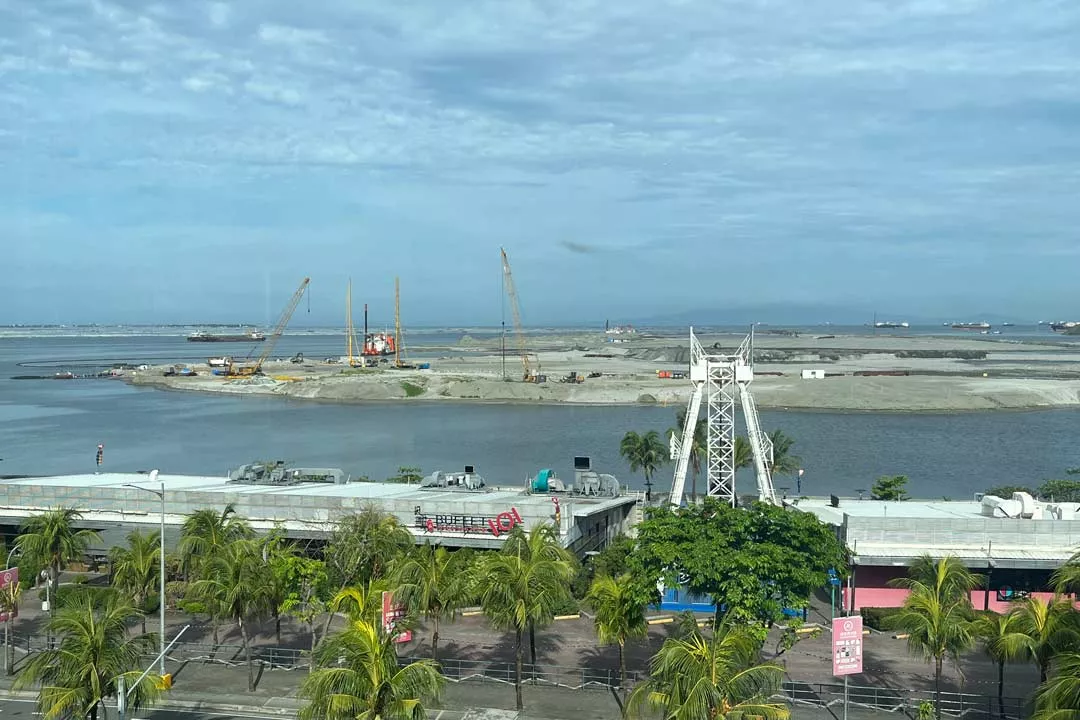
CRISIS GROUP / Georgi Engelbrecht
The Philippines is trying to modernise its military against the backdrop of growing U.S.-China rivalry, rising tensions with China in the South China Sea and deepening worries about the possibility of war over Taiwan. As it presses forward to improve its capabilities and reconfigure its military to fit the threat environment, Manila will face diplomatic tests as well. On one hand, it will need to cultivate the Trump administration in order to build as much confidence as possible in the 1951 mutual defence treaty’s continued viability. On the other, it will need to reassure China that, as it works to protect its interests, it is not seeking to escalate tensions with Beijing or upend the status quo around Taiwan. In working to strike this balance, the Marcos, Jr. administration can contribute both to Philippine interests and regional stability – and help create a template for its successors to do the same.
Manila/Washington/Brussels, 12 August 2025




Leave a Reply