

Myanmar’s Dangerous Drift: Conflict, Elections and Looming Regional Détente
nalberti
Fri, 07/18/2025 – 00:00

Myanmar’s Dangerous Drift: Conflict, Elections and Looming Regional Détente
What’s new? Changing global and regional conditions are giving Myanmar’s military regime greater room for manoeuvre. Growing diplomatic fatigue in Western capitals, China’s moves to prevent regime collapse, shifts in U.S. policy and other geopolitical realignments are hastening normalisation of relations with Naypyitaw’s rulers, despite worsening conflict.
Why does it matter? As geopolitical shifts give neighbouring countries more latitude to engage Naypyitaw, Myanmar’s conflict and humanitarian crisis could face ever greater neglect. Planned elections will lack credibility and may lead to further violence, even as they could encourage some governments to normalise ties with a future military-backed administration.
What should be done? Diplomats should preserve multilateral coordination on Myanmar, above all at the UN Security Council and Association of Southeast Asian Nations, and be ready to seize any opening for a peaceful settlement. They should avoid conferring legitimacy on the regime’s elections, while donors should sustain humanitarian and other vital programming.
Myanmar’s military regime is discovering new diplomatic opportunities as global and regional politics shift. China’s recent moves to prevent the junta’s collapse, diminishing Western interest, chaotic U.S. foreign policy and regional fatigue with a protracted conflict are reshaping the international environment. These trends have led to a gradual thaw in relations between many Asian countries and Naypyitaw, even as the regime continues to lose ground in the post-2021 coup conflict and humanitarian conditions worsen. Elections planned for late in the year will not resolve the political impasse and will likely be violent, but they may offer a convenient pretext for some governments to deepen engagement with the junta. Instead of rushing to recognise the country’s military rulers, foreign powers should preserve what limited space remains for coordinated diplomacy on Myanmar, particularly at the UN Security Council and Association of Southeast Asian Nations (ASEAN), standing ready to seek a peaceful settlement if the opening arises but not conferring unwarranted legitimacy on the forthcoming polls.
Over four years after the 2021 coup that plunged Myanmar deeper into civil war, the military continues to lose territory to its foes, in particular some of the country’s larger ethnic armed groups. Despite some limited counteroffensives, regime forces remain overstretched and under pressure on several fronts. Meanwhile, humanitarian conditions are deteriorating, compounded by the devastating earthquake that struck the north of the country in March. As the number of civilians requiring humanitarian assistance keeps increasing, international funding is falling far short of needs, especially now that global aid budgets have tightened following U.S. President Donald Trump’s decision to abolish USAID. Some of Myanmar’s most vulnerable populations are receiving little or no assistance, particularly in areas controlled by ethnic armed groups.
Despite adversities on the battlefield and public hardship, the military regime’s prospects appear brighter – in large part because of China’s more assertive role. After a series of successful military offensives by opposition forces, Beijing intervened in August 2024 to stabilise the regime, boosting its diplomatic and military support and restraining some of Naypyitaw’s enemies. Other neighbouring states took China’s backstop as their cue to boost high-level contacts with Naypyitaw on the assumption that it would make the military rulers less likely to fall. Eroding U.S. leadership on democracy and human rights has also helped reduce the political cost for regional powers seeking to normalise ties with the junta. Many now see little to gain from prolonged diplomatic isolation of the regime. They are likely to re-establish normal relations with whatever administration emerges from the elections the junta plans to hold at year’s end.
The planned elections … will not resolve Myanmar’s political crisis or reduce the intensity of the armed conflict.
But the fundamentals remain unchanged. The planned elections, which will not be credible, will not resolve Myanmar’s political crisis or reduce the intensity of the armed conflict. Instead, they are likely to harden political divisions, and they could well trigger new waves of violence as the regime tries to ensure secure conditions for voting while resistance forces fight back. At the same time, Myanmar’s state failure is generating risks that extend beyond the country. These include border instability and migrant and refugee flows, the resurgence of communicable diseases – including HIV, tuberculosis and malaria – and a boom in illicit activities by transnational organised crime syndicates that have established themselves in the country, as well as environmental degradation linked to unchecked natural resource exploitation.
Diplomatic efforts should focus on preserving what space for multilateral coordination on Myanmar remains – particularly at the UN Security Council – and on avoiding steps that would confer undeserved legitimacy on a flawed electoral process. A coordinated approach would enable the Council to respond more decisively to any future deterioration in Myanmar, whether involving violence around the elections or increased regime attacks on civilians, as well as to capitalise on any future opportunities to promote an inclusive political process. China, the country with the most influence in Myanmar, should jettison its go-it-alone approach – which has not helped achieve its objectives of stability and security for its border or investments – and engage more actively with other governments on the Council as well as regional forums. For its part, ASEAN, whose chair rotates annually, should strive for greater policy continuity. Appointing a multi-year envoy could be a useful first step toward more sustained, consistent engagement that can bridge the pre- and post-election periods.
Given the population’s immense needs, donors should also ensure that aid reaches the civilians affected by Asia’s most deadly conflict. To do so, they should look beyond dwindling traditional aid allocations and use innovative approaches to sustain critical programming. Expanding the role of international financial institutions in aid delivery and leveraging their resources, as in other conflict settings, is one avenue to explore. Tapping non-aid budgets – for example, to address transnational crime or better understand the links between Myanmar’s political and conflict dynamics and critical minerals supply chains – is another. At a time of shrinking resources, high-impact, low-cost interventions are essential: funding for community health, education and vernacular media, as well as technical support for non-state governance structures emerging in various parts of the country, can deliver tangible benefits at modest expense. Instead of succumbing to frustration, foreign powers should stand ready to respond to the humanitarian emergency and seize any diplomatic opportunity to prise open Myanmar’s deadlock.
More than four years after the coup, the regime is much less diplomatically isolated than even a year ago, when Russia was its only major ally.[1] The shift began with Beijing, which moved to bolster the regime in August 2024 in a bid to prevent its disorderly collapse in the face of rebel offensives. China’s pivot – along with widespread diplomatic fatigue with the apparent stalemate in Myanmar – prompted other regional powers to adjust their relations with the military regime, including neighbours India and Thailand, as well as Malaysia in its capacity as rotating chair of ASEAN for 2025.
[1] For details of the relationship, see Crisis Group Asia Briefing N°173, Coming to Terms with Myanmar’s Russia Embrace, 4 August 2022. For other analysis of events since the coup, see Crisis Group Asia Briefings N°s166, Responding to the Myanmar Coup, 16 February 2021; 167, The Cost of the Coup: Myanmar Edges Toward State Collapse, 1 April 2021; 168, Taking Aim at the Tatmadaw: The New Armed Resistance to Myanmar’s Coup, 28 June 2021; 170, The Deadly Stalemate in Post-coup Myanmar, 20 October 2021; 171, Resisting the Resistance: Myanmar’s Pro-military Pyusawhti Militias, 6 April 2022; 174, Breaking Gender and Age Barriers amid Myanmar’s Spring Revolution, 16 February 2023; 175, A Road to Nowhere: The Myanmar Regime’s Stage-managed Elections, 28 March 2023; 177, Treading a Rocky Path: The Ta’ang Army Expands in Myanmar’s Shan State, 4 September 2023; 179, Scam Centres and Ceasefires: China-Myanmar Ties Since the Coup, 27 March 2024; 180, Ethnic Autonomy and its Consequences in Post-coup Myanmar, 30 May 2024; 181, Disquiet on the Western Front: A Divided Resistance in Myanmar’s Chin State, 19 March 2025; and 182, A Rebel Border: India’s Evolving Ties with Myanmar after the Coup, 11 April 2025; as well as Crisis Group Asia Reports N°s314, Myanmar’s Military Struggles to Control the Virtual Battlefield, 18 May 2021; 319, Myanmar’s Coup Shakes Up Its Ethnic Conflicts, 12 January 2022; 325, Avoiding a Return to War in Myanmar’s Rakhine State, 1 June 2022; 328, Crowdfunding a War: The Money behind Myanmar’s Resistance, 20 December 2022; 330, A Silent Sangha? Buddhist Monks in Post-coup Myanmar, 10 March 2023; 332, Transnational Crime and Geopolitical Contestation along the Mekong, 18 August 2023; 339, Breaking Away: The Battle for Myanmar’s Rakhine State, 27 August 2024; and 348, The Dangers of a Rohingya Insurgency, 18 June 2025.
China had initially declined to back the military regime that seized power in February 2021, viewing the coup as damaging its strategic interests and imperilling its large investments in Myanmar. China was also unhappy with commander–in-chief and coup leader Min Aung Hlaing, whom it viewed as incompetent, harbouring anti-China sentiments and insufficiently cooperative in addressing Beijing’s main concerns – particularly regarding scam centres that were trafficking and defrauding large numbers of Chinese citizens.[1]
As a result, Beijing permitted the first-ever UN Security Council resolution on Myanmar to pass in December 2023 and did not push for the regime to get a UN ambassador, instead allowing the incumbent – who has sided with the regime’s opponents – to remain in place. China also declined to invite Min Aung Hlaing to Beijing, despite persistent regime lobbying. In addition, Beijing gave its tacit backing to a 2023 rebel offensive in Shan State – the Three Brotherhood Alliance’s Operation 1027 – that routed regime forces and gave the rebels control of vast swathes of territory, including areas that were being used by scam syndicates.[2] China was pleased that ethnic armed groups with which it had good relations had taken over areas in Shan State adjacent to the Chinese border, hoping that they would put an end to the scam centres operating there.
Even so, and irritated as Beijing was with Naypyitaw, it had never intended to trigger an existential threat to the regime when it greenlighted Operation 1027. But by mid-2024 – particularly after Lashio, the largest town in northern Shan State, fell in July and, with it, the regional military command – Beijing’s assessment was that the junta could disintegrate in a matter of months.[3] Such a disorderly demise was something Beijing wanted to avoid, largely because of the uncertainty over what would come next, and because China sees much of the resistance – particularly the National Unity Government (NUG) – as too close to the West.[4]
To stave off the regime’s collapse, China threw it a lifeline. It stepped up diplomatic support, sending Foreign Minister Wang Yi to Naypyitaw in August 2024 to meet Min Aung Hlaing for the first time since the coup.[5] The junta leader then visited China in November, an invitation he had been pushing for since he seized power – though it was to a regional summit in Kunming rather than a bilateral visit to Beijing, and he did not meet the Chinese president, Xi Jinping.[6] That coveted meeting eventually came in Moscow on 9 May 2025, when Xi agreed to speak with Min Aung Hlaing on the sidelines of Russia’s Victory Day celebrations.[7]
[1] For details, see Crisis Group Report, Scam Centres and Ceasefires, op. cit.
[2] Ibid.
[3] Crisis Group interview, Chinese analyst, September 2024. The fall of Lashio to resistance forces marked the first time the Myanmar military had lost a regional command headquarters since independence.
[4] See Crisis Group Briefing, Scam Centres and Ceasefires, op. cit., Section V. The NUG is a parallel administration appointed by elected lawmakers who were ousted in the 2021 coup, which operates mostly from exile.
[5] “Chinese FM: China supports early political reconciliation in Myanmar, to deepen bilateral cooperation”, Xinhua, 15 August 2024.
[6] “China welcomes Myanmar’s embattled leader on first visit since coup”, BBC, 6 November 2024.
[7] “Myanmar backs China’s vision for shared future and regional cooperation”, Global New Light of Myanmar, 10 May 2025.
China applied intense pressure on armed groups in northern Myanmar to halt their offensives.
China provided military support to the regime, transferring six fighter jets and other equipment in August 2024.[1] In addition, China applied intense pressure on armed groups in northern Myanmar to halt their offensives, securing a January 2025 ceasefire between the regime and the Myanmar National Democratic Alliance Army (MNDAA), an ethnic Kokang armed group which is part of the Three Brotherhood Alliance.[2] China is now mediating talks with other armed groups in northern Myanmar.
Beijing’s most striking intervention to date was brokering the MNDAA’s handover of Lashio back to the regime in April 2025. As the capital of northern Shan State and its most important economic hub, Lashio was the biggest prize in the MNDAA’s campaign against regime forces, not least because the group had managed to take control of the military’s regional command centre – the first to fall to opposition forces in Myanmar’s history. Having expended great effort and resources and suffered heavy casualties in the town’s capture, the group was extremely reluctant to give it up.[3] The fact that it eventually did so is testament to Beijing’s leverage. The MNDAA also gained substantial benefits from the deal, which confirmed its de facto control of swathes of territory it had gained since late 2023, extending well beyond the borders of the historical Kokang territory up to the Lashio town limits.[4] The group is now well placed to punish the regime should it violate the ceasefire, for example by bombing MNDAA-held towns.
Despite losing Lashio, the MNDAA thus emerged from the deal with far firmer control of a large part of northern Shan State. For the regime, it was a humiliating demonstration of both its military weakness and the extent of Beijing’s influence. Probably for that reason, Myanmar state media has made no mention of the ceasefire (it also never acknowledged the loss of the city) and, following the deal, the regime reportedly warned its top brass not to criticise China.[5]
China went much further than it has in the past to ensure that the deal would stick. Previous ceasefires that it brokered have collapsed, including the January 2024 agreement, which the MNDAA and other members of the Three Brotherhood Alliance broke when they launched phase two of Operation 1027 in June that year. There were also indications that the MNDAA hoped it might be able to stall implementation of the current deal: in the weeks leading up to the deadline for the transfer of Lashio, the group was still expanding its administrative apparatus in the town, including by establishing taxation schemes.[6]
To oversee the handover and make sure it succeeded, Beijing dispatched a high-level civilian “observer team”, headed by Chinese special envoy for Myanmar Deng Xijun. The presence of the Chinese team, which was in Lashio only briefly, helped underwrite a fraught and logistically complex transfer of authority. The delegation had to travel overland through contested territory, demonstrating Beijing’s leverage over the different parties, as well as the importance of the ceasefire to the Chinese authorities and the great embarrassment that a breakdown might cause.[7]
China’s more interventionist posture, meanwhile, has pushed it further into Myanmar’s crisis, and its involvement is likely to deepen. A key immediate goal is to reopen Myanmar-China border trade via the main Mandalay-Lashio-Muse highway, important for Myanmar’s economy and equally so for the economy of neighbouring parts of China.[8] Only a small fraction of the route remains under regime control (see the map below). The rest is held by the MNDAA, the Ta’ang National Liberation Army (TNLA), the Kachin Independence Organisation (KIO) and the Shan State Progress Party (SSPP), all of whom operate fee-collecting checkpoints along the road.[9] Of these, only the MNDAA has a ceasefire with the regime.[10]
[1] “Myanmar junta receives six more Chinese warplanes amid deadly airstrikes on civilians”, The Irrawaddy, 30 September 2024.
[2] “Myanmar insurgents call ceasefire after Chinese pressure for peace”, Radio Free Asia, 4 December 2024; “Myanmar military, minority armed group agree ceasefire, China says”, Reuters, 20 January 2025.
[3] Crisis Group interviews, Myanmar analysts, January-May 2025.
[4] Ibid.
[5] “Lashio situation: Military chief warns against criticizing a benevolent China”, Democratic Voice of Burma, 21 April 2025 [Burmese].
[6] Crisis Group interview, Lashio resident, March 2025. “Uncertain fate: Lashio rebuilds as questions of control loom”, Frontier Myanmar, 28 February 2025.
[7] The Chinese delegation travelled on the Chinshwehaw-Kunlong-Hseni-Lashio road, which is in the hands of the MNDAA but runs very close to contested territory – different parts of which are controlled by the Ta’ang National Liberation Army (TNLA), the Kachin Independence Organisation (KIO) and regime forces – that has been subject to sporadic air attacks by the regime. Crisis Group interviews, Myanmar analysts, Chiang Mai, May 2025. See the map in Appendix A.
[8] Crisis Group interviews, Myanmar analysts, Chiang Mai, May 2025. For more details and analysis, see “Subcontracting Sovereignty”, Institute for Strategy and Policy-Myanmar, May 2025.
[9] Ibid.
[10] The SSPP’s status is ambiguous. Its 2012 ceasefire has never been formally abrogated, but it has partially broken down, with clashes with the Myanmar military both before and after the coup. But the group attended a recent regime-convened peace forum. “SPTT engages in peace talks with UWSP, NDAA, and SSPP delegations”, Global New Light of Myanmar, 21 July 2023.
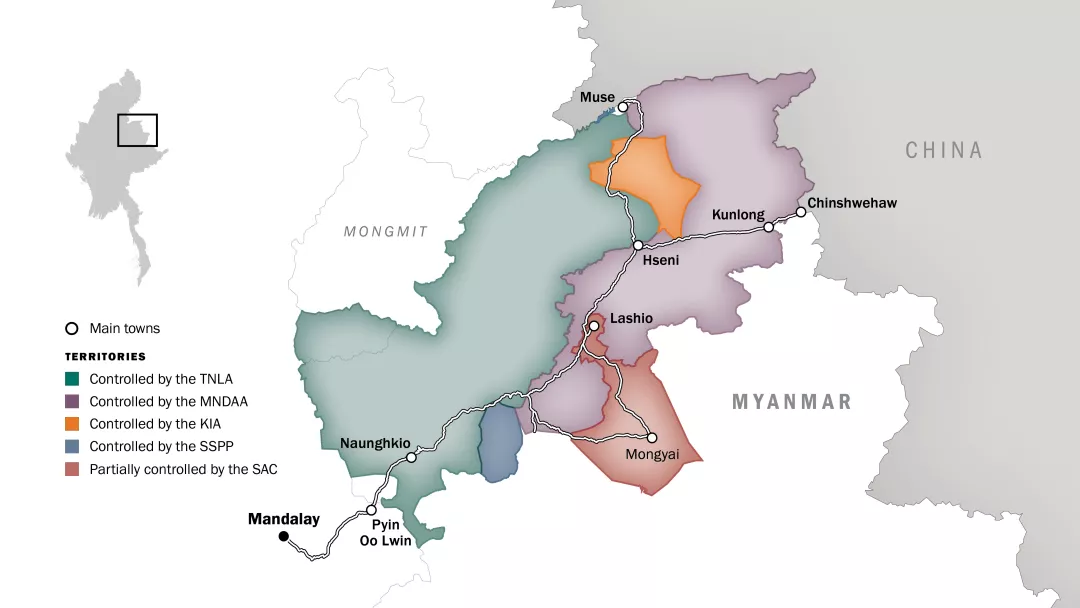
Source: Adapted from a map originally published by the Institute for Strategy and Policy–Myanmar, “Subcontracting Sovereignty”, with permission, May 2025. CRISIS GROUP
Beijing faces greater challenges in brokering accords with the others, both because it has somewhat less leverage over these groups, and because the regime is unwilling to make major concessions to them as they do not hold prizes of the same value as Lashio. For these reasons, China-sponsored talks between the regime and the TNLA in Kunming in late April 2025 ended without agreement, with the next round of talks slated for early August.[1] According to the TNLA, the regime demanded that the group withdraw from five key towns it has captured over the last year without offering anything in return, other than a ceasefire.[2]
Beyond reopening the border trade route, Beijing is keen to restart its ambitious China-Myanmar Economic Corridor project, an important component of its Belt and Road Initiative that includes everything from a planned highway and high-speed railway connecting south-western China to the Indian Ocean to special economic zones.[3] But progress will require a level of stability and security that does not exist at present, as the corridor passes through other war-torn areas, including the central Dry Zone and Rakhine State.
[1] Crisis Group interviews, Myanmar and international analysts, May 2025.
[2] Telegram post by TNLA, @taangtv2023, 2 May 2025. The regime has not given its own readout of the talks. The five towns in question are Nawnghkio, Kyaukme, Hsipaw and Mongmit in northern Shan State, as well as Mogok in Mandalay Region.
[3] Crisis Group interview, Chinese academic close to government thinking, June 2025. See also Crisis Group Report, Commerce and Conflict, op. cit.
China’s move to prevent the regime from collapsing has led other countries in the region to shift their diplomatic postures, discounting the risk of regime failure and engaging more proactively with Naypyitaw. India, for instance, has adjusted its diplomatic approach to strengthen ties with the regime, culminating in a face-to-face meeting between Prime Minister Narendra Modi and Min Aung Hlaing on the sidelines of a Bay of Bengal Initiative for Multi-Sectoral Technical and Economic Cooperation (BIMSTEC) summit in Bangkok on 4 April 2025.[1]
Min Aung Hlaing also had bilateral meetings with all of the other heads of state and government in attendance (Bangladesh, Bhutan, Nepal, Sri Lanka and Thailand), marking a notable broadening of his high-level contacts since the coup. As chair, Thailand had postponed the summit, initially planned for November 2023, when its invitation to Myanmar’s military leader caused concern within the Thai foreign policy establishment over diplomatic pushback from others in BIMSTEC and beyond.[2] China’s invitation to Min Aung Hlaing to attend another regional meeting in Kunming in November 2024 (see Section II.A above) likely helped put minds in Bangkok at ease.
[1] “Modi meets Myanmar junta chief for first time in four years”, Bloomberg, 4 April 2025. BIMSTEC is a regional body focused mainly on trade and economic cooperation among its member countries. For a detailed account of India’s post-coup policy shift and how it has been affected by China’s approach, see Crisis Group Report, A Rebel Border, op. cit.
[2] Thailand decided to postpone the meeting rather than disinvite the regime. Crisis Group interviews, regional analysts, October 2023. “Thailand postpones regional summit to which Myanmar junta boss invited”, The Irrawaddy, 9 October 2023.
The March 2025 Sagaing earthquake … gave cover to regional leaders’ increased engagement with the junta.
The March 2025 Sagaing earthquake, which according to regime statistics killed more than 3,700 people and caused widespread damage to housing and infrastructure, also gave cover to regional leaders’ increased engagement with the junta.[1] Although the BIMSTEC summit was planned long before the earthquake and had been due to include Min Aung Hlaing’s participation, the disaster made it less controversial for regional leaders to meet with the regime leader. The day after the summit, the Malaysian and Thai foreign ministers visited Naypyitaw to assess the impact – breaking, or at least weakening, ASEAN’s moratorium on political-level engagement with the regime.[2]
Less than a fortnight later, Min Aung Hlaing again travelled to the Thai capital to meet Malaysian Prime Minister Anwar Ibrahim, in his capacity as rotating chair of ASEAN, together with Thaksin Shinawatra – the Thai political heavyweight and former prime minister, whom Anwar appointed as his special adviser on ASEAN affairs during Malaysia’s chairmanship of the regional grouping.[3] Anwar also held a video call with the NUG prime minister, Mahn Winn Khaing Thann, the highest-level contact so far between the regional bloc and the parallel government.[4] The public readouts afterward focused on the need for ceasefires in order to bolster post-earthquake relief operations, but the meetings were also part of a Malaysian attempt to assess opportunities for conflict de-escalation and political mediation.[5]
The change in government in the U.S. has also given the region a freer hand to engage the regime and greater incentives to do so. The Trump administration has not expressed any discernible interest in Myanmar so far, other than in the context of tariffs. Myanmar was one of fourteen countries that Trump sent letters to on 7 July 2025, informing them of new tariff rates (of 40 per cent, in the case of Myanmar).[6] The letter was addressed to Min Aung Hlaing as regime leader, the first public recognition of the regime by Washington. Min Aung Hlaing seized on this opportunity, writing a long, flattering response to Trump on 9 July calling for an end to U.S. sanctions and offering to send a high-level tariff negotiation team to Washington.[7]
[1] “Global aid pours into Myanmar as quake toll hits 3,752”, Global New Light of Myanmar, 15 June 2025. The World Bank estimates the direct losses from the earthquake at $11 billion and projects a 4 per cent hit to economic growth in 2025. “Myanmar Economic Monitor: Economic Aftershocks”, World Bank, June 2025.
[2] “Thailand joins ASEAN effort to aid Myanmar quake victims”, The Nation, 8 April 2025. Exceptions to the moratorium initiated after the 2021 coup have included visits of ASEAN special envoys, good offices efforts by ASEAN chairs – such as former Cambodian Prime Minister Hun Sen’s controversial visit to Naypyitaw in January 2022 – and bilateral defence engagements that have been framed as security-focused rather than political, even when they involved top members of the regime.
[3] Crisis Group interviews, Thai official and regional analyst, Bangkok, May 2025.
[4] Ibid.
[5] Ibid.
[6] “Trump announces new tariffs of up to 40% on a growing number of countries”, CNN, 8 July 2025.
[7] “SAC Chairman and Prime Minister Senior General Min Aung Hlaing responds to US President Donald Trump on reduced tariff rates for Myanmar”, Global New Light of Myanmar, 11 July 2025.
The decimation of USAID and gutting of democracy promotion activities have been well received in Naypyitaw.
Meanwhile, the decimation of USAID and gutting of democracy promotion activities have been well received in Naypyitaw, giving the regime the sense that the U.S. is no longer pushing back against it or impeding relations between Naypyitaw and countries in its neighbourhood.[1] The NUG and other democratic forces, on the other hand, have been left reeling, not only at the cuts to financial support but also at the more intangible loss of an ideological anchor point that had reassured them that their struggle had supremely powerful backing.[2] As a result, observers sense even more strongly that the NUG is adrift while its leader remains incarcerated (see Section II.C below).[3]
More to the point, Trump’s chaotic tariff rollout and apparent willingness to undermine traditional alliances has left the region struggling to navigate new economic and geopolitical uncertainties. In these conditions, some regional leaders feel that they cannot afford to be distracted by interminable policy debates over Myanmar. They would prefer to normalise relations in order to be able to focus on other, more pressing issues.[4]
In the fifth year of his regime, Min Aung Hlaing is feeling emboldened by creeping diplomatic normalisation and a geopolitical environment that the junta leader finds far more conducive. Russia, once the military regime’s sole ally, even appears confident enough to upgrade their relationship. Making a first-ever formal state visit to Russia in March, Min Aung Hlaing’s was given the full red-carpet treatment by President Vladimir Putin (and subsequently in Belarus by President Aleksandr Lukashenko).[5]
China’s moves to buttress the regime, the earthquake and new geopolitical uncertainties, along with assessments that the military is on balance likely to endure, have all pushed the diplomatic centre of gravity in the region toward greater engagement with the Myanmar regime. Yet full normalisation remains unlikely for the moment. The regime has indicated it will hold elections in late December 2025, which means that most countries will probably wait until the new administration has taken over, around April 2026, before resuming routine political-level engagement. They do not expect the elections to be credible or the resulting administration to be legitimate. But the return of a nominally civilian authority will provide them with diplomatic cover, and a more fitting moment, for a reset in relations.[1]
It is inconceivable that regime-held elections could have any credibility. None of the most popular opposition parties will participate, with some refusing to register for the polls under current circumstances while others have had their registrations rejected by the regime’s election commission. The former category includes the National League for Democracy – whose landslide win in the 2020 elections triggered the coup – which refused to register and whose leader, Aung San Suu Kyi, has been imprisoned incommunicado since the military takeover. The Shan Nationalities League for Democracy, which came in third in 2020, also declined to register for the polls, and the Arakan National Party, which represents the Rakhine ethnic group, was denied registration by the authorities on the grounds that it is linked to the Arakan Army, which the regime has designated a terrorist organisation.[2] Any existing party that did not register by a March 2023 deadline, or whose registration is refused, is illegal in the regime’s eyes and must be dissolved on the orders of the election commission.
[1] Ibid.
[2] The military-established Union Solidarity and Development Party came in second. “SNLD stands firm against junta-led elections: An interview with SNLD spokesperson”, Shan Herald Agency for News, 15 May 2025; statement by Union Election Commission, 1 July 2024; and Richard Horsey, “Another Landslide Victory for Aung San Suu Kyi’s Party in Myanmar – But at What Cost?”, Crisis Group Commentary, 12 November 2020.
Even if the [Burmese] authorities limit elections to relatively secure areas, the process will likely be violent.
Regime-held elections will also cover only a fraction of the territory and eligible voters, because the regime has lost control of swathes of the country, and many areas will be too insecure for campaigning and voting to take place. Even if the authorities limit elections to relatively secure areas, the process will likely be violent, with the military using force to ensure that the polls go ahead as planned while its opponents try to disrupt them. The October 2024 census provides some indications of what to expect. According to the official results, almost 40 per cent of the population lives in areas that could not be enumerated.[1] Beyond the regime’s lack of territorial control and struggles to achieve security, the difficulty in recruiting census staff, as well as equipment shortages and malfunctions, meant that even in areas where authorities attempted to conduct a head count, many people were not reached.[2] All these challenges are likely to be more severe for the elections, which are both more complex to organise logistically and more politically controversial than the census.
Against this backdrop, the regime appears set to hold the polls in phases over several weeks, with different parts of the country voting on different days, rather than the traditional practice of the entire country voting on a single day.[3] This arrangement would allow the regime to focus its limited security, administrative and logistical capacity on smaller areas at a time. The regime has likely learnt this lesson from the experience of the census, which was supposed to be carried out from 1-15 October 2024, but eventually continued into January 2025.[4]
Despite the prospect of polls being violent, lacking credibility and offering no way out of Myanmar’s crisis, several countries in the region have been pushing for – or offering support to – a regime-held ballot. China has been pressing particularly hard, suggesting that it sees the elections as a quid pro quo for the lifeline it has thrown the junta.[5] For Beijing, the polls’ importance lies not in any popular consultation function, but rather because holding them requires an end to the state of emergency and a return to the greater predictability of the constitutional order. It also entails a dilution of Min Aung Hlaing’s authority given that the military-drafted 2008 charter divides power among several individuals, notably the president, commander-in-chief and parliamentary speaker.
[1] “2024 Population and Housing Census: Provisional Results”, Myanmar Department of Population, December 2024. Enumeration refers to the process of counting the number of residents in a given area.
[2] Crisis Group interview, international analyst with census expertise, January 2025.
[3] “267 of 330 townships designated for holding election, says Union Election Commission official”, Popular News Journal, 9 June 2025 [Burmese]. While most elections in Myanmar have been conducted on a single day, there is a precedent for phased polls. In 1951-1952, the election was held over a ten-month period due to poor security. Turnout was very low (around 20 per cent) and many areas did not vote at all due to conflict. See Robert H. Taylor, The Politics of Elections in Southeast Asia (Cambridge, 1996), ch. 7.
[4] Crisis Group interview, international analyst with census expertise, January 2025.
[5] Crisis Group interviews, diplomats and analysts, May 2025.
Other countries in the region … feel that given a choice between elections or a continuation of the status quo, they prefer the former.
Beijing would prefer to deal with a nominally civilian government and, if possible, with someone other than Min Aung Hlaing, whom it sees as harbouring anti-Chinese sentiments.[1] Other countries in the region, including India and Thailand, feel that given a choice between elections or a continuation of the status quo, they prefer the former, on the basis that some change is better than no change.[2]
For Min Aung Hlaing, the elections are politically risky for the same reasons that they are attractive to Beijing. He has remained unchallenged as leader since the coup, concentrating power in his own hands despite presiding over a period of political and economic turmoil – not to mention unprecedented battlefield losses for the military. Giving up some of that power brings with it risks. There is well-known unhappiness in military-elite circles with his leadership, which many see as indecisive and at times incompetent, and considerable resistance to the prospect of him being dictator for life.[3] The discontent is driving elite pressure for elections, which provide a mechanism for limiting his writ, either via the military-backed Union Solidarity and Development Party (USDP), which will likely do well in the elections and over which he has only partial control, or through the influence of other powerful individuals over who will hold key posts in the new administration.
Even if Min Aung Hlaing can find a formula to limit the threats the elections present to his sway – a suitably compliant commander-in-chief, if he decides to be president, or a proxy president, if he decides to keep his military leadership role – he may not get the deference he would need from all parts of the state in order to carry out his plan.
That said, three novel features of the electoral system in these polls could give Min Aung Hlaing a greater degree of influence over the outcome. First, the use of proportional representation – even if only in the upper house – makes it less likely that a single party will emerge dominant.[4] The military, with its 25 per cent bloc of reserved seats, could therefore wind up being kingmaker in the legislature.[5] Secondly, a phased election spread over several weeks would allow the junta leader to monitor the results along the way, interceding to fraudulently influence voting in the next phase if things were not going his way. Thirdly, the electronic voting system – designed in Myanmar and manufactured in India – lacks even basic integrity, audit or security features; it could thus be easier to manipulate than the system of physical ballot papers that it is replacing.[6]
[1] Ibid.
[2] Crisis Group interviews, regional diplomats and analysts, September 2024-May 2025.
[3] Crisis Group Report, Ethnic Autonomy and its Consequences, op. cit., Section III.B.
[4] While the regime has yet to issue detailed electoral rules, the election commission has suggested that proportional representation will be used for the upper house and that the first-past-the-post system will be retained for the state/region legislatures. In a proportional representation system of the kind that Myanmar will likely use, each constituency has multiple seats, which are allocated proportionally according to party vote shares. In the first-past-the-post system used in all previous elections, the winner in each constituency earns the single seat in question. Crisis Group interviews, political party representatives and electoral experts, January-February 2023 and May 2025.
[5] The 2008 constitution grants the military an unelected bloc of 25 per cent of seats in all legislatures. Thus, a party needs to win more than two thirds of elected seats to have an overall majority.
[6] Crisis Group interviews, Myanmar analysts, May 2025.
It is … not impossible that the junta could postpone the polls.
It is also not impossible that the junta could postpone the polls. The regime has suggested that it would hold elections before, in mid-2023, only to push them back.[1] The delay required an unconstitutional extension to the state of emergency and was driven by Min Aung Hlaing’s concerns that elections might weaken his grip on power.[2] At any time up to polling day, he could decide to do so again. Still, it seems unlikely he will do so given his administration’ regular references to the polls in recent months and the detailed preparations being made by the regime’s electoral commission, as well as China’s insistence that the vote be held.
Under the constitution, the state of emergency must first be lifted for elections to take place, at which point the country’s peak security body – the National Defence and Security Council – needs to appoint an interim government, with elections to be held within six months.[3] An interim government will most likely be named at the next scheduled meeting of the council on 31 July. Since the body is dominated by Min Aung Hlaing and his allies, it will do his bidding, meaning that the interim government is likely to be a rebranded version of the current regime administration, still headed by Min Aung Hlaing.
While military-run elections will not result in meaningful pluralism, it is conceivable that they could generate new political conditions in Naypyitaw, especially by diluting Min Aung Hlaing’s power and introducing additional decision-makers, who might compete with one another. But these changes are unlikely to shift the country toward a more peaceful future. The major criticism of Min Aung Hlaing within the military elite is not that he has ended Myanmar’s reformist experiment of the 2010s, but that he has proven incapable of securing post-coup stability and has instead presided over unprecedented battlefield defeats.[4] The imperative after the polls is therefore likely to be to bolster the military rather than to seek compromise with its opponents.
[1] See Crisis Group Report, A Road to Nowhere, op. cit.
[2] Crisis Group Report, Scam Centres and Ceasefires, op. cit.
[3] See sections 417, 421(b), 425 and 429 of the 2008 constitution.
[4] Crisis Group interviews, Myanmar analysts, May 2025. See also Crisis Group Report, Ethnic Autonomy, op. cit., Section III.B.
The regime may hope that elections will improve its domestic and international standing by giving rise to a nominally civilian, military-backed administration. But its lack of legitimacy stems not only from its overthrow of a popularly elected government. It is also the result of its failure to govern on behalf of citizens and its loss of control of large swathes of the country since the coup.
Even if elections that lack credibility earn the new administration greater admission into diplomatic circles, it is unlikely to be any more popular than the current regime. For the population of Myanmar, living conditions continue to deteriorate. State failure persists, including collapsed health and education systems – the former already giving rise to surging rates of malaria, HIV and tuberculosis. So, too, does the economic malaise, which is driving high rates of labour migration.[1] The fracturing of the state is also accelerating transnational criminal activities such as drug production, scam centres and money laundering, as well as unregulated natural resource exploitation that devastates the environment and damages livelihoods.[2]
The earthquake has further undermined the regime domestically. As mentioned, the destruction was concentrated in regime-held areas, including the capital Naypyitaw. Its disaster response was woefully inadequate, with no sign of contingency plans devised in the wake of earlier disasters being activated.[3] Its own civil servants in the capital – many of whose homes were damaged or destroyed – were mostly left to fend for themselves; three months on, in the middle of the monsoon, many are still sleeping in tents.[4]
Any reconstruction effort looks likely to be chaotic and chronically underfunded. While local networks and international agencies have been reasonably effective at meeting acute humanitarian needs in the earthquake’s immediate aftermath, there is little funding available for the recovery phase – rebuilding livelihoods and restoring basic services.[5] Women and girls have been disproportionately affected by the quake and remain more vulnerable in its aftermath.[6] These repercussions of the disaster further undermine the regime’s credibility and weaken the state machinery that it uses to impose its rule.
Humanitarian needs are not limited to earthquake-affected areas but are to be found across the country due to post-coup armed conflict and economic decline. Given the global funding crunch, however, very little aid is available for such programming in Myanmar: almost halfway into the year, the $1.1 billion 2025 humanitarian response plan is only 12 per cent funded, and the $275 million flash appeal for the earthquake response, only 51 per cent.[7] Non-traditional donors – notably China and India – have given generously, but mostly through regime channels, with the money apparently being used mainly for the earthquake response in Naypyitaw.[8]
[1] See “Myanmar Public Health Situation Analysis”, World Health Organization, December 2024; and “Myanmar Economic Monitor”, World Bank, op. cit.
[2] Crisis Group Report, Transnational Crime and Geopolitical Contestation, op. cit.
[3] Richard Horsey, “Support Vital for Myanmar’s Quake Victims, Despite Military Obstacles”, Crisis Group Commentary, 1 April 2025.
[4] “Down and out: Junta offers scant help to homeless civil servants”, Frontier Myanmar, 10 April 2025; and “Situation in Naypyitaw three months after the quake”, BBC Burmese, 28 June 2025 [Burmese].
[5] “Myanmar earthquake response: Situation Report no. 7”, UN Office for the Coordination of Humanitarian Affairs, 31 May 2025.
[6] “Myanmar Earthquake: Gender Situation Report No. 1”, UN Women, 13 May 2025.
[7] UN Office for the Coordination of Humanitarian Affairs, Financial Tracking Service, 3 June 2025.
[8] Crisis Group interviews, aid agency officials and Myanmar analysts, May-June 2025. See also “Down and out: Junta offers scant help to homeless civil servants”, op. cit. The regime stated that as of mid-June, China had given 1.1 billion renminbi in assistance (about $150 million). “Myanmar firmly upholds One-China policy”, Global New Light of Myanmar, 9 June 2025. On Indian aid, see Crisis Group Report, A Rebel Border, op. cit., Section IV.B.
The forthcoming polls are also unlikely to shift Myanmar’s battlefield realities, either by boosting the military’s capabilities or by weakening those of its opponents. The military may anticipate that a nominally civilian government will be in a better position to reach ceasefire deals with some of its opponents, relieving the pressure it faces. But this outcome is far from certain.
While the military has been given breathing space by China’s move to prevent regime collapse and reach ceasefires with some of its main armed opponents, it is proving unable to regain momentum due to the strength and determination of its adversaries, the large number of fronts it is fighting on and poor morale in the ranks. Where it is confronting powerful ethnic armed groups, it continues to suffer humiliating defeats; in the few areas where it is attempting limited counteroffensives, it is having mixed success. Even in areas such as the central Dry Zone, where it is battling multiple but small, lightly armed and poorly coordinated resistance groups, it is unable to re-establish control.
Across much of the country, the military is struggling to hold on to key locations, particularly where it is pitted against the country’s larger ethnic armed groups. In Rakhine State the regime has been unable to mount any kind of counteroffensive against the Arakan Army, and it appears to be steadily losing the battles for the slivers of territory it still holds – the state capital Sittwe, a small part of Kyaukpyu township and Munaung Island.[1] Arakan Army forces are within about 5km of Kyaukpyu town, and they could soon overrun it, which would allow the group to concentrate its forces on Sittwe.[2] The group and its proxies – post-coup resistance forces to which it provides training, arms and embedded fighters and officers – have also been pushing across Rakhine State’s borders into Ayeyarwady, Bago, Magway and Sagaing Regions, creating a strategic buffer zone between Rakhine and areas under military control in central Myanmar.[3]
In Kachin State, in Myanmar’s far north, regime forces are steadily being pushed back by the Kachin Independence Organisation in key areas. While the regime is attempting to dislodge its forces around Hpakant (see below), the KIO is closing in on the major town of Bhamo, which could fall imminently. Its forces have cut off all land and riverine routes to the town, meaning that supplies and reinforcements for regime troops can only be delivered by air.[4] Air supply is both costly and risky for the regime, as demonstrated by its apparent loss of two MI-17 helicopters on such missions in May 2025 – which the KIO says it downed with ground fire and drones.[5] If the KIO is able to take Bhamo, it would likely be able to reinforce its positions in Hpakant.
[1] Crisis Group Report, Breaking Away, op. cit.; Crisis Group interviews, Myanmar analysts, May 2025.
[2] Crisis Group interviews, Myanmar and international analysts, May-June 2025.
[3] Ibid. On Arakan Army proxy forces in Chin State, see Crisis Group Report, Disquiet on the Western Front, op. cit.
[4] “Kachin rebels seize tank base from Myanmar junta”, The Irrawaddy, 11 February 2025.
[5] “Drone strike destroys Myanmar junta’s crash-landed aircraft”, The Irrawaddy, 22 May 2025.
The military has attempted limited counteroffensives to retake strategic locations lost to ethnic armed groups.
The military has attempted limited counteroffensives to retake strategic locations lost to ethnic armed groups. In Kachin State, it has sent a deployment of a thousand troops to seize back control of the roads leading to the jade mining town of Hpakant. While the town itself is in regime hands, the KIO controls the surrounding area, allowing it to establish checkpoints that impose informal taxes on the lucrative jade trade.[1] The regime wants to block the KIO’s access to these revenues, which the group is using to finance its fight with the regime elsewhere. Regime forces are making slow but steady progress in this effort, but the KIO may yet regain the upper hand (see below). The KIO has also said the regime is preparing an offensive to expel it from lucrative rare earth mines near the Chinese border that are the source of much of the world’s dysprosium and terbium, essential for permanent magnets used in many high-tech and defence applications.[2]
In neighbouring northern Shan State, the military has also been fighting to take back the strategically important town of Nawnghkio from the TNLA. It has succeeded in capturing several TNLA positions close to Nawnghkio, but not yet the town itself.[3] Seizing it would prevent the TNLA from using it as a base from which to threaten the regime’s garrison town of Pyin Oo Lwin, home to the military’s top training academies, and would be the first step in re-establishing road access to Lashio from Mandalay, the country’s second largest city.
Finally, in Kayin State, on the Thai border, regime forces have been battling the Karen National Union (KNU) and allied resistance forces for more than a year in an attempt to reopen the Asian Highway, a key trade route to Thailand, after the KNU seized parts of the Kawkareik-to-Myawaddy stretch of the highway in April 2024. Despite committing more than a thousand troops, the operation to retake the artery and push KNU forces out of the corridor has failed to make much headway, with regular ambushes causing heavy military casualties and hampering reinforcements and resupply.[4] The KNU has sufficient confidence that it can hold off the regime column that it has simultaneously launched a series of successful attacks on a string of isolated military bases adjacent to the Thai border.[5]
[1] “Myanmar junta intensifies effort to retake key roads near Hpakant”, Myanmar Now, 6 May 2025.
[2] “Myanmar junta attacks to reclaim KIA’s jade and rare earth strongholds”, The Irrawaddy, 16 June 2025; and “Why China’s ultimatum to Myanmar rebels threatens global supply of heavy rare earths”, Reuters, 8 July 2025.
[3] “Myanmar junta ‘seizes eight TNLA positions’”, The Irrawaddy, 9 May 2025.
[4] Crisis Group interviews, Myanmar and international analysts, Thailand, May 2025.
[5] “Threading the Needle”, Institute for Strategy and Policy-Myanmar, June 2025.
In the wake of the March 2025 earthquake, many of Myanmar’s warring parties declared unilateral ceasefires, claiming that they would refrain from offensive operations. The NUG was the first, announcing a ceasefire on 30 March, followed by the Three Brotherhood Alliance on 1 April and the KIO on 2 April. Having initially rejected calls for a ceasefire, the regime eventually declared its own on 2 April – shortly before Min Aung Hlaing travelled to Bangkok for the BIMSTEC summit. Some diplomats and observers were hopeful that these announcements would not only pause the fighting but might also lead to a lasting de-escalation or peace settlement.[1]
Neither of these things happened. Notwithstanding the ceasefire proclamations, all sides continued to carry out attacks on their opponents, including in earthquake-affected areas. For example, KIO and allied resistance forces seized Indaw town in northern Sagaing Region on 7 April, after an eight-month siege.[2] Meanwhile, despite being a party to the Three Brotherhood Alliance ceasefire, the Arakan Army on 2 April captured a strategically important regime position in Bago Region’s Padaung Township, close to the Rakhine State border, after weeks of heavy fighting.[3]
[1] Crisis Group interviews, diplomats and analysts, April-May 2025. See also “ASEAN set to create permanent Myanmar envoy in bid to end crisis”, Nikkei Asia, 26 May 2025; and “Malaysia’s Anwar seeks to use Myanmar quake to extend ceasefire”, Nikkei Asia, 18 April 2025.
[2] “KIA-led force seizes Indaw from Myanmar junta after 8-month battle”, The Irrawaddy, 8 April 2025.
[3] That is, the Nyaung Kyo base, a key defensive line for the military. “AA has fully taken control of Nyaung Kyo strategic camp in Bago Region”, Narinjara News, 5 April 2025.
[In some cases, the junta] has struck civilians, either deliberately or in error.
The regime has also ignored its ceasefire, for example by conducting regular airstrikes. Some of these are in areas where its forces are under attack, such as in Kayin State, where the KNU did not declare a ceasefire and has been attacking Myanmar military positions, or northern Shan State, where fighting with the TNLA around Nawnghkio has continued without pause (see above). The regime would not see these airstrikes as violating its ceasefire declaration, in which it reserved the right to respond to attacks on its forces. In other cases, however, it has struck civilians, either deliberately or in error. The most egregious was the bombing of an NUG-administered school in Sagaing Region’s Tabayin Township on 12 May that reportedly killed at least twenty students and two volunteer teachers.[1]
The main reason for these rampant violations of the post-earthquake ceasefires is straightforward: while the main conflict parties in earthquake-affected areas felt that they had to declare a temporary cessation of hostilities for public relations reasons, all of them considered that the cost of adhering to a ceasefire was too great. For the regime’s opponents, calling off offensives against key towns and bases that were close to achieving success was too big a sacrifice to make. On the back foot militarily in most areas, the regime likely felt that any let-up in its attacks would risk further imperilling its forces.
The failure of the post-earthquake ceasefires to reduce armed conflict is also a reflection of the fact that they were couched as humanitarian pauses, limited in duration (some have since been extended) and, in most cases, restricted to earthquake-affected areas. In most instances, however, fighting is not happening in the areas worst affected by the earthquake and is therefore having limited impact on the delivery of humanitarian aid related to the natural disaster. The areas most heavily hit by the earthquake are urban Mandalay, Sagaing and Naypyitaw, all of them under military control and featuring no major clashes with opposition forces.
[1] “An airstrike in central Myanmar kills up to 22 people at a bombed school, reports say”, Associated Press, 13 May 2025.
Separate from these humanitarian pauses, China is trying to mediate – or more accurately, impose – lasting ceasefires between the regime and armed groups in northern Myanmar. It has already achieved one with the MNDAA (see Section II.A), and it is trying to do the same with the TNLA, so far without success. These ceasefires are intended to bring about more than just a temporary halt to the fighting; they are formal agreements that impose terms on both sides, with China able to impose meaningful costs if these are not adhered to. But such truces are unlikely to offer a formula for nationwide de-escalation. Beijing has extensive leverage over armed groups in the north and a direct interest in achieving ceasefires across northern Myanmar – with the goals of stabilising its frontier, resuming overland trade and restarting numerous economic projects. But it is unclear whether it has the ability – or the will – to impose similar deals on other groups in neighbouring northern Shan State, let alone in other parts of the country.
The Myanmar armed forces also have political and military incentives to negotiate ceasefires with their opponents. Politically, ceasefires could enable elections planned for the end of the year to be held in more areas, which the regime would see as enhancing their legitimacy. Militarily, ceasefires could enable the junta to redeploy its forces against a smaller number of adversaries, improving its prospects for both defensive and offensive actions. The military has a long history of striking such bargains with ethnic armed groups over decades of rule, when it regularly opted to freeze one conflict in order to focus its attention on another.[1] The problem is that the current regime is in a much weaker position to cut deals than previous military administrations, and the ethnic armed groups it is pitted against, much stronger. Naypyitaw lacks not just the credibility to offer political concessions – since any future administration may not honour them – but also the economic strength and control of resources to offer material incentives, as the military did to secure a series of ceasefires in the late 1980s and early 1990s.[2]
A ceasefire with post-coup resistance forces would be even more challenging, as the sides are locked in what both see as an existential battle. The regime has so far shown little inclination toward any such deal, with Min Aung Hlaing repeatedly vowing to crush these groups or calling on them to renounce violence and join hands with the regime.[3] Even if he was open to a parley, the NUG as well as most resistance forces on the ground – whether or not they are aligned with the parallel government – would likely be reluctant, as they believe they can defeat the military and have the best opportunity in decades to end its role in politics. Resistance forces share this broad objective, but they are not united behind a single institution or leader, further weakening the prospects for any effective ceasefire or political compromise.
[1] Crisis Group Asia Report N°214, Myanmar: A New Peace Initiative, 30 November 2011.
[2] Ibid.
[3] Crisis Group Report, Ethnic Autonomy, op. cit. See also “Invitation aimed at serving the Union”, State Administration Council Information Team, 5 July 2025.
Much recent diplomatic activity on Myanmar has focused on the aftermath of the devastating earthquake that struck in March.[1] Such was the case at the BIMSTEC summit and during the subsequent visit of the Malaysian and Thai foreign ministers to Naypyitaw (see Section II.B above). More broadly, foreign leaders and diplomats have entertained hopes that the disaster could open space for a peaceful settlement of the post-coup crisis.[2] For example, Malaysian Prime Minister Anwar, who currently chairs ASEAN, has hailed “remarkable progress” toward peace in Myanmar, and his foreign minister, Mohamad Hasan, said he thought the earthquake had created opportunities for conflict resolution.[3] The reality, however, is that despite the terrible loss of life and material destruction, the earthquake has not shifted the strategic calculus of the belligerents or meaningfully altered their tactical capabilities. While the earthquake has added to the humanitarian crisis, the trajectory of the conflict itself remains unchanged.
For the most part, global diplomacy aimed at resolving Myanmar’s crisis remains moribund. The combination of a domestic standoff between the regime and its opponents, competing geopolitical priorities and China’s heft leaves little room for other diplomatic initiatives that could shape Myanmar’s trajectory. That said, the most important openings for diplomacy should not be shunned. The role of the UN Security Council remains particularly important in this regard, not necessarily with a view to formal action – China and some other Council members resist the notion of a follow-up resolution to the one in December 2022 and even to a presidential or press statement – but because Myanmar’s continued presence on the Council agenda makes New York one of the only venues for multilateral coordination on policy toward the country. The Council is also one of the few forums where Western countries can discuss the file with China.[4] The Council could thus become a platform for a more coherent international response should the situation in Myanmar deteriorate or should unexpected political openings arise.
ASEAN, for its part, has been more proactive under Malaysia’s chairmanship than under its predecessor, Laos. It has, for example, engaged with both the NUG and the regime; it has also announced plans for broader joint consultations in Kuala Lumpur, including with ethnic armed groups.[5] But Malaysia is still constrained by the bloc’s internal differences over the best way to deal with Myanmar and its policy of non-interference in member states’ affairs – as well as by the fact that there is no obvious solution to the crisis. The elections announced for December also mean that time may be running out for new approaches to deal with the military regime as it stands in Naypyitaw. Determined efforts by the UN’s special envoy, Julie Bishop, to address the crisis have gained little traction, particularly with the regime, underscoring the need for more robust regional initiatives.
[1] See Horsey, “Support Vital for Myanmar’s Quake Victims, Despite Military Obstacles”, op. cit.
[2] Crisis Group interviews, diplomats and analysts, April-May 2025.
[3] “ASEAN set to create permanent Myanmar envoy in bid to end crisis”, Nikkei Asia, 26 May 2025; see also “Malaysia’s Anwar seeks to use Myanmar quake to extend ceasefire”, Nikkei Asia, 18 April 2025.
[4] UN Security Council Resolution 2669 (21 December 2022), inter alia, demanded an end to all forms of violence and called for the immediate release of all arbitrarily detained prisoners, including Aung San Suu Kyi and Win Myint (the state counsellor and president, respectively, at the time of the coup).
[5] “Malaysia invites Myanmar conflict groups for dialogue in KL”, Bernama, 31 May 2025.
[ASEAN] should give serious consideration to how it could strengthen its diplomatic approach to Myanmar.
Ahead of these polls, the bloc should give serious consideration to how it could strengthen its diplomatic approach to Myanmar. The annual change in ASEAN’s chair – and the shifting political approaches this rotation implies – has prevented any continuity over the last four years.[1] Some ASEAN members now suggest that the bloc consider appointing a permanent envoy, with a term of several years instead of the current yearly rotational practice, to avoid constant policy shifts. But nothing has been announced yet, and reaching consensus on the appointee is likely to be challenging.[2]
If member states can reach a consensus on an envoy, a multi-year appointment would be a welcome step that could boost ASEAN diplomacy. This measure is particularly important given that the bloc’s current framework for dealing with the Myanmar crisis – built around the “five-point consensus” adopted shortly after the coup, which limits political engagement with the regime and prevents it from attending key regional meetings – will likely expire after the elections as ASEAN normalises relations with the new administration.[3]
The appointment of an envoy with a multi-year mandate would bring greater consistency to ASEAN diplomacy, allowing the bloc to bridge the pre-election and post-election periods. Without such a bridge, there is a risk that the lapse in the five-point consensus would mean no further annual envoys are appointed and could pave the way for Naypyitaw’s immediate readmission into ASEAN’s top political meetings, enabling the authorities to claim that their legitimate standing in the neighbourhood has been entirely restored. Using the mandate provided by the five-point consensus to appoint a multi-year envoy now would mean that the bloc’s diplomatic efforts could continue for the duration of the term, unless a decision is taken to terminate them.
As the foreign power with the most influence in Myanmar, China should also stand ready to coordinate more closely with other governments. While it has tended to act alone and to treat Myanmar as its backyard, Beijing’s recent, more interventionist stance has revealed its limitations – failing to secure a ceasefire between the regime and the TNLA, while achieving even less of an impact in areas far from the Chinese border. These setbacks reflect both practical constraints, such as Beijing’s limited leverage over the regime and with armed groups beyond its immediate periphery, as well as political ones, including its reluctance to be seen as interfering too directly in a neighbour’s affairs.
Coordination with the region and beyond, at the UN and through ASEAN-convened platforms such as the East Asia Summit or ASEAN Regional Forum, could be valuable for both China and the bloc in identifying ways to shape Myanmar’s trajectory and strengthen the influence they bear. Recent experience has most likely demonstrated to China the limits of its leverage, as well as the threats that are posed to its core security and economic interests as a result, potentially making it open to working more closely with the bloc to remedy these shortcomings.
Ideally, any initiative by the two should be aligned with the wishes of Myanmar’s people and avoid giving legitimacy to a flawed electoral process. It is unlikely that Beijing will be troubled by questions of electoral integrity. But it will – to a degree – be sensitive to Myanmar public opinion and the views of important ASEAN members, which could nudge it to withhold full normalisation with post-election Naypyitaw if ASEAN does the same.
For Western countries, meanwhile, other priorities mean that Myanmar receives little attention. They may have few ways of influencing the country’s political trajectory or the course of the conflict. But they could do much more to help its population deal with the fallout, especially after the earthquake. With the humanitarian system under strain and most Western donors slashing development assistance, Myanmar remains an overlooked crisis. While most of those in acute need due to the natural disaster have received life-saving support, the recovery response is woefully underfunded, and most pre-existing needs are unmet – disproportionately hurting women and children.[4]
[1] The chair in 2026 will be the Philippines, followed by Singapore in 2027.
[2] Crisis Group interviews, diplomats, June-July 2025. See also “Asean mulls permanent envoy to Myanmar on 3-year term”, Free Malaysia Today, 25 May 2025.
[3] ASEAN’s Five-Point Consensus on Myanmar, endorsed soon after the coup by ASEAN leaders and Min Aung Hlaing in April 2021, calls for: an immediate cessation of violence; dialogue among all parties; the appointment of a special envoy; humanitarian assistance through ASEAN channels; and access for the envoy to meet all parties concerned.
[4] Crisis Group interviews, humanitarian and donor representatives, May 2025. See also Section III.A above.
Donors need to identify or expand alternative funding streams both for humanitarian support and the recovery phase.
Greater aid allocations are unlikely given the political and budgetary constraints in donor countries. Instead, donors need to identify or expand alternative funding streams both for humanitarian support and the recovery phase. One option is to extend the role of international financial institutions in aid financing. While that is not a traditional function of these institutions, they are increasingly being called on to fill humanitarian gaps, using their existing resources and leveraging their balance sheets to generate additional funds.[1] Both the World Bank and the Asian Development Bank have already done so in Myanmar, with scope for further expansion, as seen in other conflict settings such as Afghanistan.[2] Also important is the long-overdue appointment of a UN resident and humanitarian coordinator in the country, which would improve operational leadership and enhance the coherence and credibility of the UN response – a key factor in ensuring that the annual humanitarian response plan is better funded.[3]
Donors should also consider ways to use non-aid budgets to sustain important activities that have traditionally been supported through aid allocations. Security- and criminal justice-related funding lines could be used for research into Myanmar’s politics and conflicts, with analysis of how they foment transnational organised crime, including drug production, scam centres and money laundering – activities that are flourishing amid the civil war.[4] Acquiring such knowledge is critical for ensuring that policy responses go beyond law enforcement to include broader political and economic strategies.[5]
Similarly, funding allocated to critical minerals supply chain resilience could support more analysis of Myanmar’s expanding rare earth mining sector and tin production, examining how they intersect with conflict, armed group control, harm to communities and environmental damage. Areas controlled by armed groups in Kachin and Shan States are currently the world’s largest source of vital heavy rare earth elements and a major global supplier of tin. Analysis of this sort is essential for effective supply chain due diligence, enabling companies and regulators to identify conflict-affected and high-risk areas so that they can formulate responsible supply strategies.
None of these steps are likely to offset fully the reduction in aid budgets and thus the need to scale down programming. Facing difficult choices about which programs to end and which to maintain, donors should assign the priority to high-impact, low-cost interventions. Beyond life-saving aid, particularly to the over three million civilians displaced by conflict, examples could include technical support for non-state administrations to improve governance of the populations under their control as well as to support health and education providers in these areas – including for control of HIV, tuberculosis and malaria, which have been surging since the coup. Maternal health programs, too, can deliver major benefits at relatively low cost. Support for Myanmar media, particularly vernacular media, is another cost-effective way of countering propaganda by the regime and others, informing and promoting debate, and providing insights into evolving developments that can be vital for informing donor programming.
[1] Using their existing resources implies deploying funds that they already have in a more flexible way, including as grants for humanitarian activities. Importantly, these funds do not come from humanitarian or aid budgets but from shareholder (ie, government finance ministry) replenishments to these institutions. Leveraging their balance sheets implies using their financial strength and creditworthiness to generate additional funds, for example by issuing bonds or other financial instruments.
[2] Since the coup, the World Bank has approved $140 million in grants to the UN and other international agencies for essential basic services and livelihood assistance in Myanmar. On 17 June 2025, the Asia Development Bank approved a $100 million grant (its largest in Myanmar) for humanitarian relief and community resilience, delivered through the UN. A key constraint on scaling up such activities is that some major stakeholders in international financial institutions – notably the U.S., the largest World Bank shareholder and a leading contributor to the Asia Development Bank – are cautious about expanding leverage for fragile state financing; the U.S. is pushing instead for mobilising more private capital, which would be challenging in many such cases, including Myanmar. Crisis Group interview, international official, June 2025.
[3] There has been no permanent resident or humanitarian coordinator in Myanmar since before the coup.
[4] For analysis of transnational organised crime in Myanmar and its links to conflict, see Crisis Group Asia Report N°299, Fire and Ice: Conflict and Drugs in Myanmar’s Shan State, 8 January 2019; Asia Report N°332, Transnational Crime and Geopolitical Contestation along the Mekong, 18 August 2023; and Scam Centres and Ceasefires, op. cit.
[5] For discussion of some of the options, see ibid.
Myanmar’s trajectory remains uncertain. The regime’s planned elections will not resolve the crisis or boost the legitimacy of a post-election administration. On the contrary, military-held polls will likely deepen divisions and trigger further violence. On the battlefield, while the regime has avoided outright collapse, its forces continue to lose ground, and none of the major armed groups appears ready to de-escalate. Regionally, creeping normalisation, spurred by China’s pivot to support the regime and more generally by major geopolitical shifts, is narrowing the space for effective, coordinated diplomacy.
Against this backdrop, opportunities for meaningful external influence on the conflict’s trajectory remain limited. Diplomatically, while no breakthrough is likely, it remains important to preserve what limited channels exist for coordination among foreign powers – notably in the UN Security Council and ASEAN – as well as for communication with the different sides in Myanmar. In the near term, it will be crucial to avoid steps that would lend undeserved legitimacy to a deeply flawed electoral process that could well serve to fuel conflict. But the most immediate imperative is humanitarian: Myanmar’s people are paying a mounting price for turmoil that shows no sign of abating, at a time when global aid budgets are shrinking. Given the current funding environment globally, innovative approaches will be needed to sustain critical programs. Failure to do so would not only be a disservice to highly vulnerable people but would also worsen the likely effects of Myanmar’s crisis on its neighbours.
Bangkok/Brussels, 18 July 2025





Leave a Reply