Retooling the Trump Administration’s Somalia Policy
emactaggart
Fri, 10/24/2025 – 11:36
Retooling the Trump Administration’s Somalia Policy
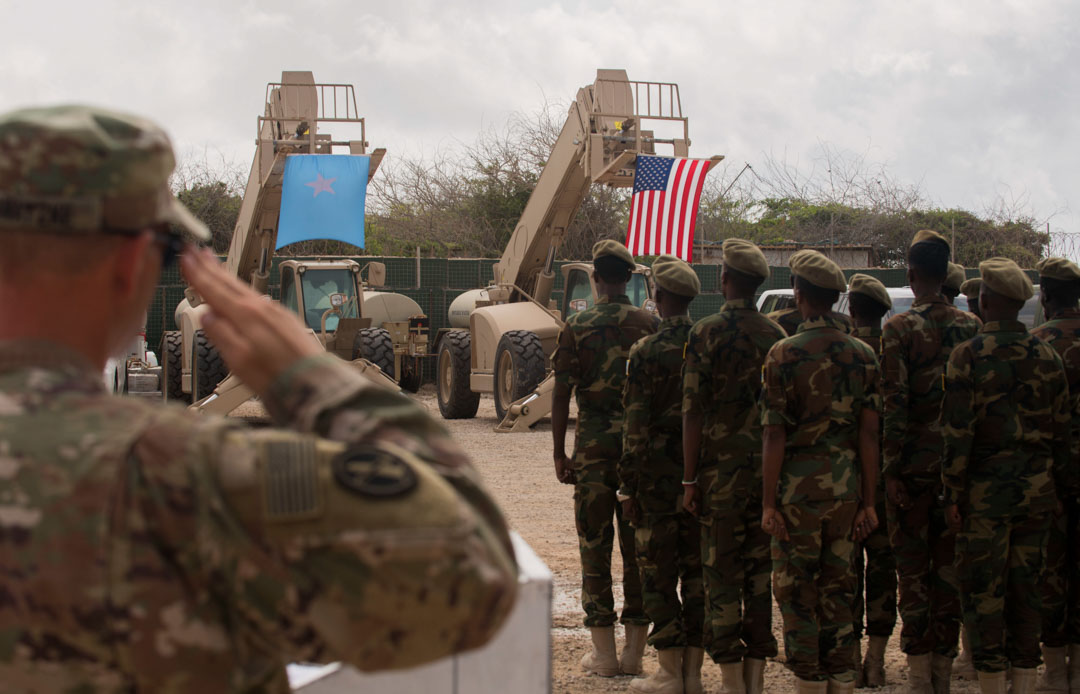
President Donald Trump seems decidedly unenthusiastic about keeping U.S. troops in Somalia, though so far, he has not grown impatient enough to pull them out.
In a lengthy speech to U.S. military brass on 30 September, Trump – not for the first time – cited Somalia as an example of how not to use the men and women of the U.S. armed forces, suggesting, controversially, that they should instead be assigned tasks at home. Yet for all his discontent with the U.S. military deployment in the Horn of Africa, which supports Somali national forces in their long-running fight with the Islamist Al-Shabaab insurgency, U.S. troops remain in the region. The hesitancy about withdrawing them may reflect the administration’s understanding that, however much it would like the troops to depart, a rush to the exits could have unwanted consequences – from encouraging Somalia’s other partners to follow suit to reinvigorating the insurgency.
The Trump White House is not the first to struggle with Somalia policy. For years, the U.S. has backstopped a weak Somali federal government’s campaign against Al-Shabaab even as frustration has mounted in Washington with the leadership in Mogadishu and its stalled state-building project. Several strands of thought sit side by side in Washington. Some grumble that the Somalia deployment is part of the “forever wars” – the phrase coined to describe the open-ended U.S. military expeditions that followed al-Qaeda’s 11 September 2001 attacks on the U.S. This camp wants to see a swift drawdown. Others say the U.S. would better serve its interests by shifting its focus in the Horn to Somaliland, a strategically located self-run entity that has declared its independence from Somalia, much to the latter’s chagrin. A third option perennially in play is for Trump to follow in the footsteps of prior U.S. administrations, which have generally found staying the course to be the least bad option. The Biden White House called this approach “low-cost, low-risk”, tacitly acknowledging that it was designed to contain Al-Shabaab but would do little to advance a long-term resolution.
Throwing U.S. weight behind Somaliland’s independence would do little to address Somalia’s issues and could attract opposition from regional powers.
None of these choices is especially appealing. Precipitously leaving would open the door for an Al-Shabaab resurgence. Throwing U.S. weight behind Somaliland’s independence would do little to address Somalia’s issues and could attract opposition from regional powers that fear the precedent might trigger splinters elsewhere. Lastly, the path of least resistance – maintaining the status quo – would trap the U.S. in a seemingly endless cycle given the slow rate of progress.
Against this backdrop, the best way forward is neither to settle for the status quo nor to cut and run. Crisis Group understands that the Trump administration is undertaking a review of U.S. Somalia policy. It should use this moment to marshal U.S. pressure around certain key issues, including pushing key Somali actors to make political compromises that will help the country stabilise. If this strategy succeeds (a tall order to be sure), it could create an opening for the U.S. to reduce its footprint, but at a deliberate pace that would carry a lower risk of boosting Al-Shabaab’s fortunes.
Stuck in a Holding Pattern
Since President George W. Bush (2001-2009) was in the White House, the U.S. has been enmeshed in Somalia, with successive administrations pursuing similar objectives. The U.S. has aimed to degrade Al-Shabaab, which has sworn allegiance to al-Qaeda, and to build up the Somali state to the point where it can keep the insurgents at bay without extensive outside support. To this end, the U.S. has funded and trained an elite unit of the Somali national army, the Danab, and provided air support for Somali offensives against Al-Shabaab and a smaller Islamic State contingent. At the same time, the U.S. has pumped billions of dollars into Somalia to bolster the federal government, which is still reconstituting itself after the brutal regime led by Siad Barre collapsed amid armed revolt in 1991. For years prior to Trump’s second term, the U.S. had been the largest humanitarian aid donor to Somalia.
The fruits of these investments are not as impressive as early architects of the policy would have hoped. Despite some progress, state building in Somalia has been slow, and Al-Shabaab remains an existential threat after years of effort, thousands of casualties and eye-watering expense. Nor are there encouraging signs that the government is making the advances needed to enable the U.S. and other partners to dial down their military and financial support in line with the timeframes Washington and others would ideally like to see.
Perhaps the most salient reason for the Somali government’s failure to defeat Al-Shabaab lies in the country’s fractured politics. The government in Mogadishu is mired in debilitating disputes with member states over the distribution of power and resources within the country’s federal model. These quarrels hinder the development of a united front to fight the insurgents and deflect the federal government’s attention from other vital tasks, building its capacity for effective governance. For much of 2024 and into 2025, for example, the government was diverted by a growing dispute over forthcoming elections, taking the pressure off of Al-Shabaab. Subsequently, in early 2025, the insurgents went on the offensive and recovered much of the territory in central Somalia the government had freed from the militants’ grip during a much-heralded campaign two years earlier.
But resolving political divisions is no small task. Puntland, the most institutionally developed member state, suspended cooperation with Mogadishu in 2023, complaining that the federal government was appropriating too much power to itself. There is also significant disagreement within Somalia’s political class over the framework for the country’s next elections, due in 2026. Concern is thus mounting that a dispute could be emerging similar to the one in 2021, when the former president, Mohamed Abdullahi Farmajo, tried to extend his time in office and faced violent pushback in Mogadishu.
Another problem is the rancour between the federal government and Somaliland, a northern region that has a colonial past distinct from the rest of Somalia. Somaliland proclaimed its independence in 1991 and has developed many trappings of a de facto state. Mogadishu rejects these aspirations, and the antipathy between authorities in Mogadishu and Somaliland’s capital Hargeisa impedes cooperation on issues of mutual concern. Chief among these are regional security amid growing concerns about the growing presence of militants like Al-Shabaab and the Islamic State in northern Somalia (an offensive led by Puntland since early 2025 has, however, eroded much of the Islamic State’s capacity currently). Observers worry about the potential for these actors to forge connections across the Gulf of Aden with Yemen’s Houthis. But notwithstanding these common worries, the relationship between Mogadishu and Hargeisa is becoming more confrontational – all the more so since the former in August this year established a new federal state in areas Somaliland claims.
So long as Al-Shabaab continues to pose a major threat to the federal government, the U.S. and others will be wary of scaling down their military assistance.
Against this backdrop, international engagement in Somalia is stuck in a holding pattern. So long as Al-Shabaab continues to pose a major threat to the federal government, the U.S. and others will be wary of scaling down their military assistance, mostly delivered directly to the Somali army and in support of the African Union peacekeeping mission, AUSSOM. Government forces and AUSSOM are strong enough to hold the line against Al-Shabaab, containing the group’s fighters for the most part to rural areas in southern and central Somalia, but they struggle to drive the militants out of their strongholds. Without extensive external aid, not just from the U.S. but also from AUSSOM and others, the government would find it difficult to maintain the status quo, much less to resolve this impasse in its favour in the near term. Even with this support, the climb often seems uphill.
Meanwhile, the people of Somalia see little benefit from their government. There is little effective state presence outside Mogadishu and other major population centres and garrison towns. In the rural areas beyond these centres, federal and state authorities have scant presence, offer few if any services and enjoy little sway.
Washington’s Dilemma
Mogadishu’s security partners, including the U.S., have often appeared keener than the federal government to take on Al-Shabaab, reflecting the extent to which Somali authorities are distracted by factional jostling over power and resources. Because of the high priority that Washington assigns to counter-terrorism, Somali political leaders tend to assume that U.S. assistance will continue to flow no matter how much dysfunction paralyses the country’s politics or how poorly the Somali military performs. Every U.S. president since George W. Bush has faced the same dilemma and left office without resolving it.
A good deal rides on Washington. Though one of several outside powers working to stabilise the country, the U.S. has disproportionate say in how outside actors shape their Somalia policies. Due to its global political influence, military capacity and budget, what the U.S. does in Somalia tends to cause others, particularly Western actors like the UK and EU, to follow in line. While a pullback by the U.S. alone would not deliver Mogadishu to Al-Shabaab, it would erode the capacity of Somali forces to maintain pressure on the insurgents. It could also cause other partners to consider withdrawing both financial and other assistance, aggravating the funding shortfalls already facing the African Union mission, for example. The U.S. provides defensive support to the airport compound in Mogadishu where most foreign embassies are stationed, meaning that a sudden wholesale retreat might cause others to head for the exits, too.
But assuming it prefers to stay and move beyond the status quo in order to enable an orderly transition, Washington’s options are far from ideal. One possibility would be for the U.S. to step up support for Mogadishu in a renewed bid to deal a crippling blow to the insurgency. But using force alone seems doomed to failure, as demonstrated during Trump’s first term – when the U.S. intensified its air war in Somalia with unconvincing results. In an echo of those first-term tactics, U.S. strikes have surged early in Trump’s second term – yet Al-Shabaab has still gained ground since February. Besides, temporary ascendancy over Al-Shabaab on the battlefield would do little to address the underlying political tensions in Somalia, making it likely that the government would again become distracted and the group again rebound unless those problems are resolved. On the other hand, broader efforts at state-building are unlikely to command much support in Washington, given the failure of such U.S. projects in other locales, such as Afghanistan, and the Trump administration’s inward-looking foreign policy.
Making the Most of Imperfect Choices
Still, the administration need not be paralysed by its imperfect choices. Rather, it should focus on how best to use its leverage to make key changes that could catalyse progress on the security, governance and geopolitical issues that presently have Somalia stalemated.
Here, Trump is aided by the mercurial legacy of his own first term. Having loosened strike protocols for U.S. commanders at the beginning of his term, he abruptly pivoted away from that posture at the end. In late 2020, he ordered U.S. forces to leave the country by January 2021. It was a hasty decision that the military brass did not support and found its way around. Although the Pentagon removed U.S. troops from Somalia itself, it kept most of them in East Africa and rotated them by air in and out of the country – until the Biden administration discontinued this arrangement and reinserted several hundred personnel into Somali territory.
Leaders in Mogadishu are conscious of Trump’s previous abrupt 2020 decision, aware of bipartisan frustration in Washington around the U.S. deployment in Somalia, and concerned about the possibility that the long-held consensus in support of a continued U.S. presence could dissipate. Even though the administration has set out no plans for withdrawing U.S. troops and other support, Somali leaders believe that Trump could very well still decide to do so at some point. They are also tracking increased support in some quarters for greater U.S. engagement with and possibly even recognition of Somaliland, though Trump administration officials have suggested that a quick unilateral recognition is unlikely.
These concerns have driven the Somali government to consider how it might pre-empt what it would consider adverse decisions. In late 2024, the Somali government reportedly hired a lobbying firm to press its case in Washington, and the following March, a draft letter from Somali President Hassan Sheikh Mohamud to Trump was leaked to the press. It contained a pitch for why the U.S. should retain a strategic relationship with Somalia, with Mogadishu offering exclusive access to the northern ports of Berbera (in Somaliland) and Bosasso (in Puntland), though the federal government’s practical authority does not extend to Somaliland or much of semi-autonomous Puntland. Authorities in Somaliland, where Berbera sits, have come up with a similar proposal to attract Trump’s eye. The U.S. security establishment has long been interested in getting access to Berbera, strategically located alongside the Gulf of Aden leading into the Red Sea. This would in turn ease U.S. reliance on its military outpost in Djibouti, where China has considerable influence and also maintains a base.
The Trump administration has yet to publicly react to these pitches, or to give much of a sense of the direction of its Somalia policy, which at this point reflects more an agglomeration of discrete acts – cutting back aid, applying a visa ban and ordering drone strikes – than an overarching vision. But the reported policy review offers a chance to set both direction and priorities. Given the lack of easy options, Washington should focus in particular on how it can use its considerable leverage – and take advantage of Somali leaders’ recent solicitousness – to push key actors to address certain core issues that have inhibited progress toward a more stable political order.
The U.S. should push Somalia’s politicians to engage in good-faith dialogue aimed at ending the chronic political infighting that has dogged the country for decades.
First, the U.S. should push Somalia’s politicians to engage in good-faith dialogue aimed at ending the chronic political infighting that has dogged the country for decades. In the short term, that means reaching an immediate election deal between the government, member states and political opposition to avoid another debilitating standoff ahead of the 2026 polls. Such a deal requires resolving certain issues such as the format for elections (Crisis Group has separately offered its recommendations on this score) and urgent attention to timelines for polls that are due in May 2026 and are in danger of being delayed. High-level engagement from Washington – including calls from key Trump administration officials directly to their Somali counterparts – could up the ante for Somali stakeholders to find agreement.
Secondly, easing the tension between the government and member states related to the distribution of power and resources in the country is crucial. Somalia’s 2012 provisional constitution left specifics on how the country’s federal model would function for a later date, but subsequent initiatives to address it have floundered. Mogadishu will need to persuade semi-autonomous Puntland to rejoin these discussions about the distribution of power and resources, given its outsized influence within the federation. The U.S. – given its deep counter-terrorism support for both Somalia and Puntland – could serve as a useful intermediary to push both sides back to the table, perhaps emphasising the need for a united front against the militants. In the most ambitious version of such an initiative, it could even try to broker a direct understanding between them, which might then be extended to bring other member states into the conversation.
Thirdly, the status of Somaliland hangs over the question of stability in the Horn, and as the chorus of support for Somaliland’s independence grows, so does the prospect of confrontation – directly or indirectly – with Somalia. The U.S. can encourage Mogadishu to resume good-faith engagement with Hargeisa to devise a sustainable modus vivendi, rather than the two administrations competing with each other for outside attention. A good near-term objective would be to reinstitute previously agreed-upon confidence-building measures regarding international assistance and airspace control, while developing options for the future of the political relationship. While Mogadishu is spooked by speculation that the U.S. may seek closer ties with Somaliland, some in Hargeisa’s new administration had been keen earlier in 2025 to resume dialogue. Washington can help push for both sides to restart discussions about their relationship. Providing space for a local solution – using external pressure as a tool to break through blockages – is a better approach for the U.S. than jumping the gun with immediate, unilateral recognition of Somaliland, which is bound to stir up trouble in the region.
Fourthly, the U.S. should urge Mogadishu to consider preparatory steps toward a conversation with Al-Shabaab about ending the war. These should include a realistic assessment of the circumstances and conditions under which the government would consider engagement with the group, which it has, up to now, largely rejected or deferred until its battlefield position is more favourable. Augmenting military pressure with an engagement track could help test the waters on whether all or part of the group might be prepared to wind down its military campaign and cut ties with other jihadists or the Houthis in Yemen. It could also gauge what sort of concessions Al-Shabaab would seek in return.
Of course, none of these efforts is guaranteed to result in a breakthrough. Yet this strategy is better than the alternatives of either failing to make any pivot at all or abandoning U.S. efforts in Somalia entirely. Taken together, these steps could help move Somalia in a better direction – and in so doing create improved conditions for U.S. forces to draw down while also advancing stability in the Horn of Africa.