

Ten Challenges for the UN in 2025-2026
nalberti
Tue, 09/09/2025 – 09:59
Ten Challenges for the UN in 2025-2026
What’s new? Leaders gathering at the UN General Assembly will find a world organisation in trauma. U.S. funding cuts have hit the UN hard, forcing it into sweeping reductions in staff. Struggling to resolve conflicts or help civilians in places from Gaza to Sudan, the institution appears to be losing its relevance.
Why does it matter? Despite its many flaws, the UN handles humanitarian and peacekeeping tasks that few other organisations can undertake. It offers a safety net for the vulnerable in numerous war zones and a channel for communication among states about divisive issues. Its decline corrodes a buffer keeping many armed conflicts from worsening.
What should be done? Though the UN cannot avoid retrenchment, its member states should try to minimise the fallout. They can offer the organisation political, diplomatic and financial support in tackling both headline-grabbing crises and forgotten ones. They can also work with international officials to reform the institution as it weathers today’s global turbulence.
When leaders arrive in New York in late September for the UN General Assembly’s annual high-level week, they will find an institution whose condition has veered from bad to worse. The UN system has been in poor shape for some time, with tensions among major powers repeatedly foiling diplomacy at the Security Council. But the return of Donald Trump to the U.S. presidency in January has precipitated an even more pronounced downturn in the organisation’s fortunes. The U.S., the organisation’s single largest donor, has cut or frozen large tranches of funding for the UN and its agencies, eviscerating humanitarian aid operations in particular. It has also quit a raft of multilateral agreements, pursued unilateral peace initiatives with little reference to the UN and at times seemed to dismiss key tenets of the UN Charter, such as respect for the territorial integrity of states. The wider UN membership now faces tough choices about how to manage the fallout of U.S. decisions, both for the UN as an institution and for the various crises where it is engaged. In many cases, their task will amount to damage control, but it will still be vital.
To date, the organisation’s other members have offered it only tepid support in withstanding the shock waves coming from the Trump White House. Many capitals, along with their diplomats in New York and Geneva, agree at least in part with Washington’s longstanding criticism of the UN as bloated and cast its present financial woes as a necessary reckoning. Secretary-General António Guterres is thus encumbered with cutting the institution down to size. As part of a reform process entitled UN80, he has promised that the UN Secretariat will shed about a fifth of its staff. Aid agencies such as the World Food Programme, which rely heavily on U.S. funds, are making even bigger cuts. Morale among UN staff is plumbing new depths.
The organisation’s travails are not solely budgetary. The UN faces political pushback and operational threats in a series of conflict zones. The most egregious and widely cited example is the calamity in Gaza, where Israel (with U.S. backing) has sidelined UN aid efforts, accusing the organisation of complicity with Hamas. But the phenomenon extends further. In the last year, to adduce just a few examples, warring factions have blocked UN diplomacy and humanitarian assistance in Sudan, while rebel groups have killed blue-helmet peacekeepers in the Democratic Republic of Congo (DRC) and South Sudan. In the meantime, Security Council discussions about how to help troubled countries such as Haiti and Somalia have languished in part due to a lack of U.S. engagement, while the UN has made no progress in resolving major conflicts – including those in Sudan and Myanmar – which have intermittently been priorities for the Council in recent years. In some cases it has proven impossible even to get life-saving aid to those who need it.
Amid the chaos of today’s world, there has been little real debate at the UN about where the organisation is headed.
Amid the chaos of today’s world, there has been little real debate at the UN about where the organisation is headed. Trump administration officials have said they want to see the UN focus on its “founding purpose” of upholding peace and security. Many Western diplomats agree that the organisation – which turned 80 in June 2025 – should concentrate on its basic goal of international stability. Representatives of non-Western countries nevertheless worry that such a reorientation will mean that economic development gets short shrift. Diplomats and international officials tend to agree that potentially acrimonious discussions about the UN’s future strategy will have to await the arrival of a new Secretary-General in January 2027.
In the meantime, UN members should address the immediate challenges and opportunities facing the organisation. It is easy to discern the UN’s malaise, but it is worth keeping in mind that the institution remains engaged in numerous important peace processes and relief efforts. It is particularly difficult – and sometimes even impossible – for other actors to replicate the UN’s capacity to run complex relief operations. The Security Council is still a clearinghouse for initiatives dealing with unexpected events, such as the fall of President Bashar al-Assad in Syria, as well as diplomacy on both high-profile matters – such as recognition of the State of Palestine and proliferation-related sanctions against Iran – and largely neglected crises like that in Afghanistan. The UN system is undoubtedly in crisis, but there is no credible alternative available to handle this range of responsibilities.
The UN was grappling with several challenges before President Trump assumed office for a second time on 20 January.[1] The outgoing Biden administration had tried to push the Security Council toward ending the civil war in Sudan and bolstering security in Haiti, but China and Russia were unwilling to support new initiatives on these files. The U.S., meanwhile, continued to stymie UN action regarding the Israel-Hamas war. Beyond the Council, the UN system struggled with cash flow problems stemming from the late payment of dues by member states including China and the U.S.[2] UN members and officials presumed that, as in his first term, Trump would be disdainful of multilateralism. But there was little sense of how bad relations with the U.S. would become.
[1] See Crisis Group Special Briefing N°12, Ten Challenges for the UN in 2024-2025, 10 September 2024.
[2] Eugene Chen, “The Liquidity Crisis at the United Nations: How We Got Here and Possible Ways Out”, New York University Center on International Cooperation, August 2024.
The Trump administration’s challenge to the UN and international cooperation more generally has unfolded on a scale, and at a speed, that few were ready for. It was predictable that the president would pull out of the Paris climate change agreement on his first day in office and that he would withdraw the U.S. from a series of other UN frameworks like the Human Rights Council and the UN Education, Scientific and Cultural Organization in the ensuing months. Similar moves had been made in his first term.
But few within the UN expected the wave of U.S. aid cuts and freezes that washed over the organisation and its agencies in late January. It hit first in Geneva and Rome, where some of the largest UN humanitarian agencies are based. The World Food Programme (WFP) – which relied on Washington to cover half of its $9 billion budget in 2024, and the UN High Commissioner for Refugees (UNHCR), which got two fifths of its funding from the U.S. – watched that money dwindle to a trickle. The agencies soon announced that they would have to lay off thousands of staffers.[1] UN entities working for gender equality, including by curbing sexual and gender-based violence, quickly realised the grave financial threat they were under as U.S. diplomats objected to the UN even using the word “gender” in its documents, and took a more restrictive stance on sexual and reproductive health than Trump’s previous administration had (see Section III.8).[2] The U.S. further shocked diplomats by turning against the Sustainable Development Goals, a set of non-binding commitments that have framed the UN’s work to eradicate poverty and promote development since 2015.[3]
[1] See Ayenat Mersie, “Exclusive: WFP to cut up to 30% of staff amid aid shortfall”, Devex, 25 April 2025; and “UNHCR steadfast in refugee protection as it completes review of operations, structures, and staffing”, press release, UNHCR, 16 June 2025.
[2] This refusal was most prominent in March: the UN General Assembly’s Special Committee on Peacekeeping Operations could not adopt its annual report due to a lack of consensus among member states, with sources telling Crisis Group that the U.S. would not accept any mention of the word “gender”. Crisis Group interviews, March 2025. Separately, the U.S. refused to support the annual Political Declaration of the Commission on the Status of Women, citing its “extremist gender ideology”. See “In Hindsight: Ensuring Effective Peace Operations in an Uncertain World”, Security Council Report, 31 March 2025; and U.S. Mission to the UN, “Explanation of Position on the Commission on the Status of Women Political Declaration”, 10 March 2025.
[3] Colum Lynch, “Exclusive: US seeks to gut UN development goals”, Devex, 12 June 2025.
The U.S. has pointed to a number of UN missions, such as the residual presence in Kosovo, as ripe for closure.
The Trump administration’s attitude toward the UN’s peacekeeping arm has been less uniformly hostile, but often unfriendly. Early in the year, optimistic UN officials noted that U.S. Secretary of State Marco Rubio emphasised the need for the UN to focus on peace and security. Washington backed the renewal of some mandates for existing peace operations in the Security Council, such as that in South Sudan. Members of the administration talked about the need to reform missions (by, for example, giving them clearer exit strategies) rather than scrap them altogether.[1] Nonetheless, the blue helmets have not been entirely spared. The U.S. has pointed to a number of UN missions, such as the residual presence in Kosovo, as ripe for closure. This summer it pushed for the UN Interim Force in Lebanon, one of the largest and longest-standing blue-helmet operations, to shut down in 2027.[2] In May the administration announced its intention to halt future funding for the UN’s peacekeeping budget, and in late August committed to rescind contributions that Congress had already appropriated for 2024 and 2025.[3]
In any event, it has been hard for international officials and diplomats in New York and Geneva to divine the administration’s stance on the UN more broadly, as they have had no senior interlocutors from Washington to talk to. President Trump withdrew his first nominee for U.S. Permanent Representative to the UN, Elise Stefanik, in March so she could keep her seat in Congress (thus safeguarding the House of Representatives’ slender Republican majority). The White House announced in May that former National Security Advisor Mike Waltz, having left the White House after a turbulent few months, would fill the slot, but his confirmation hearings have dragged out over the ensuing months. Holdover teams of diplomats have continued to represent the U.S. in UN forums. UN officials and member states alike have been left in the dark about whether the Trump White House has a long-term plan for how to deal with the UN or whether to partially restore U.S. funding.
[1] See remarks by McCoy Pitt, U.S. Senior Bureau Official for the Bureau of International Organization Affairs, at the 2025 UN Peacekeeping Ministerial High-Level Session 3 – Global Perspectives on the Future of Peacekeeping, 13 May 2025.
[2] Other Security Council members expressed concerns about the risks of creating a security vacuum in southern Lebanon if the national armed forces prove unable to police the area “Resolution 2790”, UNSC S/RES/2790, 28 August 2025; David Wood, “Helping UNIFIL Restore Stability in Southern Lebanon”, Crisis Group Commentary, 14 August 2025.
[3] Letter from the Director of the Office of Management and Budget to the Chair of the U.S. Senate Committee on Appropriations, U.S. Executive Office of the President, 2 May 2025; “Historic Pocket Rescission Package Eliminates Woke, Weaponized, and Wasteful Spending”, The White House, 29 August 2025.
The UN Secretariat and other member states alike were caught flat-footed by the alacrity with which the U.S. tightened its purse strings. Other traditional donors to UN operations, such as European governments, made clear that they could not fill the gaps Washington was creating. While some international officials hoped that China or the Gulf countries would help, none have replaced U.S. funds at full scale.[1] Diplomats and UN officials now speak of the need to do “less with less”.[2]
To date, member states have largely left the task of defining what austerity means to Guterres. The Secretary-General did not relish the opportunity – reportedly hoping to spend his final years in office focusing on personal priorities like the international regulation of artificial intelligence. But in March he announced the UN80 reform process, nodding to the eightieth anniversary of the UN Charter.[3] This process includes three tracks: one hunting for immediate savings, a second reviewing the UN’s caseload of inter-governmental mandates, and a third looking at institutional reforms. So far, the Secretary-General has taken the most action on the first track – declaring in May that all parts of the Secretariat must cut a fifth of their staff in 2026 – while assigning working groups, each representing a different cluster of UN entities, the job of plotting possible courses of longer-term restructuring.[4]
The Secretary-General has also insisted that he lacks the authority to suggest what activities the UN should or should not keep pursuing, instead deferring these questions to the UN’s membership.[5] Given that the Secretary-General’s team have counted nearly 4,000 mandates from UN member states that are the responsibility of the Secretariat alone, most New York-based diplomats view the prospect of retrenchment nervously.[6] Different blocs of UN members have largely avoided public disputes about how the organisation should redirect its shrunken resources. While Western officials talk of the need to get “back to basics” (code for emphasising peace and security), representatives from the so-called Global South insist that the UN should not veer away from its development commitments. Diplomats from all camps agree that these questions will eventually come up for debate, but they are happy to delay such contentious discussions.
[1] Beijing has offered significant new funds to only a few UN agencies, such as the World Health Organisation (WHO). “China to give $500 million to WHO in next 5 years, official says”, Reuters, 20 May 2025; Yanzhong Huang, “U.S. WHO Exit Could Expand China’s Influence”, Think Global Health, 30 January 2025.
[2] Richard Gowan, “Doing ‘Less with Less’ at the UN”, Crisis Group Commentary, 16 May 2025.
[3] “UN80 Initiative”, August 2025.
[4] António Guterres, “Secretary-General’s remarks on the UN80 Initiative”, Office of the Secretary-General, 12 May 2025.
[5] António Guterres, “Secretary-General’s remarks to the Informal Meeting of the General Assembly Plenary on the UN80 Initiative”, Office of the Secretary-General, 1 August 2025.
[6] “Report of the Mandate Implementation Review”, UN80 Initiative: Workstream 2, White Cover Publication, August 2025, para. 41. For a full list of UN mandates, see: “UN Mandate Source Registry”, United Nations, accessed September 2025.
While U.S. policy has forced diplomats to concentrate on financial and institutional questions for much of the year, they have also had to deal with the fallout of concurrent crises. As in late 2023 and throughout 2024, the war between Israel and Hamas in Gaza has dominated discussions in New York. For many UN members, Israel’s deliberate strategy of sidelining the UN from both political and humanitarian responses to the war (described further in Section III.1) has thrown into doubt the world organisation’s credibility, given that its involvement with Palestine dates to the 1940s. Yet while members of the Security Council and General Assembly have looked for ways to influence the course of events in the Middle East, they have also struggled to address a litany of other worsening problems.
The Security Council
After a period in which major-power disputes regularly hamstrung the Security Council – often along East-West lines – relations among China, Russia and the U.S. have fluctuated less predictably so far in 2025. The U.S. created consternation among its European allies in the Council in February when, with little warning, it tabled a resolution “imploring” Moscow and Kyiv to strike a quick peace deal with no reference to Ukraine’s territorial integrity, which has been violated by Russian aggression.[1] Diplomats interpreted this resolution – which passed with ten votes despite the five European members abstaining – as a sign that President Trump might see the Council as a mechanism for broader rapprochement with Russia.
Notwithstanding these early expectations, the change in U.S.-Russian relations in the Council has been far from ground-breaking. In the months that followed, the U.S. made a point of improving cooperation on Syria in the Council (jointly drafting a statement on the burst of violence in that country’s coastal regions in March) and Russia has notably toned down its criticisms of U.S. support for the Israeli military campaign in Gaza.[2] U.S. and Russian officials have also become more assertive in dealing with the elected ten members of the Council over procedural issues (the other permanent members have sometimes followed suit).[3] But the two powers continued to spar over other topics, including North Korea’s nuclear program.
In contrast, Washington showed little immediate inclination to improve relations with China in the Council, making a concerted effort to stop Beijing taking a greater diplomatic role on Afghanistan.[4] Tensions among the three powers peaked during the twelve-day Israeli-Iranian war in June, when China, Russia and Algeria (occupying the Council’s Arab seat in 2024-2025) circulated a draft resolution condemning not only Israeli but also U.S. strikes on Iranian nuclear facilities.[5] Though they abandoned this text soon after hostilities ended, it highlighted the persistent mistrust among the veto-wielding powers that intensified further after the U.S. backed a push by Britain, France and Germany to reimpose sanctions on Iran suspended as part of the 2015 Joint Comprehensive Plan of Action (see Section III.9).
[1] “Resolution 2774”, UNSC S/RES/2774, 24 February 2025.
[2] “Statement by the President of the Security Council”, UNSC S/PRST/2025/4, 14 March 2025.
[3] Crisis Group interviews with UN diplomats, May and August 2025.
[4] Richard Gowan, “US-China standoff on who runs the Afghanistan file at UN signals greater tensions ahead”, Just Security, 14 February 2025.
[5] “Iran: Non-proliferation Briefing”, Security Council Report, 23 June 2025.
More often than not, U.S. diplomacy in the Council has been adrift.
More often than not, U.S. diplomacy in the Council has been adrift. U.S. diplomats have often struggled to get clear instructions from Washington on how to handle issues – such as the crises in Haiti and Sudan – that had been bigger (if intermittent) priorities under President Joe Biden. On occasion, Washington’s interest in an item on the Council’s agenda has been pricked. In April and May, it pushed hard for the Council to renew the mandate for the UN peacekeeping force in South Sudan at a time when that country seemed close to renewed civil war.[1] On other occasions, the U.S. stance has been more averse to UN-led peace efforts. In May, Washington refused to sign onto a proposal – reluctantly greenlit by the Biden administration in December 2024 – for the UN to use assessed contributions to fund the African Union (AU) stabilisation mission in Somalia.[2] The reversal set back an AU initiative under way since 2007 to get more reliable UN support for its deployment.
Even if U.S. engagement in Council affairs blinks on and off, the fear of run-ins with Washington has led other members of the body to tread cautiously. The most obvious indicator has been discord over Gaza. Following the Hamas atrocities on 7 October 2023, Council members regularly aimed to put pressure on Israel and the U.S. to support an end to hostilities by tabling Council resolutions, though the Biden administration blocked many of these.[3] By contrast, Council members were more restrained in the first half of 2025, even as Israel began an intensified siege of Gaza, and did not table a ceasefire resolution until June.[4] This pullback apparently reflected their concerns – shared by the Palestinian mission to the UN – that forcing a showdown would spur the Trump administration to react with a show of displeasure, though in the end the U.S. simply vetoed the June resolution and moved on with little fuss.
[1] Security Council representatives told Crisis Group that their U.S. counterparts were willing to compromise on secondary issues – such as whether to refer to climate change and gender – to get the resolution passed. Crisis Group interviews, May 2025. For background, see “UN Mission in South Sudan: Vote on Mandate Renewal Resolution”, Security Council Report, 8 May 2025.
[2] Daniel Forti, “Security Council Misses Funding Deadline for AU Mission in Somalia”, Crisis Group Commentary, 16 May 2025.
[3] Maya Nicholson, “Tracking the U.S. Position on Gaza through UN Security Council Resolutions”, Lawfare, 30 July 2024.
[4] “Algeria, Denmark, Greece, Guyana, Pakistan, Panama, Republic of Korea, Sierra Leone, Slovenia and Somalia: draft resolution”, UNSC S/2025/353, 4 June 2025.
The General Assembly
The conflicts in Ukraine and Gaza have remained major items of business in the General Assembly as well. The body has continued to speak out against Russia’s war in Ukraine, though some members have appeared warier of doing so. In February, the Assembly backed a resolution tabled by Kyiv and the European Union, but opposed by the U.S., marking the third anniversary of Russia’s all-out aggression and reasserting Ukraine’s sovereign territorial rights. But this text got only 93 yes votes, compared to 141 for a similar text in February 2023.[1] The decline was partly a product of U.S. lobbying, but it also reflected a tendency among UN members – especially those disappointed by Western positioning over Gaza – to disassociate themselves from discussions of Ukraine.
The Assembly passed a resolution calling for a ceasefire in Gaza after the U.S. vetoed the Council resolution on the issue in June, but the UN’s most widely noted intervention on the Israeli-Palestinian conflict was a high-level conference on a two-state solution in July.[2] Many diplomats expected this event, which the Assembly had called for in 2024, to fizzle. But it became a lightning rod for international frustration with Israel’s campaign in Gaza. France – followed by the UK, Canada and Malta – announced its intention to recognise bilaterally the State of Palestine, and a number of other member states signalled that they might make the same move. While the Trump administration had lobbied against recognition, and Israel dismissed the conference as rewarding Hamas’s atrocities, it was a reminder that there are still moments when the UN offers a stage for states to take positions of principle that no other multilateral platform can provide (see Section III.1).
[1] The General Assembly voted on two Ukraine-related resolutions on 24 February. The Ukrainian-European resolution secured 93 votes in favour, with eighteen votes against and 65 abstentions (seventeen countries declined to vote). See A/RES/ES-11/7, “Advancing a comprehensive, just and lasting peace in Ukraine”, 24 February 2025. The U.S. tabled its own resolution that day, which included no mention of Ukraine’s territorial integrity. France and other European countries pushed for amendments to the U.S. text to insert explicit references to Ukraine’s territorial integrity and criticism of Russia’s aggression. This amended text received 93 votes in favour, with eight votes against and 73 abstentions (nineteen countries declined to vote). The U.S. abstained on its own text as it did not fully back the amendments. See A/RES-ES-11/8, “The path to peace”, 24 February 2025. For more information, see Richard Gowan, “U.S. Volte-Face on Ukraine Exposes Depths of Divide in the UN”, Crisis Group Commentary, 26 February 2025.
[2] The High-level International Conference for the Peaceful Settlement of the Question of Palestine and the Implementation of the Two-State Solution, mandated by the General Assembly in September 2024, was originally scheduled for 17-20 June 2025. But the co-chairs, France and Saudi Arabia, postponed the gathering until 28-30 July after Israel launched its twelve-day war on Iran.
The outlook for the UN in the year ahead is bleak. The defining feature will be organisational retrenchment, as the Secretariat and various agencies proceed with trimming budgets and many parts of the UN reduce their global footprints. The human costs of what the UN Office for the Coordination of Humanitarian Affairs (OCHA) calls “hyper-prioritising” aid efforts in many conflict settings will be substantial.[1] UN aid officials warn that cuts may lead to unrest in recipient countries. Though the correlation between aid distribution and rates of violence is disputed, there is little doubt that the UN’s woes will leave many vulnerable people even further immiserated.[2]
The organisation’s difficulties will also lead to talk of the need for reforms extending beyond immediate retrenchment. Some of these conversations will focus on fine-tuning the organisation’s peace and security tools. Diplomats have been discussing how the UN can do peacebuilding better – with an emphasis on finding new sources of funding, potentially from the international financial institutions – and the Secretariat is working on a review of UN peace operations, particularly “agile” missions.[3] But member states like India are liable to point out that the UN also needs more fundamental political reform, such as an overhaul of the Security Council. They may be frustrated, as the Trump administration has shown little interest in such matters, and indicated to some other UN members that it wants to keep the Council structure as it is.[4]
[1] “A Hyper-prioritised Global Humanitarian Overview 2025: The Cruel Math of Aid Cuts”, Humanitarian Action, 10 June 2025.
[2] Some scholars argue that there are in fact correlations between humanitarian aid deliveries and increases in violence. See for example Reed M. Wood and Emily Molfino, “Aiding Victims, Abetting Violence: The Influence of Humanitarian Aid on Violence Patterns During Civil Conflict”, Journal of Global Security Studies, Vol.1, Issue 3, 2016. See also “Instruments of Pain: Conflict and Famine”, Crisis Group Statement, 13 April 2017.
[3] A formal review of the UN peacebuilding architecture is taking place between April and December. This architecture – which includes a 31-member Peacebuilding Commission, a fund for peacebuilding assistance and a small support office housed within the Secretariat – is meant to help countries secure political and financial assistance for their own efforts to prevent and recover from armed conflict. See Crisis Group Briefing, Ten Challenges for the UN in 2024-2025, op. cit. Separately, the ongoing review of UN peace operations was initiated by the Pact for the Future, a wide-ranging collection of voluntary commitments made by UN member states in September 2024 on the future of multilateralism. The UN Departments of Political and Peacebuilding Affairs and Peace Operations are collaborating on this product, which should be completed by early 2026. See: “The Pact for the Future”, UN General Assembly A/RES/79/1, 22 September 2024; “Informal meeting of the plenary to hear a briefing on the review on the future of all forms of United Nations peace operations”, UN General Assembly, 79th session, 27 May 2025; and remarks by UN Under-Secretaries-General Rosemary DiCarlo and Jean-Pierre LaCroix, “Provisional Verbatim of the 9969th meeting of the United Nations Security Council”, UNSC S/PV.9969, 29 July 2025.
[4] Crisis Group conversations with UN diplomats, August 2025.
The process of selecting a new Secretary-General is sure to promote more dialogue about the state of the UN.
The process of selecting a new Secretary-General is sure to promote more dialogue about the state of the UN. Prior to President Trump’s re-election, the conventional wisdom in New York was that the next UN chief should be a woman (only men have filled the post to date), with a focus on development and climate issues. An informal and non-binding UN convention suggests that it is Latin America’s “turn” to fill the job. As Crisis Group noted a year ago, there is also a need to find a candidate willing and able play a greater role in international mediation than Guterres – a cautious leader playing a dreadful political hand – has been able to do.[1]
Since then, the change of U.S. administration has upended some of these assumptions, with several diplomats predicting that Washington will insist on a male Secretary-General to upset liberals at home and abroad.[2] It is also clear that candidates, regardless of their gender, will have to talk a good game on cost savings and associated reform issues. While a number of candidates have stuck their heads above the parapet this year – with International Atomic Energy Agency and (IAEA) Director-General Rafael Grossi making most headlines as numerous others ramp up their campaigns – the selection process could run until the last months of 2026.[3] All candidates will release manifestos and face public hearings from member states, civil society groups and the press in the first half of next year. This will be an opportunity for all sides to air their views on what sort of reforms the UN must undertake.
[1] Crisis Group Briefing, Ten Challenges for the UN in 2024-2025, op. cit.
[2] Crisis Group conversation with diplomats, May 2025.
[3] Gillian Tett, “UN nuclear chief Rafael Grossi: ‘I am a calm person. I focus on what I can do’”, Financial Times, 6 June 2025; Richard Gowan, “Guterres’ Successor Will Take Over a U.N. in Crisis Mode”, World Politics Review, 2 April 2025. The Security Council dominates discussion of candidates, but Romania and South Africa led a push in recent months to give the General Assembly a greater say. The veto powers have rebuffed much of this initiative.
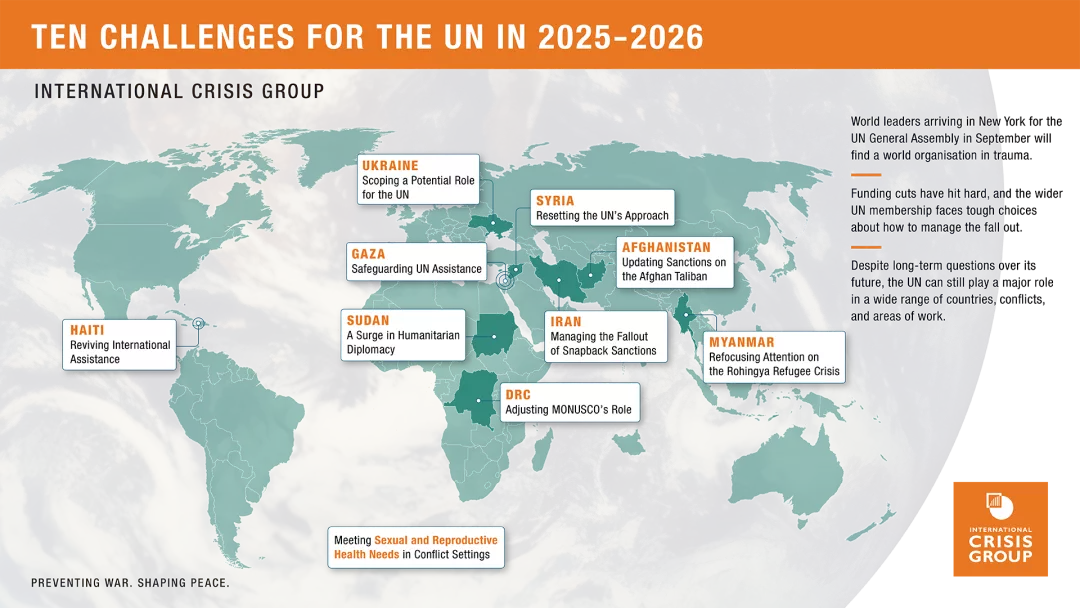
Despite long-term questions over the future of the UN, it can still play a major role in a wide range of troubled countries. Its means of doing so differ case by case. The following list of challenges covers countries, conflicts and areas of work where the organisation faces notable difficulties or opportunities in the year ahead. The list is necessarily selective and excludes many cases that Crisis Group has highlighted elsewhere. The topics in focus do, however, illustrate various dimensions of UN action that offer a sense of the world organisation’s continuing responsibilities, including humanitarian aid, peacekeeping, peace enforcement and sanctions.
The choice of topics also underlines the difficulties involved in selecting what priorities the UN should pursue over the coming months and what to let go. In some cases, our recommendations for dealing with these challenges would be broadly cost-neutral for the UN. In others, we highlight the reasons for the world organisation and its members to scrape together resources in the current period of radical belt-tightening to address specific problems. This raises questions about the trade-offs involved: if the UN funnels more financing to the situations we identify, others are liable to lose out. Readers should not infer that the fact that certain countries and crises do not feature in this publication means that they are less worthy of support. Instead, it is necessary to acknowledge that the UN is struggling to muster resources to cover even those cases that do feature here – and in the current financial climate, UN members and international officials will face unpalatable choices about how to distribute resources both within and between a multitude of pressing crises.
The UN has been a direct target of Israel’s nearly two-year war with Hamas in Gaza. Much of what Israel has upended during its campaign – Palestinians’ basic human rights, services to Palestinian refugees in the occupied territories and a diplomatic runway for a two-state solution – rested upon a UN-safeguarded legal and humanitarian framework. This order now lies in tatters. Israel has ignored pressure to halt its offensive and lift its siege of Gaza, resulting in a humanitarian catastrophe.[1] The U.S. has unhesitatingly backed Israel, exercising its Security Council veto six times to block calls for a ceasefire since 7 October 2023. Yet even if the UN has not been at the helm of diplomacy to halt the fighting, it is impossible to discuss surges of life-saving assistance or Palestine’s political future without involving the world organisation.
Mass hunger, caused by Israel’s draconian blockage of aid inflows, has afflicted Palestinians in Gaza. In August, the Integrated Food Security Phase Classification (IPC), the UN-affiliated body that makes such determinations, declared famine in parts of the strip, while famine-like conditions had ravaged much of the territory for months beforehand.[2] Israel’s decision to disrupt UN aid systems and impose in their place the U.S.-backed Gaza Humanitarian Foundation in late May has made food distribution unreliable, chaotic and all too often deadly.[3] The UN remains the only organisation with the capacity and experience to deliver aid at adequate scale in Gaza.[4]
The UN Relief and Works Agency (UNRWA), historically the keystone of international assistance to Gaza, faces existential challenges.[5] Founded in 1949 to care for Palestinian refugees across the Middle East, the agency has been caught in Israel’s crosshairs. Some 360 UNRWA workers have been killed and over 300 UN installations destroyed since October 2023, “almost entirely as a result of Israeli military operations”.[6] Equating the agency with Hamas, Israel has used domestic legislation and defamation campaigns to obstruct its work.[7] Many countries – and Palestinians themselves – still hope to save the embattled agency, even as Israel and the U.S. actively work to abolish it.[8]
[1] Crisis Group Statement, “The World’s Shame in Gaza”, 2 September 2025; Crisis Group Statement, “Open the Gates to Save a Starving Gaza”, 25 July 2025; and Robert Blecher and Chris Newton, “The Gaza Starvation Experiment”, Crisis Group Commentary, 6 June 2025.
[2] “IPC Global Initiative – Special Brief”, Integrated Food Security Phase Classification, March 2024.
[3] Crisis Group Statement, “Open the Gates to Save a Starving Gaza”, op. cit.
[4] Ramesh Rajasingham, “OCHA urges Security Council to ‘summon courage’ to end inhumanity in Gaza”, briefing to the 9978th Meeting of the UN Security Council, New York, 10 August 2025.
[5] UNRWA has a broad mandate, providing humanitarian aid but also primary health care, basic education, sanitation and employment to Palestinians, in the absence of state-provided services. Crisis Group Statement, “Keep UNRWA Alive in Gaza and the West Bank”, 18 November 2024.
[6] A specially-commissioned report to the UN Secretary-General notes that the Gaza war has been the deadliest conflict in history for any UN agency. “UNRWA Strategic Assessment – UN80 Initiative: Report to the Secretary-General”, UN General Assembly, 20 June 2025.
[7] In January 2024, Israel alleged that particular UNRWA personnel were involved in carrying out the 7 October 2023 attacks. Pursuant to these allegations, the Israeli Knesset passed legislation banning UNRWA operations inside Israel and barred contact between the agency and Israeli officials. Crisis Group Statement, “Keep UNRWA Alive in Gaza and the West Bank”, op. cit. Following a UN investigation, UNRWA terminated the contracts of nine staff members (out of 13,000 in Gaza), despite the fact that Israel provided no evidence for its allegations. See: “Note to correspondents – on the UN Office of Internal Oversight Services (OIOS) investigation of the UN Relief and Works Agency for Palestine Refugees in the Near East (UNRWA)”, Executive Office of the Secretary-General, 5 August 2024.
[8] “Statement of Shared Commitments on UNRWA”, 12 July 2024.
So long as Israel denies Palestinians the capacity to administer their own affairs, it is vital that UNRWA remain in place.
A July UN report offers a roadmap for making UNRWA more financially and operationally sustainable.[1] It outlines a scenario where responsibility for most services presently offered by UNRWA (such as education and health care) would devolve to the refugee host governments of Jordan, Lebanon and Syria – and eventually to a Palestinian state – while a slimmed-down version of the UN agency would continue safeguarding Palestinian refugees. But this reform can only unfold as part of a discussion about Palestine’s political future, and would require some sort of peace agreement with Israel. So long as Israel denies Palestinians the capacity to administer their own affairs, it is vital that UNRWA remain in place.
The French and Saudi-organised Conference on the Two-State Solution in July showed that there also remains space for the UN to assist diplomacy.[2] Seven states have announced plans to recognise Palestinian statehood in September, alongside eight others that have already done so since October 2023; 145 UN members currently recognise Palestine as a fellow state.[3] More may follow suit ahead of the General Assembly’s high-level week.
UN members can build on this newfound momentum. First, the General Assembly can serve as a clearinghouse for concrete pledges to apply material pressure on Israel to roll back its control over Palestinians. A September 2024 General Assembly resolution, building on the July 2024 advisory opinion of the International Court of Justice that deemed Israel’s occupation unlawful, lays out legal duties that member states can act upon: abstaining from treaties or trade dealings, withholding military assistance, sanctioning individuals and preventing corporate complicity in illegal Israeli activities in the occupied territories.[4]
Secondly, despite Washington’s obstruction of action in the Security Council, the General Assembly can offer a platform for countries to lay the foundations for Palestinian recovery and institution-building. The Arab League’s March plan for Gaza – which was welcomed by the General Assembly in its June resolution, and has been endorsed by the EU, the Organisation of Islamic Countries, China and others – may be a helpful departure point.[5]
As things stand, Arab League members have yet to establish the Steering Committee or reconstruction trust fund outlined in the plan. But Arab countries could work with counterparts in the General Assembly, particularly European states, to establish these structures through the UN, which would offer them more political legitimacy and house them within a formal structure.[6] In the medium term, the Steering Committee could serve as the international community’s focal point for advancing the plan’s core provisions.
Although the UN cannot impose changes on the ground without major shifts in Washington’s policies, it remains the best place to foster global consensus on the need to preserve Palestine’s future.
[1] The report suggests formalising UN members’ support to UNRWA by creating an Executive Board, comprising UN members that would have responsibilities for providing the agency with political backing, administrative oversight and fundraising assistance. It also suggests that countries could discuss transferring responsibility for services from UNRWA to other UN and government providers. “UNRWA Strategic Assessment – UN80 Initiative: Report to the Secretary-General”, op. cit.
[2] “High-Level Conference on Two-State Solution Concludes General Debate, Will Reconvene to Consider Outcome Document”, press release, UN General Assembly, 30 July 2025.
[3] The seven states are Australia, Belgium, Canada, France, Malta, San Marino, and the UK. “Which UN members recognise Palestinian statehood?”, RTE, 11 August 2025; “Belgium to recognise Palestinian statehood, impose sanctions on Israel”, Al Jazeera, 2 September 2025.
[4] “Advisory opinion of the International Court of Justice on the legal consequences arising from Israel’s policies and practices in the Occupied Palestinian Territory, including East Jerusalem, and from the illegality of Israel’s continued presence in the Occupied Palestinian Territory”, UNGA ES-10/24, 18 September 2024.
[5] The Arab League’s 4 March statement adopting the Gaza reconstruction plan offered several areas of possible cooperation with and within the UN, including promoting the plan itself; engaging with Security Council members to protect the Palestinian cause and compel Israel to withdraw from occupied territories; convening an international conference in Cairo on reconstruction; supporting UNRWA’s mandate; and establishing a fund for orphaned and wounded children in Gaza. See, “Identical letters dated 11 March 2025 from the Permanent Representative of Bahrain to the United Nations addressed to the Secretary-General and the President of the Security Council”, UNSC S/2025/151, 11 March 2025.
[6] “Cairo Statement and Arab Plan Adopted at the League of Arab States Summit for Early Recovery, Reconstruction and Development in Gaza – Letter from Bahrain”, UNGA A/79/820-S/2025/151, 11 March 2025.
UN efforts to make peace in Sudan are struggling to gain traction more than two years after the country’s civil war began in April 2023. Secretary-General Guterres appointed a personal envoy to the country, Ramtane Lamamra, that November, but he has yet to sustain indirect talks between the Sudanese army and the Rapid Support Forces (RSF), the main belligerents. Nor have efforts by Lamamra and others to forge common ground among the various, mostly stagnant diplomatic initiatives launched by a number Western, Arab and African countries made inroads.[1] With little hope at present for its peacemaking pursuits, the UN should focus its diplomacy on addressing the world’s largest humanitarian crisis.
Unrelenting fighting over the course of over two years has devastated much of Sudan. The UN estimates that nearly 30 million people need international assistance, with one fifth of the country’s pre-war population now displaced by the war. Both the army and RSF have been accused of committing serious human rights violations against civilians, including allegations of sexual violence.[2] Since the army retook the capital, Khartoum, in March, the locus of the conflict has shifted west to the Darfur and Kordofan regions. Months earlier, in December 2024, the IPC had already determined that parts of both areas were slipping into famine, and their plight has got worse since.[3]
This catastrophe has received far too little international attention. Appeals for de-escalation and ceasefires, including from the Security Council and the Secretary-General, have gone unheeded.[4] Neither the army nor RSF appears likely to negotiate in earnest absent concerted outside pressure. So far, however, that has not been forthcoming, in part because those regional powers with the most influence over the parties – Egypt and Saudi Arabia for the army, and the United Arab Emirates for the RSF – disagree about how to end the war.[5] The U.S., which has strong relations with all three of these Arab states, is attempting to corral the group to agree on a path toward a ceasefire, though these efforts have yet to bear fruit.
[1] See Crisis Group Briefing, Ten Challenges for the UN in 2024-2025, op. cit.; and Crisis Group, “Any Hope Left for Diplomacy in Sudan?”, The Horn (podcast), 25 April 2025.
[2] “Sudan war intensifying with devastating consequences for civilians, UN fact-finding mission says”, press release, UN Office of the High Commissioner for Human Rights, 17 June 2025; “Reports of the Sudan Humanitarian Research Lab”, Yale School of Public Health, August 2025.
[3] “SUDAN: Significant deterioration expected as famine‑affected areas face the lean season”, IPC Alert no. 132, Integrated Food Security Phase Classification, 29 July 2025. “Sudan: Türk gravely concerned at rising civilian deaths and widespread sexual violence in North Darfur”, press release, UN Office of the High Commissioner for Human Rights, 25 April 2025.
[4] See “Security Council Press Statement on Sudan”, UNSC SC/16144, 13 August 2025. In November 2024, Russia vetoed a resolution co-drafted by the UK and Sierra Leone that called for greater efforts to protect civilians in Darfur. (See UN Security Council draft resolution, 18 November 2024.) Sources said Russia vetoed the resolution both to assert its alignment with the Sudanese army and to protest the UK’s Ukraine policy. Crisis Group interviews, November 2024. See also “Recommendations for the Protection of Civilians in Sudan: Report of the Secretary-General”, UNSC S/2024/759 (2024), 21 October 2024.
[5] Alan Boswell, “Sudan: London Conference Puts Paralysed Sudan Peace Efforts on Display”, Crisis Group Analyst’s Notebook, 18 April 2025.
In the absence of unified diplomatic pressure, Sudan’s belligerents have manipulated the humanitarian crisis for their own benefit.
In the absence of unified diplomatic pressure, Sudan’s belligerents have manipulated the humanitarian crisis for their own benefit. Port Sudan – where the army has relocated the seat of the UN-recognised government – routinely asserts state sovereignty rights to restrict aid flows into RSF-held territory, though it has recently permitted limited humanitarian access through Adre, close to the Chad border, as a modest concession. For their part, RSF leaders rebuff any international effort that does not treat them and the army generals as political equals.[1] The UN’s latest push for a seven-day humanitarian ceasefire in late June fell victim to these tensions.[2]
Breaking the impasse between the warring sides will not be easy. The UN should keep trying, but it may be in a better position to lead the international humanitarian response regardless of whether fighting continues or not. First, the Secretary-General could work closely with influential countries like France, Germany, Switzerland and the UK to rally attention to the humanitarian crisis. He should press donors to increase their commitments – the UN’s humanitarian response plan for Sudan is only 22 per cent funded at present – though he will need to summon all his powers of persuasion at a time of massive aid cuts in Washington and worldwide.[3]
A reinforced UN response will also require more effective internal coordination. In particular, the organisation’s high-level diplomacy should be better synchronised with the operational requirements of front-line humanitarian agencies like the United Nations Office for the Coordination of Humanitarian Affairs (OCHA) and WFP. In June, when the Secretary-General was trying to secure the seven-day ceasefire, aid agencies were sceptical that – were he to succeed – they could deliver the required surge of assistance in such a short time and without prior mobilisation.[4] Different parts of the UN system will need to work together more seamlessly so that aid can be trucked rapidly to where it is needed should a similar opportunity arise.
With the warring parties establishing parallel governments, and no consensus among major external players on how to end the conflict, Sudan’s war could rage indefinitely. While the UN can stand ready to re-engage with political negotiations if and when they resume, it should not delay in pushing for an improved humanitarian response that gets life-saving assistance to the country’s suffering population.
[1] Crisis Group interviews, RSF political leaders, Nairobi, May 2025.
[2] Crisis Group interviews, diplomats, Nairobi and New York, July 2025.
[3] Sudan 2025 Financial Tracking Service Summary”, OCHA Financial Tracking Services, 2025.
[4] Crisis Group interviews, diplomats and UN officials, Nairobi and New York, July 2025.
The UN has been tentatively recalculating its engagement in Syria since the ouster of President Bashar al-Assad in December 2024. After years of arguing over the Syrian war, with Western countries criticising the deposed regime and Russia backing it, Security Council members are exploring how they can assist the country’s post-Assad transition. Syria’s interim government, headed by President Ahmed al-Sharaa, is pushing for the UN to lift sanctions imposed on its members while they were rebelling against Assad. The Council is divided over this question, but it should resolve the disagreements as soon as possible. It may have only a small window to demonstrate that the UN can be a helpful partner as Syria emerges from war and authoritarian rule.
The main sticking point is the inclusion of Syria’s new masters – who formerly belonged to the Islamist group Hei’at Tahrir al-Sham (HTS), now dissolved – on a UN sanctions list, stemming from their past links with al-Qaeda and ISIS.[1] While a July UN report noted “no active ties” between al-Qaeda and HTS, the group, al-Sharaa and Interior Minister Anas Khattab remain sanctioned even as the U.S. and EU have lifted their own measures.[2] These sanctions discourage aid agencies and international financial institutions from engaging with Damascus, impeding the country’s prospects for economic recovery.
The U.S. circulated a draft Security Council resolution in June proposing to delist HTS, al-Sharaa and Khattab, as well as create sanctions exemptions that would facilitate transactions for governmental purposes and the work of the IAEA, the Organisation for the Prohibition of Chemical Weapons, and demining groups. While most Council members support these steps, some are urging a more gradual approach, based on specific conditions being met. China is worried about the role of Uighur fighters, including from the Turkistan Islamic Party (a faction that fought the Assad regime alongside the former HTS), who are now being incorporated into the new Syrian army. Russia for its part indicated scepticism about rapidly delisting HTS members given concerns over the presence of Central Asian and Chechnyan fighters (though on a much smaller scale than the Uighurs). France is also hesitant to move too quickly to delist and lose the Council’s leverage over Damascus.
Recognising these concerns, the U.S. has dropped its proposal to delist HTS from the draft resolution.[3] But the interim authorities and UN leadership are pressing the Council to reach a deal on this issue as soon as possible. Should they fail to agree on removing all sanctions, Council members could alternatively map a route to incremental relief.
Separately, the UN Secretariat has begun looking into how to offer more direct support to Syria’s political transition.[4] The interim authorities were reluctant at first to deal with the UN special envoy as they felt that parts of the UN had been too cooperative with the old regime. But they are now more open to engagement with the UN, and countries in the nearby region have also helped them appreciate the legitimacy that it brings as they face the enormous challenges of rebuilding the Syrian state. A UN team spent much of the spring brainstorming with a cross-section of Syrian society about the way forward. Further discussions among the UN, the interim authorities and the Security Council will pick up toward the end of the year.
[1] HTS is listed under the UN’s al-Qaeda/ISIL (Daesh) sanctions regime, also known as 1267, which places individuals and entities under UN sanctions based on their ties to these groups. See Jerome Drevon, Maya Ungar and Delaney Simon, “Rethinking UN Sanctions on Syria’s Interim Leaders”, Crisis Group Commentary, 28 February 2025.
[2] HTS broke with al-Qaeda in late 2016 and subsequently fought its remaining Syrian affiliates, as well as ISIS. See “Thirty-sixth report of the Analytical Support and Sanctions Monitoring Team submitted pursuant to resolution 2734 (2024) concerning ISIL (Da’esh), Al-Qaida and associated individuals and entities”, UNSC S/2025/482, 24 July 2025.
[3] There are a number of avenues through which HTS as an entity could still be delisted, including the UN Sanctions Committee and the Ombudsperson. See Drevon, Ungar and Simon “Rethinking UN Sanctions on Syria’s Interim Leaders”, op. cit.
[4] UNSC Resolution 2254 (2015) provided a roadmap for a Syrian-led process to end the country’s conflict, facilitated by the Office of the Special Envoy of the Secretary-General for Syria. The mandate instructs the office to operate in line with principles of national unity, independence, territorial integrity, non-sectarianism, continuation of government institutions, protection of all civilians and humanitarian access.
[Relocating the special envoy’s office from Geneva to Damascus] would bolster the UN’s credibility and access to Syrians inside and outside government.
In the meantime, the Secretary-General can take several steps. He is widely expected to relocate the special envoy’s office from Geneva – where it has sat since 2012 – to Damascus. This move would bolster the UN’s credibility and access to Syrians inside and outside government. More important changes – such as transforming the envoy’s office into a full-fledged political mission – would require a new Security Council mandate. Council members should work closely with the interim authorities to draft the job description for a new mission that would offer technical advice on the transition, governance, and other matters.
Such a mission could support the government’s nascent efforts to promote national cohesion. In a country riven by deep mistrust, the UN could help the interim authorities bridge gaps between their efforts to consolidate control of the state and ethnic and religious minorities’ demands for protection and inclusion. This divide has grown wider following a series of violent outbreaks in predominantly minority areas along the coast of Syria and in Sweida governorate.[1]Similarly, a new UN mission could help amplify the concerns of women-led civil society organisations that are advocating for greater representation and participation in Syria’s new political structures.
The Security Council can no longer put off hard choices about its engagement with Damascus, as it risks squandering what could be a passing moment of good-will. Having fallen short of Syrians’ expectations for over a decade, the UN should not let its present opportunity go to waste.
[1] Crisis Group Statement, “A Compromise is Urgently Needed in Southern Syria”, 18 July 2025; Crisis Group Statement, “Finding a Path through a Perilous Moment for Post-Assad Syria”, 10 March 2025,
A year ago, Security Council members hoped that the arrival of the Multinational Security Support (MSS) mission would help the Haitian authorities stop a spiral of gang violence. But security has only deteriorated in the country since the Kenya-led mission deployed in June 2024: armed gangs are active in around 90 per cent of the capital Port-au-Prince, and they control vital economic routes to the north, south and east.[1] They stage regular, coordinated attacks on state forces and MSS personnel alike. Haiti’s transitional government is rapidly approaching the end of its term in February 2026, but it is no closer to achieving stability.[2]
Now, the future of the MSS is in doubt. Until very recently, the Haitian government and its partners worried about securing additional troops and the infusion of cash it needed to be able to operate into 2026.[3] In late August, however, the U.S. surprised UN diplomats with a proposal to transform the MSS into a “Gang-Suppression Force” (GSF), authorised by the Security Council but led and overseen by a group of countries from the region – the U.S., Canada, El Salvador, Guatemala, Jamaica, Kenya, and the Bahamas – and partly funded through a UN logistics support package.[4]
This is a radical shift, as the U.S. had been the MSS’s chief proponent. The Biden and Trump administrations contributed over $800 million to its startup and operations from October 2023 onwards.[5] In the second half of 2024, sensing reluctance in Congress to sustain this assistance, U.S. diplomats pushed to transform the mission into a UN peacekeeping operation.[6] Their appeals to the Security Council and the Secretariat fell flat, however, due to scepticism about sending blue helmets into active combat. Instead, the Secretary-General recommended that the Council bolster the MSS with a UN-funded logistics package involving operational, material, and administrative support, coordinated by a new UN office in Haiti and paid through the UN’s peacekeeping budget.[7]
[1] “Sixth quarterly report of the United Nations Office on Drugs and Crime”, UNSC S/2025/85, 6 February 2025; “Eighth quarterly report of the United Nations Office on Drugs and Crime”, UNSC S/2025/420, 26 June 2025; “Intensification of criminal violence in Lower Artibonite, the Centre Department and regions located east of the metropolitan area of Port-au-Prince”, UN Office of the High Commissioner for Human Rights, 10 July 2025.
[2] Crisis Group Latin America and Caribbean Report N°107, Locked in Transition: Politics and Violence in Haiti, 19 February 2025.
[3] As of August, only six countries had sent a combined 991 personnel, less than one third of Kenya’s initial request, and the UN-managed trust fund for the mission had received donations covering a mere 14 per cent of its annual costs. The contract for its operational headquarters in Port-au-Prince expires at the end of September. See: “Note verbale dated 20 June 2025 from the Permanent Mission of Kenya to the United Nations addressed to the President of the Security Council”, UNSC S/2025/402, 20 June 2025.
[4] “Letter dated 27 August 2025 from the Permanent Representative of Haiti to the United Nations addressed to the President of the Security Council”, UNSC S/2025/537, 27 August 2025.
[5] Crisis Group Report, Locked in Transition: Politics and Violence in Haiti, op. cit. “Multi-Partner Trust Fund for the United Nations Mission to Support the Haitian National Police”, dataset, UN Peace and Security Data Portal; Frances Robles, “A Year After an International Force Landed, Haiti Is No Closer to Peace”, The New York Times, 25 June 2025.
[6] Renata Segura and Daniel Forti, “Weighing the Case for a New Peacekeeping Mission to Haiti”, Crisis Group Commentary, 1 November 2024.
[7] “Letter dated 24 February 2025 from the Secretary-General addressed to the President of the Security Council”, UNSC S/2025/122, 27 February 2025.
Washington’s proposal envisions over 5,500 troops conducting kinetic anti-gang operations independently from, and alongside, the Haitian police.
President Trump came back to office with a new approach to Haiti, which initially stressed bilateral sanctions on the gangs and burden sharing through the Organisation of American States (OAS).[1] After months of slow-walking discussions in the Security Council, it circulated last month a draft resolution that would upend international security assistance to Haiti. Washington’s proposal envisions over 5,500 troops conducting kinetic anti-gang operations independently from, and alongside, the Haitian police.[2] The proposal is an explicit recognition that the scale of Haiti’s security challenges far exceeds what the MSS can realistically offer, but it is likely to arouse scepticism from Council members who question its viability and outright opposition from Russia and China, who have argued against international interventions in the country.
Even if Washington secures the Council’s backing for the proposal, diplomats will need to clarify important details to give this operation any chance to succeed. Although it would not be a UN-led mission, the GSF should be designed with explicit mechanisms for UN oversight and accountability, as well as robust coordination channels between Haitian authorities, the UN and the proposed force. Council members should also have a clear understanding of which countries are prepared to contribute funds before endorsing any mandate, as the GSF’s reliance on voluntary contributions of money to pay for troop stipends could hinder its operations – just as has happened with the MSS. Haitian political leaders and civil society will also need to play a prominent part in shaping the rollout of any new force, as many remain wary of international interventions led by former colonial powers.
As diplomats turn their attention to the future of the MSS, the UN political office in Haiti (BINUH) can play a significant role in keeping international attention on the country’s political transition. A constitutional referendum and elections are now due by February 2026 despite the widespread insecurity and infighting among the Haitian elite. The UN has been marginal in national political debates since the transitional authorities took office in April 2024. But with the UN conducting an internal review of the mission, the newly appointed head of BINUH has an opportunity to push for a new outlook.[3]
Above all, BINUH should help mitigate the extreme polarisation that characterises Haitian politics so the country can establish a coordinated security strategy.[4] The office should also improve relations with the Caribbean Community Eminent Persons Group and the Secretary-General of the OAS, so that all three multilateral institutions can send common messages and pool resources.
Haitians need improved security and effective government to stop the deadly cycle of conflict in their country. In spite of its current limitations, the UN is one of the few institutions with the diplomatic capacity and know-how to help. The organisation and its members should urgently revive international assistance that is on the verge of flatlining.
[1] The U.S. designated Viv Ansanm and Gang Grief – two of the largest gang groupings – as Foreign Terrorist Organizations in May 2025. Washington succeeded in getting the UN Security Council sanctions regime on Haiti to cover these entities as well. “Security Council 2653 Sanctions Committee Adds 2 Entries to Its Sanctions List”, press release, 8 July 2025. The U.S. has also pushed the OAS to take more responsibility for resolving the Haitian crisis. See “Remarks at a UN Security Council Briefing on Haiti”, U.S. Mission to the UN, 2 July 2025.
[2] The initial U.S. proposal entails a Chapter VII mandate for the Gang-Suppression Force to conduct independent operations against the gangs, protect critical infrastructure and transport routes, conduct joint security operations with the HNP, and support the HNP to combat illicit arms trafficking. The Standing Group of Partners would choose the mission’s political and military leadership, and be responsible for force generation, securing voluntary financial commitments, and overseeing the mission’s coordination efforts. The U.S. proposal would also establish a UN support office that would fund and administer nearly all of the new Force’s operational requirements, as well as those of the UN political office in Haiti (BINUH), and provide support for up to 13,000 Haitian police when conducting joint operations with the GSF. For more information see: Jacqueline Charles, “‘Gang Suppression Force’ to replace Haiti’s Kenya-led mission under U.S. proposal”, Miami Herald, 31 August 2025.
[3] “Mr. Carlos G. Ruiz Massieu of Mexico – Special Representative of the Secretary-General for Haiti and Head of the United Nations Integrated Office in Haiti”, press release, UN, 2 July 2025.
[4] Crisis Group Report, Locked in Transition: Politics and Violence in Haiti, op. cit.
Since the Taliban seized Kabul in 2021, the Security Council and UN system have struggled with how to deal with the de facto authorities in Afghanistan. At first, Council members agreed that the Taliban should remain isolated and unrecognised. This view no longer enjoys consensus. A 2023 review commissioned by the Council proposed a pathway to recognition and sanctions relief, in return for regime pledges to respect women’s rights and other international obligations.[1] But talks in Doha between the Taliban and UN have made little progress, and many UN members still see the Taliban as pariahs due to their draconian restrictions on the rights of women and girls. Others, notably China and Russia, have nurtured diplomatic ties with Kabul. Russia became the first country to recognise the de facto authorities in July.[2]
Despite these divisions, the Council could try adjusting the UN sanctions regime against the Taliban – comprising an arms embargo, travel bans and asset freezes on individuals and entities associated with the group – to nudge them toward modest changes in their behaviour. The sanctions regime has not been updated in a decade. The 2015 resolution (2255) contains many anachronisms, including a clause urging member states to consult offices of the former Afghan government, which has been defunct for more than four years. Any entity that supports the group’s “acts and activities” is currently eligible for penalties – an unrealistic bar now that the Taliban run the country.
[1] “Report of the independent assessment pursuant to Security Council resolution 2679 (2023)”, UNSC S/2023/856, 9 November 2023.
[2] Ibraheem Bahiss, “Russia Becomes First State to Recognise Taliban as Rightful Afghan Government”, Crisis Group Commentary, 04 July 2025.
An updated sanctions regime could be a huge incentive in future negotiations with the Taliban.
An updated sanctions regime could be a huge incentive in future negotiations with the Taliban. The UN Mission in Afghanistan has recently proposed a six-part “mosaic” approach to jump-starting talks between the de facto authorities and outside parties. The plan includes engagement on sanctions reform, unfreezing assets of the Afghan central bank and restoring diplomatic representation in exchange for progress by the Taliban on counter-terrorism, inclusive governance and women’s rights. Sanctions reform is the most urgent of these steps for the Taliban, and the one most likely to generate concessions from them. Taliban leaders tend to view the persistent sanctions as a form of economic warfare, and they have repeatedly asked UN officials about the potential conditions for lifting the restrictions.[1]
The mere existence of the sanctions has a chilling effect on humanitarian and economic activities in Afghanistan.[2] U.S. sanctions are more prohibitive than UN sanctions, but the latter still pose challenges. In 2021, the Council passed Resolution 2615, which states that financing humanitarian activities in Afghanistan does not violate UN sanctions. Even so, humanitarian and financial institutions continue to approach the country with great care. The private sector has a low risk tolerance when it comes to Afghanistan; the cost of running afoul of the sanctions regime, even if unintentionally, often outweighs the benefit of engagement. Other concerns, such as the general reputational harm of associating with the Taliban, and confusion about what the sanctions permit, have also contributed to decisions to stay out of Afghanistan despite the dire humanitarian situation; 75 per cent of Afghans struggle to meet daily needs.[3]
The Security Council could clarify the scope of UN sanctions and try to increase their leverage over the Taliban by updating the regime. Changing out-of-date language is a logical first step. The Council could also consider adding benchmarks with a clear quid pro quo. In other cases, it has coaxed governments into cooperating by proposing certain benchmarks that would qualify for sanctions relief once they are met.[4] In the Afghan case, options would include setting clear counter-terrorism goals for the de facto authorities, such as preventing transnational jihadist groups from using Afghan soil as a base of operations or loosening constraints on the rights of women and girls. Instituting a periodic review of the sanctions – a mechanism that exists in the UN regime covering al-Qaeda and ISIS – could help build confidence in Kabul that concessions will have a reward.
In practical terms, easing UN sanctions on the Taliban will have a limited economic impact as long as U.S. restrictions remain in place. But if powerful Council members can put aside their divergent views on how to deal with Kabul, and back a common roadmap for improving relations, it could offer the UN a belated diplomatic opportunity to influence Afghanistan’s trajectory.
[1] Crisis Group interviews, Taliban and UN officials, Kabul, 2023-2025.
[2] Crisis Group interviews, Taliban, UN officials, business owners, Kabul and Dubai, 2023-2025. See also Erica Moret, “Barriers to Afghanistan’s Critical Private Sector Recovery”, Norwegian Refugee Council, March 2023.
[3] “Afghanistan Socio-Economic Review”, United Nations Development Programme, April 2025.
[4] Maya Ungar, “Political Divides Drive a Reassessment of UN Sanctions”, Crisis Group Commentary, 26 August 2024.
The Security Council will vote in December on a new mandate for MONUSCO, the blue-helmet mission in the Democratic Republic of Congo (DRC), nearly a year after Rwandan-backed M23 rebels captured the capitals of the North Kivu and South Kivu provinces.[1] Despite Rwanda and the M23 committing to respect the DRC’s sovereignty as part of recent peace deals, they are bedding down for a long-term occupation. This poses numerous problems for MONUSCO as it must operate in areas that are under the M23’s de facto control. Nevertheless, the UN still has a role in the eastern DRC, especially if the parties finally comply with a long-promised ceasefire. Council members should be prepared to quickly reposition MONUSCO to support any truce that may emerge.
The mission’s failure to stop the M23’s advance worsened its reputation among ordinary Congolese, while the violence soured already frosty relations between the force and the M23 rebels. During fighting for Goma, all sides engaged in sexual violence and forced recruitment of children. UN peacekeepers, tasked with protecting civilians in conflict zones, could not halt widespread abuses, despite having the authority to conduct offensive operations in precisely such cases.[2] Today, movement restrictions imposed by the M23 on UN personnel in North Kivu’s capital Goma and surrounds continue to hamstring the mission.[3]
Dividing lines between rebels and the army have shifted little in recent months. Combined with the parties’ commitments on paper to a ceasefire, this may give the peacekeeping operation new purpose. The 27 June Washington Agreement between the Congolese and Rwandan governments, along with the 19 July declaration of principles negotiated separately in Doha by Kinshasa and the M23, commit the parties to a permanent ceasefire, the protection of civilians, the return of displaced populations and the restoration of state authority in the eastern DRC.[4] Some of these elements, especially restoration of state authority, reflect negotiating terms but have little bearing in areas under M23 control. But the commitment to a ceasefire is vital and MONUSCO, though excluded from previous negotiations, could help the belligerents fulfil its terms.[5] UN peacekeepers have decades of experience observing ceasefires, including in the DRC during the early 2000s.[6] The Security Council broached this idea in February, and UN officials have already outlined possible requirements.[7]
Security Council members could think about three main forms of ceasefire assistance. One could entail a boosted presence around Uvira, where frontline fighting is most active, provided that diplomatic pressure helps tamp down the current hostilities. This would require MONUSCO to redeploy to South Kivu after withdrawing from the province in June 2024; although the Congolese government had pressured the blue helmet mission into leaving, its recent military defeats could make the prospects of their return more palatable to Kinshasa. A second prospect could involve the mission widening its footprint around hotspots in North Kivu, where the M23 and Rwandan troops clash with pro-Kinshasa Wazalendo militias, Rwandan rebels and other armed groups.[8] A third could see UN peacekeepers expand activities in Ituri province, where they protect over a million people fleeing fighting from local armed groups.[9]
Successful ceasefire monitoring would require commitment from the parties, the mission, troop-contributing countries and the Security Council. It would also require additional resources, as peacekeepers would need advanced reconnaissance technologies to conduct real-time monitoring.
[1] Crisis Group Statement, “Fall of DRC’s Goma: Urgent Action Needed to Avert Regional War”, 28 January 2025.
[2] Volker Türk, “DRC: Risk of escalation throughout the sub‑region has never been higher”, speech to the Human Rights Council Special Session on the Human Rights Situation in the east of the Democratic Republic of the Congo, Geneva, 7 February 2025; S/2025/176, paras 35-39. See “United Nations Organization Stabilization Mission in the Democratic Republic of the Congo: Report of the Secretary-General”, UNSC S/2025/176, 20 March 2025, para 20; and “Resolution 2765”, UNSC S/RES/2765, 20 December 2024.
[3] In June, MONUSCO chief Bintou Keita visited Goma to begin discussions with the M23 about a framework agreement that would allow for the safety and freedom of movement of UN personnel in areas under its control. S/2025/403, para. 15; “DRC: Turk appalled at attacks against civilians by Rwandan‑backed M23 and other armed groups”, press release, UN Office of the High Commissioner for Human Rights, 6 August 2025.
[4] “DR Congo, M23 rebels sign deal in Qatar to end fighting in eastern Congo”, Al Jazeera English, 19 July 2025. Richard Moncrieff, “DR Congo-Rwanda Deal: Now Comes the Hard Part”, Crisis Group Commentary, 4 July 2025.
[5] The 19 July Doha Declaration specifies that MONUSCO and regional parties may, when appropriate, provide support for a mechanism to verify the parties’ commitments to protect civilians and uphold the ceasefire. In the 27 June Washington Agreement, the DR Congo and Rwanda also commit to support both MONUSCO’s mandate and the Security Council’s February 2025 resolution on the crisis. “Peace Agreement Between the Democratic Republic of the Congo and the Republic of Rwanda”, U.S. Department of State, 27 June 2025.
[6] “MONUC Mandate”, UN Organization Mission in the Democratic Republic of the Congo (MONUC), as defined by Security Council resolutions including 1291 (2000), 1565 (2004) and subsequent extensions.
[7] “Resolution 2773” UNSC S/Res/2773, 21 February 2025, para. 3. Crisis Group interview, UN official, New York, July 2025.
[8] These areas include the mining territories of Walikale and Masisi in the west, as well as Virunga National Park and the riverside areas located in the territory of Rutshuru farther north.
[9] A stronger UN presence in Ituri may also deter threats to civilians posed by the Allied Democratic Forces, a Ugandan insurgency affiliated with ISIS, in areas outside the control of the Ugandan-Congolese coalition that is battling this group.
Consistent messaging from the Security Council, combined with direct pressure from Doha and Washington … would give MONUSCO the political backing it needs.
The politics will be, as ever, hard to navigate. MONUSCO needs to safeguard its impartiality without compromising its protection responsibilities. Rwanda and the M23 have clashed with blue helmets for nearly four years and engaged in fierce exchanges of fire before Goma fell.[1] For Kinshasa, on whose consent the mission depends, the M23 are a foreign-backed terrorist force. Cooperating with rebels in order to ensure access, while avoiding accusations of cementing the annexation of Congolese territory, is already a major headache for MONUSCO’s leadership. Consistent messaging from the Security Council, combined with direct pressure from Doha and Washington on Kinshasa and Kigali, would give MONUSCO the political backing it needs as it balances different components of its mandate.
The mission’s exact role will depend on how far the parties comply with their commitments, or, conversely, how much the fighting continues. Nevertheless, international pressure on the parties remains relatively high in the wake of the Washington deal: the UN can play an active role in monitoring a ceasefire in areas where it more or less holds, in the hopes that such areas expand over time.
[1] Olivier J.P. Nduhungirehe, “Rwanda Statement at the UNSC Briefing on MONUSCO”, speech to the UN Security Council, New York, 27 March 2025.
The plight of Rohingya Muslim refugees from Myanmar in Bangladesh remains one of the largest humanitarian crises facing the UN. Close to a million Rohingya have fled northern Rakhine State since Myanmar’s military launched a campaign of ethnic cleansing against the religious minority in 2017. While the Bangladeshi government has facilitated basic assistance for these refugees, it has resisted integrating them into the local economy, insisting despite much evidence to the contrary that repatriation is near. Aid cuts are worsening their lot; the UN has warned that without additional pledges, funding for food assistance will run out by December.[1]
Bangladesh has pressed for greater international support, and on 30 September UN members will hold a special high-level conference in New York on the Rohingya crisis.[2] While this gathering will cover both the situation in Myanmar’s Rakhine State and questions related to the humanitarian response across the border, participants should also focus on another dimension of the crisis: insecurity in the refugee camps in Bangladesh, caused partly by increasingly unified Rohingya armed groups, which are enlisting refugees into their ranks and mounting a growing number of violent cross-border incursions into Rakhine.
The situation is complicated by security and political developments on both sides of the border. In Myanmar, the Arakan Army – an ethnic armed group backed by the local Buddhist majority – has seized control of most of Rakhine State in the wake of the 2021 coup. Fighting through 2024 pitted the Arakan Army against Rohingya armed groups, which sided with the Myanmar military; the Arakan Army has since been accused of atrocities against Rohingya civilians, and there has been a fresh influx of refugees into Bangladesh.[3] In the refugee camps, Rohingya armed groups have responded by suspending long-running turf wars and carrying out recruitment campaigns. The Bangladeshi security services seem to have tolerated these activities, with the apparent goal of using the armed groups as a negotiating tool to push the Arakan Army to cooperate on refugee repatriation.[4] The armed groups have also launched raids on Rakhine State targeting both the Arakan Army and civilians, helping perpetuate a cycle of violent friction between the state’s Buddhist and Muslim communities.
[1] “Geneva Press Briefing: WHO, UNHCR, OHCHR”, press briefing, UN, 11 July 2025.
[2] “Situation of human rights of Rohingya Muslims and other minorities in Myanmar”, General Assembly A/RES/79/182, 19 December 2024.
[3] Crisis Group Asia Report N°348, Bangladesh/Myanmar: The Dangers of a Rohingya Insurgency, 18 June 2025.
[4] Ibid.
Though many in Bangladesh are aware of the security challenges in the camps, the country’s transitional leadership … is struggling to respond effectively.
Though many in Bangladesh are aware of the security challenges in the camps, the country’s transitional leadership – preoccupied with the fallout from Prime Minister Sheikh Hasina’s overthrow in August 2024 – is struggling to respond effectively. While Bangladesh will understandably use the forthcoming UN conference to highlight the need for sustained humanitarian funding and a plan for repatriation, other participants should seize the opportunity to flag concerns about growing Rohingya militancy with senior Bangladeshi officials, albeit discreetly so as to avoid any backlash.
The UN and foreign governments lack the authority or the ability to intervene directly in the camps, but they can work with the Bangladeshi authorities to curb the armed groups’ appeal to refugees. One reason that young men in particular are drawn to the groups is a lack of other livelihood options. The government bars refugees from getting jobs or launching small businesses, though in practice many do both.[1] Providing the refugees with more livelihood opportunities that prepare them for repatriation, reduce aid dependence and support the local economy, while taking further steps to improve their living conditions – such as raising the quality of shelters and available education and health care – would give them alternatives to joining armed groups and help them navigate the effects of declining international aid. Some of this assistance would be contingent on additional financial support.
Officials in Dhaka will reasonably worry that such steps could result in many Rohingya refugees settling down on Bangladeshi soil. But the alternative is enabling armed groups to gain further power, allowing them both to impose themselves in the camps and ratchet up clashes with the Arakan Army.
[1] Crisis Group interview, Rohingya refugee living outside the camps, March 2025.
As budget cuts upend the UN system, sexual and reproductive health services in conflict zones are at particular risk. Prior to the Trump administration’s dismantling of USAID, the U.S. was the largest contributor to international health care providers, with UN agencies among the main recipients. The withdrawal of U.S. funds, alongside cuts by the UK, Belgium and others, has left the global health sector in tatters. The reduction of health services from UN agencies in conflict-affected countries is creating ever larger challenges – and becoming ever more costly to reverse – while the need for sexual and reproductive health care in conflict settings is on a relentless rise.[1]
Take Sudan, where evidence of large-scale sexual violence continues to emerge and survivors’ needs remain largely unmet.[2] UN officials told Crisis Group that aid cuts have forced the UN Population Fund (UNFPA) to close 40 safe spaces that provided medical treatment and counselling for rape survivors, including in battlegrounds like El Fasher, the capital of North Darfur province, where sexual violence is rife.[3] In Afghanistan, where Taliban edicts had already complicated access to maternal health services, 409 midwives will lose UNFPA support in 2025 due to aid cuts.[4] With famine stalking Gaza, UNFPA’s appeal for life-saving assistance for mothers and newborns had raised less than 13 per cent of the necessary funds as of April.[5]
UNFPA has faced reductions in funding during all the U.S. Republican presidencies since Ronald Reagan’s, but this time cuts were accompanied by a stop-work order that clawed back committed and partially spent funds that had been allocated under the Biden administration.[6] Further complicating the funding panorama, other donors are not stepping in this time, as aid is being trimmed more broadly while the global conservative clamour against providing sexual and reproductive health care has reached a volume not heard in recent decades.[7]
[1] Cristal Downing and Floor Keuleers, “Strengthening the Response to Conflict-Related Sexual Violence”, Crisis Group Commentary, 6 July 2023. See also “Remarks of SRSG-SVC Pramila Patten at the Security Council Open Debate on CRSV”, New York, 19 August 2025.
[2] “Statement of Deputy Prosecutor Nazhat Shameem Khan to the United Nations Security Council on the Situation in Darfur, pursuant to Resolution 1593”, press statement, International Criminal Court, 11 July 2025.
[3] Crisis Group telephone interviews, UN officials, July 2025.
[4] “UNFPA warns of devastating impact of funding cuts on midwife support in crisis‑hit countries”, press release, UNFPA, 5 May 2023.
[5] “UNFPA warns of catastrophic birth outcomes in Gaza amid starvation, psychological trauma and collapsing healthcare”, press release, UNFPA, 23 July 2025.
[6] Crisis Group telephone interviews, UN officials, July 2025.
[7] “The Next Wave: How Religious Extremism Is Reclaiming Power”, European Parliamentary Forum for Sexual and Reproductive Rights (EPF), June 2025.
Aid cuts have … revealed structural weaknesses in how sexual and reproductive health needs in conflict were being met.
Aid cuts have also revealed structural weaknesses in how sexual and reproductive health needs in conflict were being met. UN representatives told Crisis Group that the high level of international contributions enabled national governments to rely on external partners and masked low internal investment in national health systems. As aid cuts sever parts of the supply chain for health care, the effects of this dependence have started to show. Warehouses are full of wasting HIV/AIDS treatments in Cameroon and post-rape kits in the DRC, while the U.S. makes proactive efforts to destroy millions of dollars of contraceptives stuck in storage in Europe rather than allow the UN and others to purchase them.[1] Meanwhile, the interruption of the U.S.-supported Demographic and Health Surveys has created a major gap in knowledge of populations’ medical needs and thwarted data-driven analysis of the impact of the aid cuts.
To limit additional harm, donors should ringfence their remaining support for sexual and reproductive health services when making aid cuts, as the Netherlands and Sweden have done. Cuts to areas like contraception in particular are likely to cause a long-term strain on the global humanitarian system’s operations in conflict-affected societies, as decreased access to prophylactics will lead to a rise in births and increasing basic needs in a growing population.
Donors and the UN should also intensify UN efforts to address the shortcomings in national healthcare systems by directing scarce funds toward boosting lasting capabilities. Among these, occupations such as midwifery are particularly important because they offer ways to fulfil basic sexual and reproductive health care needs such as safe births at relatively low cost.[2] Such services can then be managed by national health systems themselves over the longer term, reducing the reliance on volatile external support. But building national health systems will not be quick or simple, so international partners should ideally continue their support for the most essential sexual and reproductive care programs in the interim.
[1] “Impact of the US funding cuts: A snapshot of HIV‑commodity availability and management risks”, UNAIDS, 1 May 2025; “US‑funded contraceptives for poor nations to be burned in France, sources say”, Reuters, 24 July 2025.
[2] “The Midwifery Accelerator: Expanding Health Care for Women and Newborns”, UNFPA, 7 April 2025.
A struggle is under way in the Security Council over UN sanctions on Iran. When Iran and world powers agreed to the Joint Comprehensive Plan of Action (JCPOA) in 2015, the Security Council suspended a raft of sanctions against Tehran related to its nuclear and ballistic missile programs.[1] The Council said the JCPOA signatories could reimpose those measures if Iran had failed to comply with the deal’s terms and all other dispute resolution mechanisms had been exhausted. On 28 August, Britain, France and Germany (the JCPOA’s European signatories, known as the E3) triggered this option, known as snapback, claiming that Iran has been breaching its non-proliferation commitments since 2019 to the extent of “significant non-performance”.[2]
According to the snapback process, which was designed to bypass Chinese and Russian vetoes, the sanctions will come back into force unless the Council passes a resolution reaffirming their suspension within 30 days.[3] Britain, France or the U.S. can use their own vetoes to block any such resolution. The upshot is that – absent a last-minute deal with Iran – the Western powers will declare that sanctions come back into force on midnight of 28 September.[4] The wide-ranging measures include prohibitions on trading in nuclear materials and many types of conventional weapons with Iran.
The E3 have been dangling the prospect of snapback throughout this year, in part because Security Council Resolution 2231 endorsing the JCPOA is set to expire on 18 October. The U.S. – which attempted to trigger the process in 2020 but was largely ignored due to President Trump’s 2018 decision to exit the JCPOA – has supported the initiative.[5] After the Israeli and U.S. strikes on Iran in June, the E3 tried to persuade Iran to agree to a six-month extension of the snapback option’s end date, to buy time for further talks on a new nuclear agreement and a restoration of suspended UN access to its facilities.[6] Iran has, however, refused to contemplate European conditions and any extension, and slow-pedalled talks.
[1] “Resolution 2231”, UNSC S/RES/2231, 20 July 2015.
[2] Letter from the Foreign Ministers of France, the United Kingdom, and Germany to the President of the Security Council, 28 August 2025.
[3] Naysan Rafati and Daniel Forti, “Iran Sanctions Snapback at the UN”, Crisis Group Commentary, 25 August 2025.
[4] The sanctions come into force 30 days after notification, which would occur at midnight GMT on 28 September.
[5] Richard Gowan, Ashish Pradhan and Naysan Rafati, “Behind the Snapback Debate at the UN”, Crisis Group Commentary, 17 September 2020.
[6] “Letter dated 12 August 2025 from the Charge d’affaires a.i. of the Permanent Mission of France, Germany and the United Kingdom of Great Britain and Northern Island to the United Nations”, UNSC S/2025/513, 13 August 2025.
Iran has threatened to leave the Non-Proliferation Treaty in response to snap-back [sanctions].
While the sanctions resolutions the E3 wish to restore are supposedly binding on all UN members, it is not clear that powers including China and Russia will accept them. Like Tehran, Moscow has argued that the E3 are no longer in compliance with the JCPOA, having failed to deliver on economic commitments to Iran.[1] Though Russia and China have no obvious way to stymie snapback, they can complicate it by blocking creation of a Security Council committee to oversee the sanctions regime and a panel of experts to monitor states’ interactions with Iran. Beyond New York, the U.S. and European powers and may compete with Russia and China to persuade other countries that the snapback process was legitimate or illegitimate, respectively. European diplomats also concede that – whatever the legal merits – enforcement of renewed sanctions may prove patchy. Iran has threatened to leave the Non-Proliferation Treaty in response to snapback, though as of writing has yet to implement a formal riposte following the E3 notification.[2]
Even while triggering snapback, the E3 – as well as Washington – have underscored their willingness to use the weeks before the restoration of sanctions to pursue a diplomatic agreement. Neither they – nor Tehran – should give up on the hunt for a negotiated solution to the nuclear issue. Forsaking future talks could spur Iran into racing for a nuclear weapon. With UN inspectors unable to monitor what nuclear activities are under way inside the country, the risks of an eventual resumption of Israeli and or American attacks against Iran would seem unavoidable in this scenario.
An alternative to resurgent conflict exists. As Crisis Group has argued, the U.S. and its allies could aim to reframe the problem by proposing that Iran enter a multinational consortium of states to enrich uranium for civilian purposes – which Tehran insists is its right – and negotiate a non-aggression pledge with Israel.[3] Should Iran take steps in this direction, the Security Council would likely be involved in endorsing any measures and the UN’s nuclear watchdog in verifying Iranian compliance.
[1] Letter from the Foreign Ministers of Iran, Russia, and China to the President of the Security Council, 28 August 2025.
[2] “Iranian negotiator threatens to exit nuclear treaty if sanctions are reimposed”, Associated Press, 23 July 2025.
[3] Crisis Group Statement, “A Three-point Plan for Consolidating the Israel-U.S.-Iran Ceasefire”, 21 July 2025.
In early 2025, the Trump administration’s push for a quick ceasefire between Russia and Ukraine stirred backroom discussions in New York as to what the UN could do to help. These lost momentum as the prospect of a speedy end to hostilities has dimmed. Following the August meeting between President Trump and President Vladimir Putin in Alaska – and Trump’s subsequent gathering with the Ukrainian and other European heads of state at the White House – the question of what role the UN can play in Ukraine could be up for debate.[1]
From 2022 to 2024, discussions on the Security Council of Russia’s all-out aggression fell into a predictable pattern, with Ukraine’s allies and Russia trading barbs in frequent but unproductive meetings. In the General Assembly, a majority of member states voted for resolutions in support of Ukraine in the war’s first year, but the consensus frayed as a growing number of countries from the so-called Global South argued that the UN should focus more on their concerns, such as debt and development, and the Israel-Hamas conflict took over the agenda.[2]
As noted above, the Trump administration shook up UN debates in February by opposing a Ukrainian- and European-drafted Assembly resolution marking the war’s third anniversary and tabling an alternative in the Security Council calling for an early peace (a text that Russia supported while France and the UK abstained). But the U.S. initiative also spurred discussion of what part, if any, the UN could have in monitoring a potential ceasefire. While the UK and France led talks on a potential post-conflict European military deployment to Ukraine, both the U.S. and several other NATO states acknowledged that a separate international verification mission – with a Security Council mandate and possibly under UN command – might be needed to oversee a ceasefire line and help tamp down unintended flare-ups.[3] France appears to have been one of a number of states to have raised this topic with Secretary-General Guterres.[4]
Prior to 2025, the UN had done no planning for any sort of peace operation in Ukraine. The Secretary-General has been wary of engaging in diplomatic initiatives around ending hostilities, in part because he did not want to seem to endorse a settlement involving Kyiv ceding territory. There have been more discussions in the Secretariat, but not at a great level of detail (more substantive ones have taken place at think-tanks focused on peacekeeping).[5]
[1] Oleg Ignatov and Lucian Kim, “Beyond the Ukraine Summits: Five Realities after Three Years of War”, Crisis Group Commentary, 22 August 2025.
[2] Richard Gowan, “The Double Standards Debate at the UN”, Crisis Group Commentary, 7 March 2024.
[3] Lisa Musiol, Marta Mucznik and Olga Oliker, “A Way Forward for Europe’s Coalitions of the Willing”, Crisis Group Commentary, 23 June 2025.
[4] James Crisp and Iona Cleave, “Macron exploring UN alternative to Starmer’s Ukraine plan”, The Guardian, 20 March 2025.
[5] Anton Troianovski, “How would peacekeeping work in Ukraine? These experts gamed it out”, The New York Times, 9 March 2025.
Even though a settlement [of the war in Ukraine] is not yet in view, UN officials and diplomats need to think through various contingencies for the UN.
Even though a settlement is not yet in view, UN officials and diplomats need to think through various contingencies for the UN. As Crisis Group has noted, the contours of a plausible deal have become clearer throughout on-and-off diplomacy, and it is hard to imagine a sustainable settlement without an outside body – possibly the UN – overseeing the line of contact between the two sides.[1] Even if this is still a hypothetical and remote outcome, UN officials could use such scenarios as starting points for planning.
The Security Council could also help oversee any international presence on Ukrainian soil, and the UN itself could have a direct operational role in facilitating an end to hostilities. UN-sponsored bodies could monitor the front line, for instance, as well as backstop exchanges of prisoners, help with demining and coordinate the return of civilians including children. Some of these tasks – such as monitoring – might require the deployment of UN personnel, while others would fall to UN humanitarian agencies already active in Ukraine, though the latter have seen financing for their work in the country take a hit.
[1] Oleg Ignatov and Lucian Kim, “Beyond the Ukraine Summits: Five Realities after Three Years of War”, Crisis Group commentary, 22 August 2025.
For many UN members and international officials, the main goal for the world organisation in the next twelve months will simply be muddling through. It will be a relief if the Secretariat and agencies can stabilise their finances. Secretary-General Guterres will move from outlining the UN80 reform process to making those specific cuts and changes he can manage during his final term in office. While the coming year may not bring much comfort for the UN, it may offer some clarity about the organisation’s future. If and when senior U.S. political appointees arrive in New York, Geneva and other UN centres, they may offer other representatives a better sense of how the Trump administration will engage diplomatically. The process of selecting a new Secretary-General will be an opportunity for UN members to indicate their preferences about the organisation’s priorities. The coming year may thus be a transitional period, as the institution adapts to its reduced circumstances and policymakers mull reforms for whomever succeeds Guterres.
Yet the UN faces problems that cannot wait. The window to gain a foothold in Syria will not stay open for long, and it is well past time for the Security Council to recalibrate its stance toward Afghanistan. The humanitarian emergencies in Gaza and Sudan demand immediate attention, as does the security crisis in Haiti. Conflicts including that between Russia and Ukraine will evolve at speed, with uncertain results. Moreover, allowing further rollback of standards on gender equality that have taken decades to achieve will increase the suffering and harm the life chances of women and girls in conflict zones around the world.
UN officials often talk about the need to get ahead of emerging challenges rather than react to them. They rarely do so. But as this briefing has shown, there are a range of crises facing the UN that – despite ill geopolitical and financial omens – require rapid action, even if the cash to do so and easy solutions are in short supply. The dominant emotion at the UN in 2025 has been self-pity. Despite the headwinds, the organisation should not forget what it can still achieve.
New York/Brussels, 9 September 2025


Leave a Reply