Kosovo Tests the Limits of EU Patience
eschelhaas
Thu, 10/16/2025 – 14:15
Kosovo Tests the Limits of EU Patience
Most European Union member states and the United States supported Kosovo’s declaration of independence in 2008, which came after the Kosovar uprising of 1997-1999 culminated in NATO intervention and the separation of Kosovo (with its ethnic Albanian majority) from Serbia. But Kosovo’s relations with the EU and the U.S. have grown ever more troubled in recent years. The EU has imposed “restrictive measures” – namely, cuts to funding and a suspension of bilateral visits – on Kosovo since 2023. In September, the U.S. announced it was suspending its “strategic dialogue” with Prime Minister Albin Kurti’s government. That move was particularly striking given that Washington has historically been the country’s biggest patron, both politically and financially. The reasons for the diplomatic cold shoulder are Kurti’s moves to centralise power and his government’s harsh treatment of the ethnic Serbs living in the country’s north, who have long hoped for the autonomy promised them in past agreements and, failing that, union with Serbia. (Serbs are a majority in the north but a minority in Kosovo as a whole.) The crackdown on Kosovo’s Serbs has also impeded the continuing bilateral talks between Belgrade and Pristina, which have never normalised relations nor fully implemented the deals reached through their negotiations. Serbia, for its part, refuses to recognise Kosovo as an independent country and lobbies other states to withhold or reverse their recognition.
For Kurti and his ruling Vetëvendosje (Self-Determination) party, populist nationalism, including the crackdown on Serbs, serves as ballast for plans to remake the Kosovo state by weakening checks and balances and loosening constitutional safeguards. Since coming to power in 2021, the Kurti government has made a series of moves to bring the majority-Serb north further under its control, including deploying specialised police forces. Serbs have resisted, at times violently and with covert support from Belgrade, culminating in clashes between Serbs and NATO in May 2023 and a foiled attempt to smuggle in heavy weapons that September. Since then, the Kosovo government has maintained firm control of this area. But this approach could be the harbinger of prolonged international isolation for Kosovo, an outcome that the EU has sought to avoid since it began to mediate dialogue between Belgrade and Pristina in 2010.
The EU is not in a position to reverse Kosovo’s political course. But it can help mitigate the risks. To do so, the EU should:
-
Focus the continuing EU-mediated dialogue between Kosovo and Serbia on practical issues that deliver tangible benefits to citizens on both sides. These include finding ways to fully implement earlier agreements – notably on border management and mutual recognition of diplomas – that remain only partly fulfilled. The dialogue should also explore allowing Serbia to offer education and health care services to the Serbs living in Kosovo’s territory and Kosovo to do the same for Albanians residing in Serbia;
-
Double down on efforts to leverage EU enticements, particularly the prospect of accession, to press Pristina to protect the Kosovo Serb minority and ensure local autonomy, including by establishing the Association of Serb-majority Municipalities;
-
Make financial assistance and diplomatic support for Kosovo dependent on concrete steps to strengthen institutions and build state capacity. The continuing autonomy of municipalities and institutions outside direct government control but facing increased pressure, such as the judiciary, the state broadcaster and independent agencies, should be priorities.
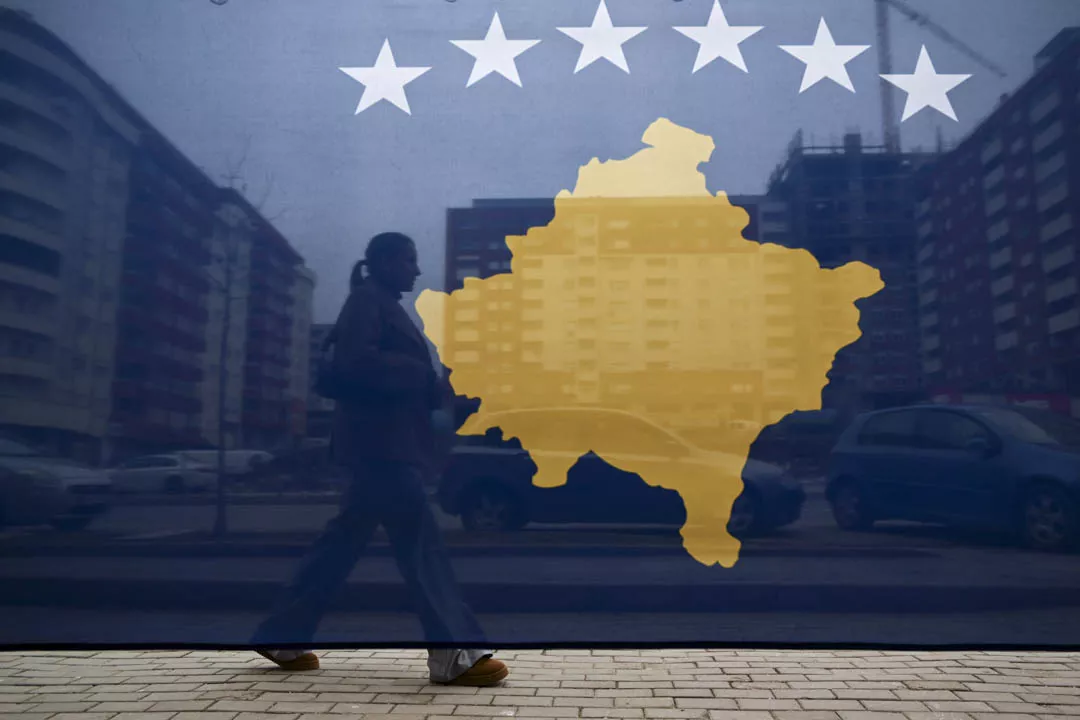
Armend NIMANI / AFP
Kurti’s Push for Power
Kurti and his ruling party have long viewed Kosovo’s constitution and institutional framework with suspicion. When Vetëvendosje emerged in 2005, part of its platform called for rejecting talks led by UN mediator Martti Ahtisaari, which laid the basis for Kosovo’s negotiated independence in 2008. In their view, Kosovars should not have to negotiate their country’s status or basic laws. They especially take issue with the constitution’s provisions for special rights for Serb and other minorities, and for Kosovo Serbs’ right to links with Serbia, but they also dislike the broad autonomy enjoyed by municipalities. Kurti has often called for a “third republic”, founded without foreign input and with a clear Albanian national identity – indeed, he has called for unification with Albania. Since entering office in 2021, he has sought to centralise decision-making, empower trusted party members and circumvent institutions he views as flawed and staffed by civil servants loyal to previous leaders. His brash, uncompromising style has challenged a system designed to require cross-party and inter-ethnic consensus.
Tensions have heightened since 9 February elections handed Vetëvendosje the largest share of seats in the country’s unicameral legislature, the Assembly, though not an outright majority, leading to political deadlock. Kosovo’s laws require the Assembly to elect its speaker and deputy speakers before a new government can be sworn in. It took six months, more than 50 attempts and two interventions by the Constitutional Court to finally get an Assembly speaker in place. Kurti’s party nominated the same candidate repeatedly until the Court ruled that no person could stand more than three times. A different Vetëvendosje candidate eventually won the vote on 26 August, only to see the Assembly stuck in a new logjam around the election of a deputy speaker from the Serb community. At last, on 10 October, the Assembly chose a Serb deputy speaker, the sole Serb delegate who is close to Kurti, though against the wishes of the other nine Serb delegates. The appointment is controversial and may be appealed. Kurti, who is still in office as acting prime minister, was formally nominated for a third term on 11 October.
Meanwhile, the Constitutional Court’s ability to pull Kosovo out of this impasse may be fading. Kurti has accused it of being an agent of opposition parties and of the Serbian List, the main ethnic Serb party. The court’s one Serb judge, whose non-renewable term runs through August 2027, is under intense public pressure. In Serbia, courts have sentenced him in absentia to six years in prison on bribery charges. In Kosovo, President Vjosa Osmani, among others, has accused him of being a threat to national security. But if he (or any other judge) resigns, the court, which is already down to seven of its nine statutory members, would no longer have a quorum and would be unable to issue rulings. Appointing new judges requires a two-thirds majority in the Assembly (and a concurrent two-thirds majority of the twenty Assembly members representing minorities, for the two minority judges).
In the national government, officials feel sidelined and insecure.
In the national government, officials feel sidelined and insecure. Though civil servants, they complain of ministers seeing them as holdovers from previous governments, tarred by association with politicians who were in office when they were first hired. More than 40 per cent of respondents working in Kosovar public administration told researchers from the Organisation for Security and Co-operation in Europe that they feared dismissal on political grounds – along with North Macedonia, Kosovo had the highest proportion of employees giving this answer in the western Balkans. Policy decisions are often delivered already drafted by party activists, with instructions to staff simply to put them into effect.
Journalists at state broadcaster Radio Television Kosovo complain of having to work under intense political pressure from the ruling party. The government has summarily dismissed journalists, and it failed to pay salaries in August. The broadcaster’s Serbian-language service, which is constitutionally mandated, has long fought for its autonomy but still lacks its own website, video channel or social media feed.
At the local level, meanwhile, Vetëvendosje controls only six of Kosovo’s 38 municipalities, including just one city (Gjilan) of any size. Mistrustful of institutions outside its control, the party has been withholding funds from municipal governments and obstructing international donors that are seeking to help them directly. The government also blocked renewal of a major project supporting municipal government underwritten by the EU, Switzerland, Sweden and Norway, which had been in operation since 2014.
A Nationalist Surge
Paralysis in the state could hurt Kurti in the next election, which would normally be in 2029 but may come as soon as the spring of 2026 if the parliamentary deadlock continues. Yet he may hope that popular discontent will be overcome by his increasingly visible show of force against Kosovo’s beleaguered Serb minority, especially in the four northernmost municipalities. These policies began during his first term in 2021 and have continued through his second, securing for Pristina full control of Kosovo’s restive, Serb-majority northern region and driving out most of the remaining Serbian institutions. While cracking down on the Serbs is of little or no benefit to Kosovars, it appeals to nationalist-minded voters.
The government is now treating many overt expressions of Serb national identity as forms of criminal hate speech. Past governments tended to tolerate the ambivalence of many Serbs toward Kosovo’s government – accepting the state in Pristina out of pragmatism but rejecting its independence – as the price of integration. But Kurti believes that exhibitions of Serb nationalism bespeak the persistence of irredentist claims to Kosovo’s territory and are meant to arouse ethnic hatred. While the display of national symbols is a protected right under Kosovo’s constitution, police have repeatedly arrested Serbs – including children – for wearing t-shirts with Serbian nationalist slogans or waving the Serbian flag; Serbia treats displays of the Albanian flag similarly. Criticism of Albanian nationalist statements and symbols is also being treated as a criminal offence. Prosecutors charged a visiting Serbian official with inciting ethnic hatred for a speech in which he referred to the Kosovo Liberation Army (UÇK) as “terrorists”, as the official Serbian narrative views them. (The UÇK led a rebellion against Serbian authorities from 1997 to 1999.)
Pristina views Serbia’s lingering institutional footprint as having no valid legal basis.
These steps come after the Kurti administration’s efforts to exert control of the northern municipalities triggered a series of barricades, a Serb boycott of government institutions in 2022, and violence involving NATO peacekeepers and Kosovo police in 2023. A Serbian-trained paramilitary group was caught smuggling heavy weapons in the village of Banjska in September 2023, and one policeman and three Serbs were killed in the clash. Pristina responded with a major crackdown on Serbian institutions in northern Kosovo and a controversial set of land expropriations for construction of special police bases in 2023 and 2024. Kosovo banned use of the Serbian dinar and confiscated shipments of the currency, which Serbs rely on for pensions and social benefits paid by Belgrade. It shuttered many civilian offices maintained by Serbia, putting local staff out of work and forcing residents to travel to Serbia to get services. Pristina views Serbia’s lingering institutional footprint as having no valid legal basis and believes the steps it has taken are necessary to affirm its sovereignty. Yet these sudden, unilateral measures – taken against EU and U.S. advice – have raised tensions and stoked ethnic polarisation.
Kurti says he bears no grudge against Kosovo Serbs per se, and he repeatedly addresses them in fluent Serbian. Rather, he takes exception to what he presumes is their loyalty to Serbia and ambition to act collectively to secure the special rights granted them in the Ahtisaari plan and in past iterations of the EU-mediated dialogue. Though committed to protecting individual Serbs’ civil rights – namely, the same rights enjoyed by all citizens to human dignity, equality before the law, life, personal integrity, and others protected by the constitution – he is hostile both to the party most of them choose to vote for and to their demands for collective ethnic rights. Under his leadership, the government increasingly wants Serbs to shed their ambivalence and demonstrate loyalty to Kosovo as an independent, Albanian-majority republic.
There are also worrying signs that the government is considering moving against the Serbian Orthodox Church, whose most important churches and monasteries lie in Kosovo and whose status is explicitly protected by the constitution. Government officials have met with a self-proclaimed Orthodox bishop claiming to run the “Orthodox church of Kosovo”, who has led unauthorised services in Serbian Orthodox churches, raising suspicions that some in government see him as the leader of an alternative, patriotic Orthodox church. Government officials have been instructed to avoid referring to the “Serbian Orthodox Church”.
Deadlocked Dialogue
EU-mediated dialogue between Belgrade and Pristina, which has been faltering since it began in 2010, has become even more challenging under Kurti. For the EU, the objective has been to improve the bilateral relationship gradually, delivering gains for people on both sides of the border, and to bring Kosovo Serbs under the umbrella of Pristina’s government while preserving their links to Belgrade and allowing them substantial autonomy. Along the way, Brussels has hoped, both states would prepare themselves for accession to the EU. The dialogue’s last agreements in 2023 were meant to lead to full normalisation of relations, with a legally binding agreement settling all open questions, in effect representing a type of de facto recognition of Kosovo by Serbia. Yet the Brussels and Ohrid deals of 2023 remain largely unfulfilled, while many of the dialogue’s early achievements have disintegrated as the Belgrade-Pristina relationship has soured. With a 2020 U.S.-mediated agreement focused on economic cooperation also moribund, hopes for a breakthrough to normalisation in bilateral ties are receding.
A core problem is that Kurti has long espoused full reciprocity: Kosovo will treat Serbia and the Serbs on its territory just like Serbia treats Kosovo and the Albanians living in Serbia. It is an appealing proposition that seemingly could serve as a good basis for agreement. Yet it ignores important differences between the two. Kosovo’s Serb minority was about 10 per cent of its population at the time of its declaration of independence in 2008, though it accounts for a smaller share today. Serbia’s Albanians are about 1 per cent of the population and a clear majority in only one municipality. It is neither unreasonable nor unfair to expect Kosovo Serbs to play a greater constitutional role than Serbia’s Albanians do. Kurti’s emphasis on reciprocity also ignores the realities of power politics. Kosovo wants something only Serbia can give it: full membership in the international community.
Kurti may believe he can … integrate the Kosovo Serbs into his vision of a centralised Kosovo and wait for the EU to press Serbia into accepting a fait accompli.
Indeed, Kosovo has strong incentives to treat its Serb residents well, above all due to the effects its policy toward the minority has on its prospects of becoming an EU member and its international standing (it is currently recognised by about half the UN’s member states). Pristina will need to offer Belgrade something to balance the big concession it wants from the Serbian government – namely, normal relations and recognition. Granting some form of autonomy to Kosovar Serbs, plus respect for their rights as enshrined in the constitution, would seem to be an obvious concession to offer. Still, Kurti may believe he can make a different deal: integrate the Kosovo Serbs into his vision of a centralised Kosovo and wait for the EU to press Serbia into accepting a fait accompli. He may reasonably suspect that Serbian President Aleksandar Vučić has no intention of normalising relations with Kosovo, much less of recognising it.
Not surprisingly, progress is now stalled, even if Belgrade and Pristina continue to talk to each other. The keystone of the EU dialogue has been a novel institution for Serb self-government, known as the Association of Serb-majority Municipalities. Pristina’s unilateral moves to bring the minority Serb population to heel have derailed progress toward establishing the Association and prompted the EU to impose “measures” on Kosovo in 2023, citing the country’s failure to take steps to de-escalate tensions in the north. The measures have primarily restricted Kosovo’s access to EU funding in certain areas and put bilateral visits, except those related to the EU-facilitated dialogue with Serbia, on hold. In May, the EU began a gradual, conditional process of lifting these restrictions, after tensions in the north eased. Pressure had also been mounting from MEPs who argued that keeping the sanctions risked undermining the EU’s credibility and slowing Kosovo’s momentum on the European path. EU leaders have continued to emphasise that further easing will depend on sustained de-escalation in the north. But it remains unclear exactly when and how the measures are being lifted and what steps Kosovo has taken to meet the conditions. Meanwhile, Kosovo’s EU accession process is also stuck, largely due to the lack of progress in normalising relations with Serbia and persistent internal EU divisions over recognition of Kosovo.
Where Next for the EU?
The EU’s priority should be keeping the possibility of a Kosovo-Serbia agreement alive, while using what leverage it can to press the Kurti administration to cease its attempts to hollow out Kosovo’s institutions. The former means keeping the Belgrade-Pristina dialogue going and doing what it can to support the beleaguered Kosovo Serbs, who are crucial to any future accord. Its tools are the dialogue itself, financial support and the accession process. The funding the EU provides through the Instrument for Pre-Accession Assistance, is already conditional on good governance and rule of law reforms, as well as on progress in Kosovo’s dialogue with Serbia. So, too, is the prospect of lifting the punitive measures imposed in 2023 as well as access to the newly approved Reform and Growth Facility, aimed at supporting reforms, boosting growth and fostering socio-economic convergence with the EU. For all his actions in power, Kurti remains intent on achieving EU membership, which is one of his top foreign policy priorities, along with his effort to cast Kosovo as the region’s most pro-Western, pro-democratic and pro-EU state. He often stresses to EU officials that, unlike Serbia, Kosovo fully aligns with EU foreign policy.
When it comes to dialogue between the two, border management and freedom of movement are good places to look for modest and achievable wins, since they are of interest to both parties. One of the dialogue’s earliest breakthroughs was a 2011 agreement on “integrated border/boundary management”, which remains only partly implemented. The six crossing points between Kosovo and Serbia are plagued by long delays. They need new infrastructure, additional lanes and better data sharing, as well as backing for smoother border crossings by both governments. Serbia still prevents foreign nationals from entering via these crossing points, on the basis that they entered its territory (that is, Kosovo, which it continues to claim) illegally. A normally functioning border would benefit citizens on both sides.
Serbia and Kosovo also agreed to recognise each other’s educational diplomas and professional qualifications in 2011, but Belgrade has never followed through, hampered by a 2014 Constitutional Court decision against the agreement. Kosovo does recognise most diplomas issued by the Serbian university in North Mitrovica. Attempts to resolve the issue by the EU in 2016 and the U.S. in 2020 were unsuccessful. As with the border, fully implementing this deal would give tangible benefits to many people, removing a major obstacle to employment.
To remain viable, meanwhile, the Kosovo Serb community needs schools, hospitals and jobs – issues that the dialogue could also address. Crisis Group’s previous recommendations on education and health care remain valid and urgent. Kosovo Serbs send their children to schools and go to hospitals that are fully integrated into the Serbian educational and medical systems. The Kosovo constitution gives Serb-majority municipalities the right to run their own post-secondary education and health care, while all municipalities in Kosovo are responsible for their own primary and secondary education. But these small, impoverished places lack the resources to do so; the only practical solution is to allow Belgrade to continue offering these services. Pristina has been slowly ratcheting up the pressure, confiscating imported medications and school materials and staking claims to the buildings these facilities occupy. Closing these would likely produce an exodus. Pristina might be more flexible if Serbia offered reciprocal concessions to its own Albanian minority.
Brussels should use its leverage to press the Kurti administration to stop eroding Kosovo’s system of checks and balances in its quest to centralise power.
Besides encouraging agreement around practical steps that would benefit both sides, Brussels should use its leverage to press the Kurti administration to stop eroding Kosovo’s system of checks and balances in its quest to centralise power. It should push the government to support municipal autonomy, respect the rule of law, and honour the independence of the judiciary and various state agencies, including the state broadcaster. So far, none of the €882 million allocated to Kosovo under the Reform and Growth Facility have been disbursed. The EU should refrain from doing so until Pristina demonstrates stronger commitment to the rule of law. In the future, portions of these Facility disbursements could be linked to tangible efforts to improve minority protection, municipal governance (especially but not only in Serb-majority areas) and compliance with prior commitments in the dialogue.
EU member states can make their leverage more credible if they continue to take steps to bridge their own divisions over Kosovo’s status. Current non-recognisers should signal that, with full normalisation between Serbia and Kosovo, they would not stand in the way of recognition of Kosovo, while the EU as a whole should consistently reiterate that the future of the entire western Balkans, including Kosovo, lies in the Union. Such messaging is crucial, as Kosovo’s EU aspirations hinge on consensus among all member states.
Kosovo’s status as a partly recognised state – denied membership in the UN and unrecognised by five EU member states – may persist for years, if not decades. The challenge for its leadership and its friends will be to make the best of that unfortunate situation. But it is hard to see a positive future for the young country without support from the EU – support that is unlikely to come unless Kosovo’s government works to rebuild trust with Serbia, to repair relations with the country’s own Serb minority and to abide by the principles of good governance that the EU strives to uphold.