Taiwan Strait: Managing Europe’s Risk in a Global Hotspot
eschelhaas
Thu, 10/16/2025 – 16:47
Taiwan Strait: Managing Europe’s Risk in a Global Hotspot
Tensions across the Taiwan Strait have increased in recent months. China is applying greater pressure on Taiwan, while the government in Taipei is emphasising the island’s de facto sovereignty and taking measures to counter Beijing’s infiltration and influence operations. As the renewed friction puts the decades-old cross-strait status quo under additional stress, the U.S. government is sending mixed signals toward both China and Taiwan, injecting new uncertainty into the Indo-Pacific security order.
These rising tensions have both security and economic implications for the European Union and its member states, given the escalatory potential of a cross-strait conflict and the devastating impact such a clash would likely have on global trade. Brussels and other European capitals have consistently spoken of the importance of all sides upholding the status quo, while moving to protect their interests from perceived threats posed by Chinese behaviour. These include, among others, China’s efforts to flood Europe with highly subsidised commodities, and its close partnership with Russia, which the EU sees as playing a significant role in sustaining Moscow’s war in Ukraine.
In order to manage these risks, the EU and its member states should:
-
Work to align its contingency planning for a Taiwan crisis with that of regional governments, while exploring opportunities to deepen cooperation with them in areas such as intelligence sharing or supply chain resilience;
-
Consider creating new diplomatic positions in the Indo-Pacific with a remit to track cross-strait dynamics and Chinese activity in the region;
-
Help bolster Taiwan’s resilience in the face of China’s hybrid tactics in the Taiwan Strait by adapting lessons learned from Russian operations on Europe’s eastern flank – and, conversely, learning from Taipei’s experience with China to bolster European capabilities;
-
Consistently reiterate the importance of maintaining the status quo in the Taiwan Strait in multilateral settings such as the UN and the G20;
-
For those countries capable of deploying naval assets to the Indo-Pacific, consider conducting freedom of navigation operations through the Taiwan Strait more regularly – including in coordination with the EU’s current and future security and defence partners, such as the UK.
Yu Chen CHENG / AFP
Growing Cross-strait Tensions
The delicate status quo across the Taiwan Strait has been fraying since Tsai Ing-wen of the pro-sovereignty Democratic Progressive Party (DPP) became Taiwan’s president in 2016. Tsai’s tenure coincided with that of the first Trump administration, during which Washington stepped up its engagement with Taipei, in the form of higher-level interactions and arms sales. These developments alarmed Beijing, which disapproves of the DPP’s stance on Taiwan’s status and cross-strait relations, and is always on the lookout for signs that the U.S. is hollowing out the “one China” policy – ie, the position that there is only one China and the government in Beijing is its sole representative.
During Tsai’s term in office, China cut off official contact with the autonomously governed island, which it considers part of its territory, and ramped up military, economic and diplomatic pressure on Taipei. In 2019, Beijing began to dispatch military aircraft across the median line of the Taiwan Strait, an unofficial demarcation between the two sides. From 2020 onward, Chinese warplanes flew around the island nearly every day and Chinese naval vessels operated in nearby waters just as frequently. The heightened tensions persisted in former U.S. President Joe Biden’s tenure, during which former House Speaker Nancy Pelosi (from Biden’s Democratic party) made a historic visit to Taiwan in August 2022 and Tsai met with Pelosi’s successor, Kevin McCarthy (from Trump’s Republican party), in California in April 2023. On both occasions, China’s People’s Liberation Army (PLA) responded by conducting multi-day, blockade-style drills around Taiwan.
The 2024 election of Taiwanese President Lai Ching-te has seen tensions rise further. Since coming to power, Lai has regularly used more forceful language to characterise Taiwan’s de facto sovereignty and highlight the growing threats Beijing poses. In his inauguration speech on 20 May 2024, he described China’s pressure campaign against the Republic of China (ROC), as Taiwan officially calls itself, as “the greatest strategic challenge to global peace and stability”. He has since given several addresses referring to China as a “foreign hostile force” trying to “annex Taiwan”, and sought to refute the notion that the People’s Republic of China (PRC), which is China’s official name, is Taiwan’s motherland on the grounds that the ROC has a longer political history. Lai has also been more assertive in stating that the ROC and PRC are “not subordinate to each other”. While Beijing views this framing as antagonising, it resonates with the majority of Taiwan’s people, over 80 per cent of whom reject Beijing’s claim that “Taiwan is a part of China”.
The Taiwanese president has also taken action against alleged Chinese influence operations on the island. In March, he introduced a series of seventeen measures to counter Chinese infiltration and espionage, ranging from reinstating military courts to more heavily scrutinising residents who come from China, Hong Kong or Macau. These developments came after at least 64 Taiwanese individuals were charged with “suspicion of spying for China” in 2024, and at least two former government employees were investigated for allegedly conducting espionage for Beijing.
While Lai has toughened his stance toward China, he has also repeatedly said he is willing to cooperate with Beijing based on “reciprocal dignity”. But his remarks have met with strong scepticism in the Chinese government, which has continued to increase pressure on Taipei. Since Lai came into office, China has staged three large-scale military exercises around Taiwan, each following a major political speech by the Taiwanese president. The Chinese coast guard has also been conducting regular law enforcement patrols in waters near Taiwan’s outlying Kinmen Islands, flouting the longstanding tacit understanding between the sides that there is a prohibited waters line around Kinmen serving as an unofficial demarcation, as well as demonstrating its ability to control these waters if it wishes. Beijing is still conducting near-daily military incursions into the waters and airspace around Taiwan. The Chinese government has also announced new civilian air routes that both challenge Taipei’s ability to manage its airspace and increase risks for Taiwanese military aircraft flying nearby.
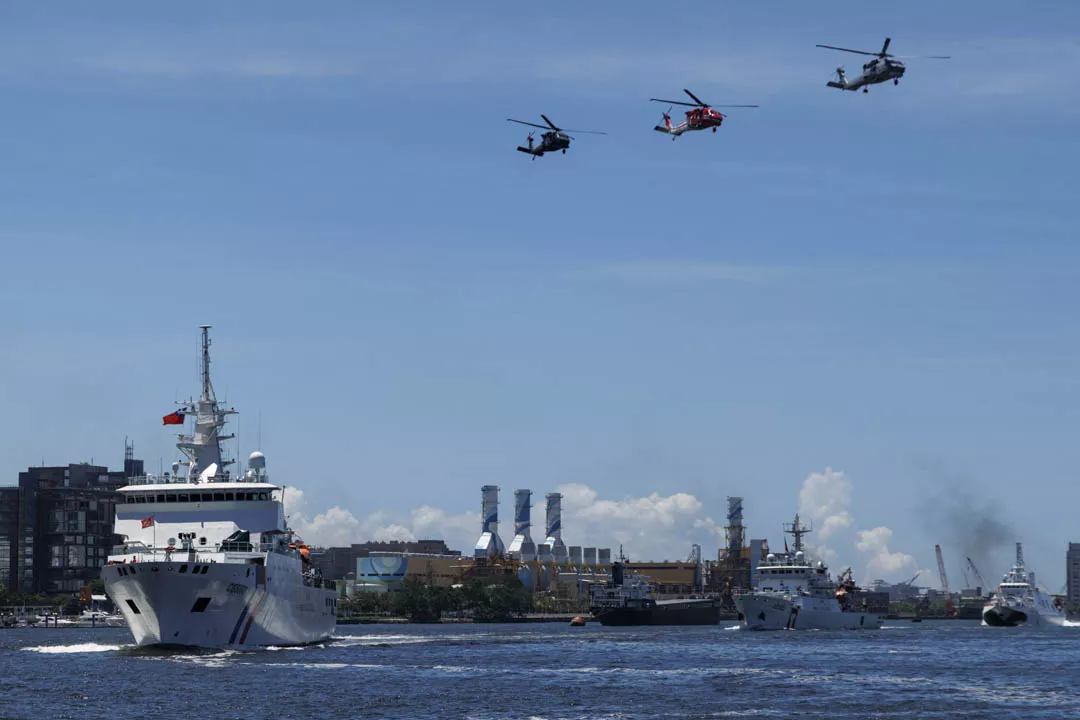
In the immediate term Beijing’s increasing military activity around [Taiwan] heightens the risk of inadvertent collisions with craft from Taiwan or other countries.
Since the year began, China has further increased the frequency of joint combat readiness patrols, aimed at assessing the PLA’s integrated combat capabilities, in the airspace and seas near Taiwan. Some of these patrols have coincided with the PLA navy’s deployment of two its three aircraft carriers, the Liaoning and Shandong, in key waterways south and north of Taiwan. Analysts have told Crisis Group that these drills could be part of PLA simulations of tactics intended to keep the U.S. from sending naval assets to Taiwan in a conflict scenario. Whatever the case, in the immediate term Beijing’s increasing military activity around the island heightens the risk of inadvertent collisions with craft from Taiwan or other countries. Absent effective communication channels between Beijing and each of Taipei and Washington, such accidents could easily escalate.
Meanwhile, the mixed messages emanating from the Trump administration on its Taiwan policy have made these dynamics even more fraught. Some U.S. government decisions seem to suggest that Washington’s priority is to reach a trade deal with China in advance of an autumn summit between Trump and Chinese President Xi Jinping, raising concerns among some Taiwanese that the U.S. could try to strike a grand bargain with China at the island’s expense. In July, for example, Washington reversed a ban on the sale of U.S. tech giant Nvidia’s H20 chips, key for artificial intelligence development, to China. Washington also cancelled a meeting between Taiwan’s Defence Minister Wellington Koo and senior Pentagon official Elbridge Colby in June, and reportedly denied permission for Lai to pass through New York during a diplomatic trip to Latin America originally set for early August, after Beijing objected.
In an attempt to reassure Taipei of its support, the U.S. hosted discreet talks with Taiwanese defence officials in Alaska at the end of August. The Republican chair of the U.S. Senate Armed Services Committee, Senator Roger Wicker, also made a two-day trip to Taipei around the same time, floating the idea of joint U.S.-Taiwan weapons production. But despite these signals, scepticism about the Trump administration’s intentions remains high among Taiwanese, with one recent poll indicating that 78.5 per cent of the population does not trust Trump.
Why the Taiwan Strait Matters to the EU
The EU and its member states conduct relations with Taiwan and China against the backdrop of cross-strait tensions and within the framework of a status quo that has warded off armed escalation for years. Under that status quo, Taipei and Washington maintain ambiguity about whether they consider Taiwan sovereign and whether the U.S. would defend it in the event of an attack from the mainland. Beijing, for its part, refrains from attacking both out of fear for escalation and because it believes it still has a prospect of achieving its unification goals through peaceful means. But it is anyone’s guess whether these unwritten rules will be sufficient to keep the peace amid a rapidly changing geopolitical landscape.
That uncertainty worries Europeans. The prospect of a cross-strait war that draws in the United States and pits the world’s two leading military and economic powers against each other is of course a global concern. Putting aside the escalatory dangers, and focusing on the economic dimension, the potential for disruption is immense. Over one fifth of global maritime trade, amounting to around $2.45 trillion in goods, passes through the strait annually. Europe also depends heavily on importing advanced semiconductors from Taiwan, including chips critical for European industries like automotive, electronics and defence. The EU’s bilateral trade with China is another consideration. That trade reached €732 billion in 2024, making China the EU’s third largest partner for exports and the biggest partner for imports. Seeing this risk, the EU and member states walk something of a line, both working to shore up the status quo but also taking measures to protect their interests from China, which they see as a revisionist power.
For example, the EU has long upheld the “one China” policy, through which it acknowledges that there is only one China and the PRC is its sole legal representative. But this policy is differently understood by different member states. Lithuania, for example, allowed a representative office to open in its capital Vilnius under the name “Taiwan”, prompting a furious reaction from Beijing. By contrast, Cyprus tends to block references to Taiwan in EU meetings due to domestic sensitivities and its concern that support for Taiwanese sovereignty could undermine its own case against recognition of the “Turkish Republic of Northern Cyprus”. Member states’ trade ties with China also influence their stance on Taiwan. According to a European diplomat, disagreements over how to approach Taiwan have hindered collective EU efforts to develop contingency plans for various scenarios, including a cross-strait invasion.
Still, overall EU relations with Beijing have grown tenser since 2019, as Brussels has become increasingly uneasy about China’s growing domination of supply chains and critical industries, its trade practices, which are widely seen as unfair, and its increasingly bellicose posture in the South China Sea, the Taiwan Strait and along its border with India. In 2020, the two sides were inching toward a comprehensive investment agreement, but the effort fizzled when the EU imposed human rights sanctions, kicking off a series of tit-for-tat measures that brought the negotiations to a halt. The U.S. has also pushed the EU to distance itself from China in exchange for tariff cuts since Trump returned to the White House in January.
Tensions further escalated after Russia’s large-scale invasion of Ukraine in 2022, partly as a result of Beijing’s close partnership with Moscow. Central and Eastern European countries in particular tended to draw parallels between Russia’s invasion of Ukraine and China’s more assertive stance in the Taiwan Strait. Since 2023, the EU has adopted a series of measures to reduce its economic dependence on China and raised tariffs on highly subsidised Chinese products pouring into the European market. Nevertheless, it has been hit hard by Chinese export restrictions on critical raw materials in the past year. The EU also faces persistent demands from the U.S. to impose sanctions on Chinese companies supporting Russia’s war in Ukraine.
Bilateral trade in goods [between Taipei and the EU] reached €77.6 billion in 2023, and direct investment from the EU to Taiwan accounted for $58.1 billion that year.
Meanwhile, the EU has been trying to deepen ties with Taipei, which it views as an important partner. Bilateral trade in goods reached €77.6 billion in 2023, and direct investment from the EU to Taiwan accounted for $58.1 billion that year. These figures make the EU Taiwan’s fourth-largest trading partner and its largest source of foreign direct investment. Technology is another area where Brussels and Taipei are increasingly forging closer partnerships. In August 2024, the EU and the Taiwan Semiconductor Manufacturing Company announced that the latter had begun building a factory in Germany, which will mainly produce chips for Europe’s industrial and automotive sectors. Several EU member states, such as France, are also helping Taiwan bolster its defences by supporting upgrades to its military hardware.
Brussels has also become increasingly supportive of Taiwan’s inclusion in international bodies, such as the World Health Organisation, and the European Parliament has passed several key resolutions to denounce China’s measures aimed at coercing Taiwan. But both the EU and its member states remain cautious about displays of support for Taipei that Beijing might view as in tension with the “one China” policy. Despite these reservations, a few Central and Eastern European countries, such as the Czech Republic and Poland, have sought to deepen relations with Taiwan through increased business and educational exchanges. This trend is driven largely by these EU member states’ mounting concern about China’s support for Russia’s war in Ukraine. It also reflects their sense that engagement with Taiwan, including mutual efforts to counter hybrid threats, will be beneficial.
Managing Risk
At a time when the U.S. is sending mixed signals regarding its approach to the Indo-Pacific, cooperation with regional countries can help the EU and its member states better prepare for sudden changes, including a Taiwan contingency. In particular, as tensions rise across the Taiwan Strait, the EU and its member states should enhance diplomatic engagement in the Indo-Pacific, coordinating their policies with those of regional countries and exploring areas where they can deepen cooperation, on issues such as sharing intelligence about Chinese military operations in the region and enhancing supply chain resilience. The EU is already taking steps to draw closer to countries like Japan, Australia, South Korea, the Philippines and India. During the EU-Japan Summit in July, for example, Brussels and Tokyo reiterated their commitment to strengthen collaboration in areas such as cybersecurity, space security, maritime security and defence production.
To better understand and manage risks relating to growing instability in the Indo-Pacific, the EU and its member states should also consider expanding their diplomatic presence in the region. One innovation could be to create new positions in Taipei or regional capitals such as Tokyo or Manila that monitor cross-strait developments. The U.S., the UK, Japan, Australia and Canada have all established new diplomatic roles in Taiwan or nearby countries. Mirroring such diplomatic expansions would also make it easier to strengthen coordination with regional governments, including as part of the EU’s security and defence partnerships. Brussels and EU member states should also seize every opportunity to promote the importance of maintaining peace and stability across the Taiwan Strait in multilateral venues, such as the UN and G20, making the case that opposing unilateral change of the status quo through military means is a collective interest for the vast majority of governments around the world.
In parallel, the EU and its member states can reinforce deterrence by deepening cooperation with Taiwan about how to combat foreign information interference and manipulation, foil acts of sabotage and fend off cyberattacks, among other related matters. These exchanges should be based on lessons that both sides have learned from countering Russian and Chinese operations.
Lastly, the EU and its member states should consider stepping up other initiatives that can provide reassurance and contribute to deterring China from harassing Taiwan, such as conducting more regular freedom of navigation operations or strengthening coast guard-related cooperation. While most European countries cannot project naval power in the Indo-Pacific, those that can should consider joining other like-minded governments, such as the U.S., Canada, the UK, Australia and Japan, in conducting regular freedom of navigation operations through the Taiwan Strait. France, Germany and the Netherlands, in particular, are well placed to do so. All three have already sent warships through the Taiwan Strait in recent years, though mostly on their own. More frequent transits, in partnership with others, could help send a message to Beijing that European countries are committed to upholding the status quo.
Other EU countries that do not have adequate naval capabilities could consider following in Canada’s footsteps in strengthening coast guard cooperation with Taipei. While it might not be possible for most to engage in joint coast guard exercises, deepening relevant technological exchanges would be another meaningful way to enhance Taiwan’s overall capacity to deal with Chinese military activity around the island.