

Supporting Effective Policing by Lebanon’s Embattled Security Agencies
nalberti
Wed, 08/27/2025 – 10:48
Supporting Effective Policing by Lebanon’s Embattled Security Agencies
What’s new? Since October 2019, Lebanon’s economic crisis has gutted funding for the country’s security forces, including the army and national police. Overstretched, these agencies have resorted to makeshift solutions for keeping the peace, including initiatives that allow communities to help police themselves.
Why does it matter? With the country’s security institutions struggling for resources, public safety in Lebanon is maintained by a patchwork of ad hoc solutions and quick fixes that cannot hold forever. As formal institutions continue to weaken, security will fray. Violence could follow, particularly in neglected and impoverished areas.
What should be done? Donors should keep pressing Lebanon’s leaders to better address the economic crisis so that the government can reinvest in the security forces’ long-term viability, especially after the latest destabilising Israel-Hizbollah war. In parallel, targeted interventions by donors can help bolster the security forces’ performance and professional integrity.
Even before the latest disastrous Israel-Hizbollah war, the economic crisis that gripped Lebanon in October 2019 was threatening to cripple its security forces. A financial meltdown had pushed the national currency’s value into steep decline, eviscerating army and police salaries and gutting agency budgets, which now cover only a fraction of operational needs. Yet, contrary to widespread expectations, the combination of an impaired security apparatus and deepening poverty has not led civic order to crumble. Instead, through improvisation by the security forces, help from donors and informal arrangements with non-official actors, the country has maintained a shaky equilibrium. But it may be unsustainable – requiring too much of donors and leaning too heavily on collaboration with local people, which sometimes involves vigilantes and even alleged criminals. Lebanon needs well-functioning security institutions instead. To make this vision viable, the country’s political leaders will need to implement long-delayed governance and economic reforms, so that the state can deliver sustainable budgets for its security agencies.
In October 2019, Lebanon’s economy collapsed amid a spiralling debt crisis and massive street protests. Anger at the country’s corrupt elites soared as the Lebanese lira’s value plummeted and the country’s hard currency reserves dwindled. Observers worried that, at this time of hardship, the tenuous bonds that largely held the country’s diverse constituencies together after its civil war (1975-1990) could fray, amid spiking criminal and intercommunal violence. Should that happen, they feared, the country’s security forces – under huge budgetary strain and struggling to pay employees a living wage – might be unable to quell the unrest. Yet for all the challenges that Lebanon has faced in the ensuing years – from the COVID-19 pandemic to the latest Hizbollah-Israel war – the country has managed to avoid this dark scenario for now.
The reasons for the relative calm are manifold, but two stand out. One is that Lebanon’s security institutions – starting with the Lebanese Armed Forces (LAF) (the army) and the Internal Security Forces (ISF) (the national police) – have found ways to stretch their resources and share burdens. The LAF, which enjoys better funding and a stronger public reputation than the ISF, took on more of the latter’s policing duties. As real wages fell, the state looked to external donors to help top up officers’ salaries, tacitly suspended rules barring personnel from moonlighting in other jobs and engineered postings that were closer to home to reduce commuting costs. Municipal police also picked up some of the load that would normally be borne by the ISF.
The second element that has helped Lebanon muddle through the economic crisis is greater reliance on “hybrid security” schemes. Under these informal arrangements, the security agencies in effect outsource some of their policing tasks to unofficial actors.
Hybrid security structures vary considerably from one place to the next. In Tripoli, Lebanon’s second largest city, security institutions have leaned on longstanding relations with influential locals, including crime bosses, to keep the city from descending into uncontrolled violence or becoming a magnet for jihadists. In Beirut’s Shiite-majority southern suburbs, authorities sometimes collaborate with Hizbollah and Amal (the political parties with greatest local sway) – though the parties often defer to powerful local clans. In areas with major refugee populations, government forces have generally tried to work through internal camp committees and leaders, rather than directly policing refugees. In some places, from a generally affluent Beirut suburb to less well-heeled towns farther north, communities have set up neighbourhood patrols – both armed and unarmed – to fill gaps left by what they perceive as inadequate policing.
[Donor support] could well begin to wane if Lebanese leaders fail to make headway on the reforms needed to tackle the economic crisis in earnest.
This patchwork of improvisations has held up for Lebanon at a difficult moment, more or less, but relying on it indefinitely would not be a sound strategy. For one thing, it relies on the continued support of donors, which could well begin to wane if Lebanese leaders fail to make headway on the reforms needed to tackle the economic crisis in earnest. It also requires too much of the LAF: even before the Hizbollah-Israel war, the army was having difficulty juggling its traditional duties and the extra work it was doing to fill in for the ISF. Now, the November 2024 ceasefire deal between Israel and Lebanon has put still more on the army’s plate, including mandates to deploy extensively in the south and to disarm Hizbollah, while also securing Lebanon’s porous border with Syria.
Nor do the hybrid arrangements on which the state has been depending seem uniformly healthy for Lebanon’s long-term security. In some cases, they empower people with alleged links to organised crime. In others, they are encouraging the formation of proto-militias that could conceivably be called to arms in the event of civil strife. The latter initiatives may also foment a type of “siege mentality” among some Lebanese, hardening divisions between them and other communities.
For these reasons, Lebanon needs to move from its current ad hoc security architecture to a more durable, state-centric model. A key question is whether Beirut can come up with the funding to make that transition. For years, the country’s external backers have urged Beirut to undertake the reforms required to put the country’s shattered economy on a sound footing. In early 2025, Lebanon’s new president and government both pledged to usher in the necessary changes, renewing hopes that Lebanon would finally begin addressing the insidious crisis with rigour. Outside actors should keep pressing in this direction, while also delivering targeted interventions aimed at rebuilding the security agencies’ lost capacity in key areas.
Quite simply, Lebanon’s leaders can no longer defer serious efforts to tackle the economic crisis. In turn, these reforms can become the foundation for funding a stronger, more self-sufficient set of security institutions – ones that can help the country address the challenges it faces without relying on arrangements that may just add to its long-term problems.
Beirut/Brussels, 27 August 2025
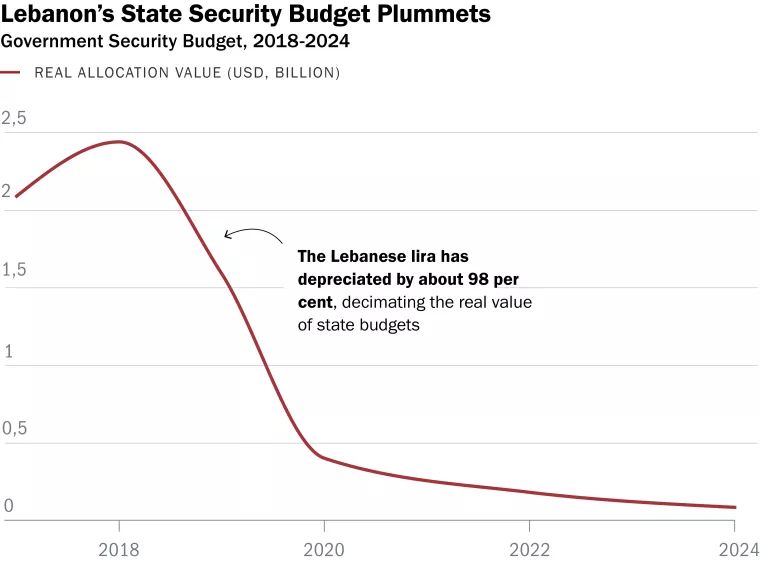
Lebanon’s long-running economic crisis has severely weakened the country’s defence and security forces. Since October 2019 – when waves of protesters flooded into the streets amid spiralling public debt and an imploding banking sector – the Lebanese lira has depreciated by about 98 per cent. The currency’s precipitous decline has decimated the real value of state budgets, including for funding the security apparatus. The COVID-19 pandemic (2020) and the Hizbollah-Israel war beginning in 2023 added more stress. The budgetary collapse has wracked the two largest components of that apparatus – the Lebanese Armed Forces (LAF) and the national police or Internal Security Forces (ISF) – as well as two smaller intelligence agencies, General Security and State Security.
These institutions, along with their employees, are under tremendous strain. Administrators often cannot afford to buy fuel or spare parts for vehicles. Meanwhile, rank-and-file soldiers saw the value of their monthly wages crash from around $900 before the crisis to less than $50 by 2022 – a fate also suffered by police and staff at the intelligence agencies.[1] Since 2022, defence and security personnel have received slightly better remuneration, owing in part to help from external donors, but it still amounts to no more than a few hundred U.S. dollars per month.[2] Even many senior officers struggle to cover basic household expenses.[3] While most personnel have stayed on the job, some have deserted, and a few rogue officers have faced corruption charges for allegedly seeking to augment their income through illicit means.[4] Perhaps not surprisingly, the ISF has struggled for years to recruit new police officers.[5]
[1] “Just how bad is Lebanon’s economic crisis?”, Reuters, 14 September 2022.
[2] The additional remuneration consists of salary increases, some made possible by foreign subsidies, and transport allowances. See “Cabinet approves 4-fold increase to public-sector wages”, National News Agency, 18 April 2023; and “Is there a new adaptation?”, al-Qaous, 9 March 2024 [Arabic].
[3] Crisis Group Middle East Report N°228, Managing Lebanon’s Compounding Crises, 28 October 2021.
[4] In the period from October 2019 to May 2024, more than 1,000 ISF members reportedly deserted. “‘If I come back I’ll be sent to jail’: Why solving ISF desertion problem is complicated”, L’Orient Today, 27 May 2024. On the corruption allegations, see “After the smuggling of a detainee from a General Security prison: 25 officers and wardens under investigation”, al-Akhbar, 3 June 2024 [Arabic]; and “A police officer colluded with police station detainees: This is how it ended”, al-Manar, 16 March 2024 [Arabic].
[5] Between 2019 and 2024, the ISF’s ranks shrank from 30,000 members to fewer than 25,000. “ISF’s recent recruitment campaign”, L’Orient Today, 13 March 2024. In late 2024, the ISF did manage to enlist 800 new recruits. “Conducting a Participatory Gender Audit to Promote Organisational Resilience”, Siren Associates, 7 March 2025. Half of these new ISF personnel are women.
Source: Crisis Group, July 2025. CRISIS GROUP
As these institutions’ budget woes deepened, many Lebanese leaders and foreign observers began to worry about a breakdown of public order.[1] They feared that the economic crisis might cause a spike in crime, committed either by desperate people trying to make ends meet or hardened criminals capitalising on general lawlessness as the police weakened.[2] Separately, they warned that reduced police coverage could allow Lebanon’s persistently simmering sectarian tensions to boil over into violence, as they have in the past. Some highlighted the risk of political groups using rising crime as a pretext for arming their supporters, who could later become embroiled in politically motivated clashes.[3] The country’s political leaders are not alone. Anxiety about disorder continues to grow in some quarters of Lebanese society as the economic meltdown goes on.[4]
Yet for all the concern, statistics suggest that, thus far, the system has managed to stave off total lawlessness. As the economic crisis has progressed, official crime rates have waxed and waned in many categories. Thefts reportedly rose by 266 per cent from before October 2019 to mid-2021, while murders more than doubled in frequency.[5] Then, in mid-2023, the ISF released data suggesting that crime had fallen by an average of 38 per cent since the previous year.[6] Since then, official crime rates have remained at around the same level.[7]
[1] Both the caretaker interior minister and the LAF commander expressed such concerns. “Lebanon’s interior minister says security forces reached ‘rock bottom’: local media”, Reuters, 10 March 2021; “A Meeting of the Army Commander with Command Staff and Major Unit Commanders”, Lebanese Armed Forces, 8 March 2021 [Arabic].
[2] “Conflict Analysis: Lebanon”, Center for Operational Analysis and Research, November 2021; and “Lebanon’s Security Forces Struggle with Compounding Crises”, New Lines Institute, November 2022.
[3] Crisis Group Report, Managing Lebanon’s Compounding Crises, op. cit.; and “Conflict Analysis: Lebanon”, op. cit.
9 “Security in Lebanon: When the streets call for order”, This is Beirut, 12 April 2025.
[5] “Statistics show dramatic rise in thefts, murders since onset of financial crisis”, L’Orient Today, 30 November 2021.
[6] An ISF source traced the decrease in reported crime to more effective policing. “Reported crime in Lebanon ‘drops by 38%’ in first seven months of 2023”, L’Orient Today, 8 August 2023.
The overall picture is not one of a country that has slipped into wanton criminality or widespread sectarian violence … even if that prospect is hovering too close for comfort.
To be sure, these statistics may not tell the whole story. It is unclear to what extent the drop reflects an actual improvement or a growing public sense that reporting crime – especially petty crime – is a wasted effort.[1] Some categories of violent crime, notably gender-based violence, have risen alarmingly.[2] (The latter occurred amid reports that programs to boost capacity in this area flagged because of poorly paid, demotivated staff.[3]) Still, the overall picture is not one of a country that has slipped into wanton criminality or widespread sectarian violence due to overlapping economic and conflict-related pressures – even if that prospect is hovering too close for comfort.
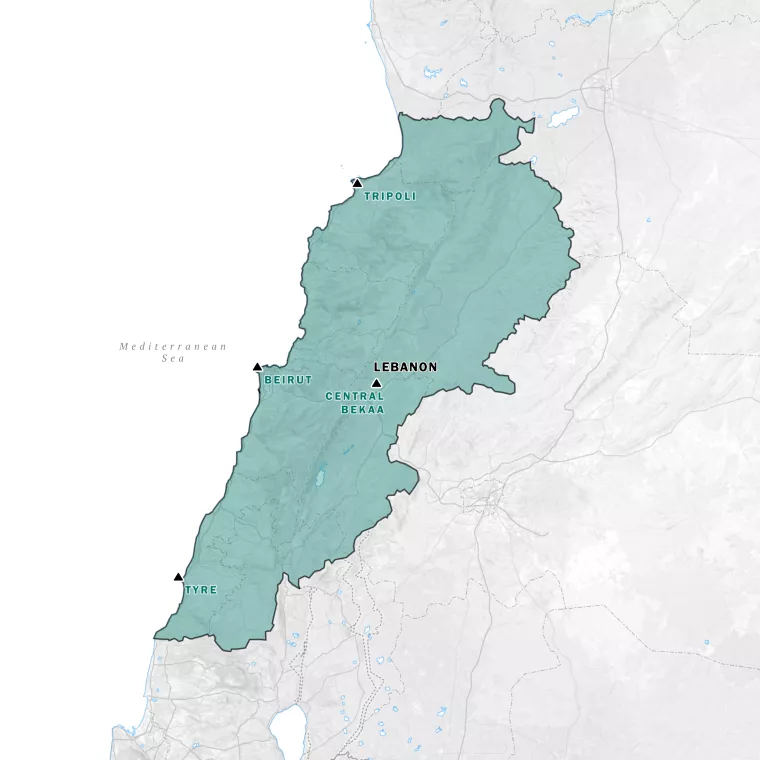
This report explores the formal and informal arrangements that Lebanese authorities have relied on to maintain relative law and order in a time of economic duress and war. It identifies those arrangements that are seemingly either unsustainable or vulnerable to abuse; it also offers recommendations for internal and external actors who seek to move to a more stable dispensation under the rule of law. The report draws on five location studies conducted between February 2023 and July 2025 in Beirut’s southern suburbs, known as Dahiyeh; Achrafieh, an eastern district of the capital; the northern city of Tripoli; the southern city of Sour (Tyre); and the central Bekaa region. These studies are intended to offer insight into how communities of varying demographic composition have grappled with security problems and how the economic crisis has affected those approaches.
The report benefits from some 160 interviews with residents, LAF and ISF representatives, Lebanese politicians, officials working on the security sector, foreign diplomats and political analysts.[4] Women were represented in all categories of interlocutors, except for the LAF and ISF officers, as both of those agencies made only men available for interview.
[1] Sally Abou al-Joud, “Is Lebanon witnessing a surge in crime?”, L’Orient Today, 29 April 2024; and Carmen Geha, “Citizens’ Perceptions of Security Institutions in Lebanon”, International Alert, February 2015. A Beirut restaurateur said he had reported only one of the five thefts on his premises during the crisis, because he “knew [the police] cannot do anything about it”. Crisis Group interview, Badaro (Beirut), 5 March 2024.
[2] “Burned, suffocated, beaten: Why women in Lebanon are dying at the hands of their partners”, The Guardian, 27 February 2023. Like many other countries, Lebanon experienced significantly more assaults on women during the COVID-19 pandemic; ISF figures indicated a 241 per cent increase during the pandemic’s various lockdowns, compared with the preceding eighteen-month period. Yet rates of these crimes have remained high, and even climbed, since the pandemic came to an end – a trend that women’s rights organisations trace to the economic crisis, as more households come under financial strain. “Gender Alert on Missing Women and Girls in Lebanon’s Humanitarian Crisis”, UN Women, March 2023. Meanwhile, survivors of gender-based violence have an even harder time getting justice than they did before the economic crisis began, as state institutions deteriorate. “Responding to Domestic Violence in Lebanon: Who Does What?”, Siren Associates, October 2023. Even before October 2019, the International Commission of Jurists found that Lebanon’s “ineffective procedures for the investigation, prosecution and adjudication of gender-based violence fail to adequately protect women’s rights”. “Lebanon: Ensure Accountability for Gender-Based Violence”, International Commission of Jurists, 12 July 2019. Observers identified mistrust of the police as one reason, among others, why many women may decide not to report incidents of gender-based violence to the authorities. Kate Rougvie, “Exploring Gender Norms in the Lebanese Internal Security Forces”, Al-Raida, vol. 42, no. 1 (2018).
[3] In one crucial example, a UN agency partnered with local women’s rights NGOs for well over a decade to train the ISF in investigating cases of gender-based violence. A UN representative said these projects were doing well – until the economic crisis hit in October 2019. From that point onward, in her view, staff morale eroded as institutional priorities changed. “The ISF … was getting much better at handling gender-based violence cases”, the official said. “But … with the crisis, we have lost most of the gains that we had achieved before”. According to the official, the government explained that, with officers facing personal hardships, its priority needed to be spending on employee benefits like life-saving medication. Crisis Group telephone interview, 25 June 2024.
[4] Dahiyeh is the generic Arabic term for “suburb”, but in Lebanese parlance it refers nearly exclusively to Beirut’s Shiite-majority southern suburbs, where Hizbollah and its main Shiite ally, the Amal Movement, dominate. While Achrafieh, strictly speaking, refers to a district next to Sassine Square, the term commonly denotes the entire eastern part of Beirut, predominantly inhabited by Christians, between Damascus Street and the Beirut River.
Since October 2019, Lebanon’s security agencies have made various institutional changes in response to the economic crisis. As salaries have dropped throughout the public sector, they have identified ways for their personnel to earn subsistence wages. These efforts have allowed them, especially the LAF, to keep desertion rates under control and uphold morale, at least compared with other parts of the public sector.[1] In parallel, the LAF and municipal police have assumed greater policing duties than before to support the beleaguered ISF. Yet, important as these adaptations have been, they are only stopgap measures and not long-term solutions for the country’s various security challenges.
[1] Crisis Group Report, Managing Lebanon’s Compounding Crises, op. cit.
Aware that salaries and benefits have withered during the economic crisis, Lebanon’s security apparatus has adapted to protect staff livelihoods. Perhaps most significantly, the main security agencies have tacitly permitted members to take other jobs, such as repairing cars or driving taxis, relaxing the official prohibition on moonlighting.[1] This unwritten concession acknowledges the pressing need for soldiers and police officers to supplement their official salaries to support themselves and their dependents. The LAF has allowed soldiers, on rotation, to serve part-time during certain weeks. Participating soldiers are thus able to save money on transport, while also finding secondary employment.[2]
In parallel, the army and security forces have striven to maintain staff benefits whenever possible. The LAF has provided soldiers and their families with emergency food parcels, as well as continued access to army commissaries, where they can purchase essential goods at below-market prices.[3] The army command has also made concerted efforts to maintain the military health care system, a key reason for many soldiers to stay enlisted.[4] Throughout the crisis, soldiers and their families have been able to go to military hospitals and clinics for free at a time when many Lebanese households are facing prohibitively expensive medical bills.[5] One LAF member, who moonlights as a taxi driver, said he has continued reporting for duty only so his family can keep participating in the army medical scheme.[6] The ISF does not have an equivalent health care system.[7]
Donors have additionally supported staff benefits with emergency aid. Even before October 2019, Lebanon’s security apparatus ranked among the Middle East’s most reliant on external funding, which was then aimed at improving performance and institutional capacity.[8] When the crisis hit, many donors shifted to providing emergency support, fearing that a security-sector collapse would be disastrous for Lebanon. Qatar and the U.S. have subsidised the salaries of LAF members, with the latter doing the same for ISF employees, for fixed periods.[9] Washington took these steps despite opposition among members of Congress who were concerned that the LAF was doing too little to rein in Hizbollah.[10] Qatar and a host of other countries have also made in-kind donations to meet the LAF’s urgent operational needs, including for fuel, food and medical equipment.[11]
[1] “Cash-strapped Lebanese soldiers moonlight as mechanics, waiters”, France 24, 12 May 2023.
[2] “Lebanese army ‘risks disintegrating’ without cash aid, diplomats worry”, The National, 22 September 2021; and Joseph Sarkis, “Leading a Resilient Lebanese Armed Forces through Crises and for the Long Run”, Middle East Institute, 9 November 2021.
[3] Sarkis, “Leading a Resilient Lebanese Armed Forces”, op. cit. The LAF has even supported agricultural projects on military land so that it can produce affordable food for army personnel. “Breaking barriers: Former enemies and members of the army unite for an inspiring agricultural project”, press release, MARCH, 27 March 2023.
[4] The LAF Orientation Directorate emphasised the military’s success in maintaining “vital” health care for members and their families during the economic crisis. Crisis Group correspondence, 11 July 2024.
[5] Members of the security apparatus’s four main components receive various other benefits, including subsidies for medication and school fees. Before the crisis, the annual cost of these benefits – when added to pensions and end-of-year indemnities – amounted to 32.9 per cent of the government’s spending on social welfare. “Social Protection Spending in Lebanon: A Deep Dive into State Financing of Social Protection”, Institut des Finances Basil Fuleihan, 2021; and Sarkis, “Leading a Resilient Lebanese Armed Forces”, op. cit.
[6] Crisis Group interview, Beirut, December 2023.
[7] “Lebanon: Security forces face crisis as declining personnel retire and desert”, al-Sharq al-Awsat, 2 October 2023 [Arabic]. A Lebanese security expert drew a straight line between the availability of medical services and professional motivation. “The ISF doesn’t even have medical coverage now. So [as a police officer], you are being asked to take a bullet for your job, and then you can’t go to the hospital for treatment?” Crisis Group interview, Beirut, 13 December 2022.
[8] Western-backed interventions typically focused on providing equipment and training, as well as initiatives aimed at improving respect for human rights. Osama Gharizi, “International Aid to Lebanon’s Security and Justice Sectors”, The Samir Kassir Foundation, January 2023.
[9] See “Washington extends for a month aid to support Lebanese army salaries”, al-Sharq al-Awsat, 16 January 2024 [Arabic]; “Qatar to support Lebanese soldiers’ salaries with $60 million pledge”, Reuters, 30 June 2022; and “US and UN to hand out financial aid to Lebanon’s security forces as hardship mounts”, The National, 17 April 2023.
[10] Cate Brown and Thanassis Cambanis, “Why the United States should pay the Lebanese army’s salaries – before it’s too late”, The Century Foundation, 27 July 2022; “Republicans oppose US financing of Lebanese Armed Forces”, Intelligence Online, 22 June 2023; and Michael Young, “A military lifeline”, Diwan, 16 June 2021. In March, a Republican congressman, Greg Steube of Florida, reintroduced a bill proposing to make Washington’s LAF funding contingent on the Lebanese authorities “rescinding their recognition” of Hizbollah and Amal. “Steube reintroduces PAGER Act to protect U.S. funding from Hezbollah”, press release, Office of Congressman Greg Steube, 5 March 2025.
[11] See, for example, “Qatar Fund for Development supplies the Lebanese army with fuel”, Qatar Fund for Development, 17 September 2024; and “Lebanese army receives a donation from French and Cypriot authorities”, L’Orient Today, 25 January 2025.
LAF/Army Intelligence Directorate. Since the end of the Lebanese civil war (1975-1990), the LAF has supported civilian agencies to ensure domestic stability, on top of its regular military obligations. In 1991, a cabinet decree authorised the LAF to help maintain order inside Lebanon’s borders, including by assisting the ISF in executing its duties.[1] Under this mandate, the LAF has sometimes carried out tasks more commonly associated with a national police force, such as conducting criminal investigations, quelling riots and providing crowd control at demonstrations.
Observers argue that the army’s heightened involvement in policing has proven necessary in Lebanon – at least to date. Until 2005, when Syria ended its post-civil war occupation of Lebanon, the ISF played a small role in police work, which had largely been handled by Syrian intelligence operatives and soldiers.[2] The ISF, as well as the two smaller Lebanese intelligence agencies, also enjoy far lower public confidence than the LAF, in part due to perceptions that they favour one political faction or another.[3] The LAF’s broad appeal places it in a unique position to help control political violence, as most Lebanese believe that it has no bias in such matters.[4] The LAF keeps multiple regiments in Beirut, where they stand ready to assist the ISF in dealing with disturbances.[5] When sectarian fighting erupts, the army intervenes to defuse the immediate danger and then lets political leaders reach a settlement behind the scenes, typically without using force against the belligerents or even imprisoning them.[6]
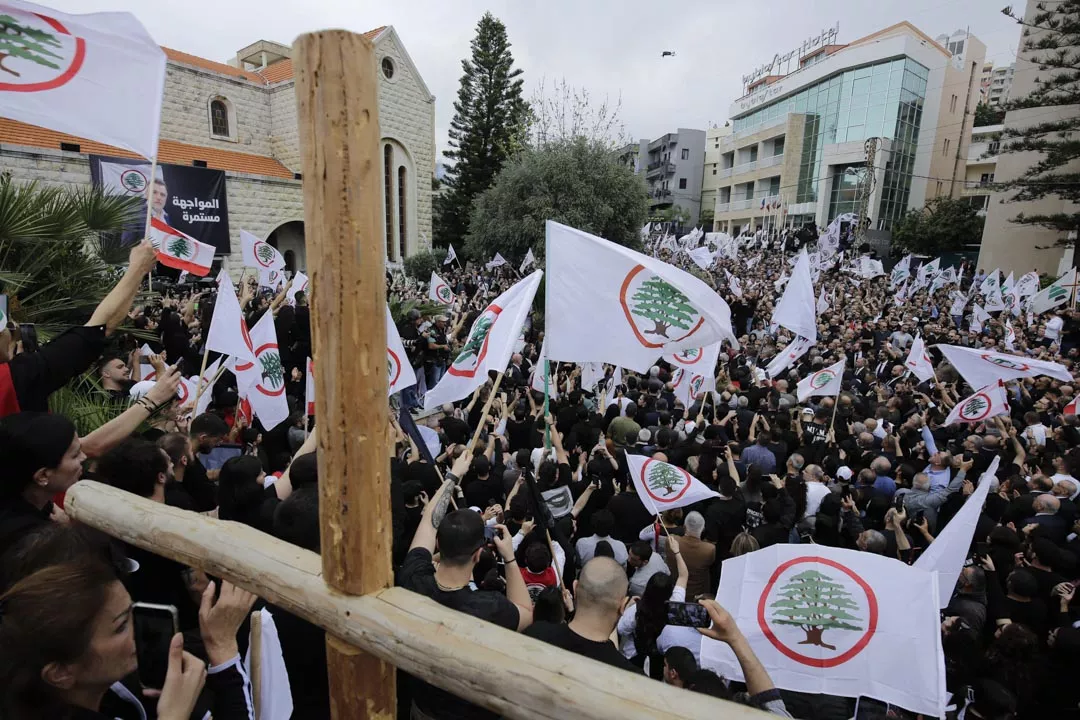
During the economic crisis, the LAF has continued playing this crucial role in preventing sectarian clashes from spiralling out of control. In August 2023, for instance, the LAF intervened when a truck loaded with weapons for Hizbollah’s arsenal crashed in the Christian village of Kahaleh, leading to a shootout between residents and the Hizbollah guards.[7] Soldiers were able to disperse the combatants and seize the weapons shipment. In another case, in April 2024, the Army Intelligence Directorate investigated the murder of Pascal Sleiman, an official of the Lebanese Forces (a major Christian political party), swiftly arresting suspects and calming tensions. Sleiman’s killing had threatened to inflame sectarian ill-will, with the Lebanese Forces suggesting that he had fallen victim to a “political assassination”, a thinly veiled accusation against Hizbollah, its arch-rival.[8]
[1] “Reply to joint communication from the Special Rapporteur on the rights to peaceful freedom of assembly and of association”, Permanent Mission of the Lebanese Republic to the United Nations, 26 October 2020.
[2] Crisis Group interviews, foreign officials working on security-sector interventions, Beirut, 12 December 2022.
[3] The ISF has previously faced accusations that it favours factions opposed to Hizbollah. Are John Knudsen and Tine Gade, “The Lebanese Armed Forces: A United Army for a Divided Country?”, in Are John Knudsen and Tine Gade, eds., Civil-Military Relations in Lebanon (London, 2017). Hizbollah’s detractors claim that the party exerts undue influence over General Security. Lina Khatib, “How Hezbollah Holds Sway over the Lebanese State”, Chatham House, 30 June 2021. See also Geha, “Citizens’ Perceptions of Security Institutions in Lebanon”, op. cit. A senior security source speculated that the public has lower confidence in the ISF because it polices everyday matters, such as traffic violations, while the military remains at a distance except during times of major unrest. Crisis Group interview, Beirut, 4 July 2024.
[4] Hijab Shah and Melissa Dalton, “Playing Politics: International Security Sector Assistance and the Lebanese Military’s Changing Role”, Carnegie Middle East Center, September 2020; and Nicholas Blanford, “The United States-Lebanese Armed Forces Partnership: Challenges, Risks and Rewards”, Scowcroft Center for Strategy and Security, May 2018.
[5] A Lebanese security sector consultant who has worked extensively alongside the LAF argued that reassigning these troops (who number 2,500-3,000 at full strength) would greatly assist the army with tasks elsewhere in Lebanon. Crisis Group interview, Beirut, 5 July 2024.
[6] The LAF has faced criticism from some quarters for helping restore calm amid clashes rather than arresting the perpetrators. Hanin Ghaddar, “Can the Lebanese Army Prevent a Hizbollah-Christian Conflict?”, Washington Institute for Near East Policy, 11 August 2023. Since the ceasefire, the LAF has assertively dispersed a number of demonstrations. “Airport clashes show rupture between Hezbollah and Lebanon’s army”, The Arab Weekly, 16 February 2025.
[7] Ibid.; and “Lebanese army statement: Ammunition load from overturned truck in Kahaleh transported to military facility”, LBC Group, 10 August 2023.
[8] “Nasrallah lashes out at Lebanese Forces and Kataeb over Sleiman’s kidnap accusations”, Naharnet, 9 April 2024. More recently, in January, the LAF deployed to quell tensions between Hizbollah and Amal supporters and residents in Christian-majority areas of Beirut. “Criticism after Hezbollah, Amal motorised parade in some Christian neighbourhoods”, L’Orient Today, 27 January 2025.
Ibrahim CHALHOUB / AFP
But the LAF has also taken on additional policing tasks during the economic crisis, as the ISF has struggled to meet its responsibilities. For many years, the LAF has received more funding from both the Lebanese government and foreign donors than the ISF.[1] The latter, facing a heavier workload than before with fewer resources, has frequently claimed it lacks the wherewithal to follow through on every criminal investigation. Ghassan Hasbani, a parliamentarian affiliated with the Lebanese Forces party, asserted that LAF-ISF collaboration has shifted more and more responsibility onto the army’s shoulders:
[1] A foreign official who works on security sector interventions in Lebanon outlined several reasons for the LAF’s appeal to donors: its good local reputation, the clear link between its mandate and maintaining regional stability and its strength compared with other institutions. “The ISF is generally seen as a much more difficult assignment”, he said. “I honestly think that many donors would not even know where to start”. Crisis Group interview, Beirut, 8 May 2024.
What [used to] happen was that the Army Intelligence Directorate would provide information to the ISF, which would then make the arrest and carry out the investigation. But these days the ISF does not have the capacity to act on that intelligence, so the Army Intelligence Directorate just ends up doing it all by itself. In these cases, somebody needs to take action.[1]
[1] Crisis Group interview, Achrafieh (Beirut), 3 April 2024.
In this improvised manner, the Army Intelligence Directorate began investigating crimes such as murders without a political motive, burglaries, street fights and drug dealing.[1] A foreign official with knowledge of the subject said soldiers have sometimes taken on the most routine policing assignments, such as directing traffic.[2]
Municipal police. Lebanon’s municipal police have also shouldered a heavier load in trying to assist the ISF with its work. Lebanese law empowers municipal police (or, in Beirut, municipal guards) to handle low-level duties such as directing traffic and reporting suspected crimes to the ISF, which then is meant to proceed with an investigation.[3] But during the economic crisis, several local governments have empowered municipal police to assume broader duties.[4] In Beirut, they have conducted patrols and traffic stops looking for legal infractions.[5] Municipal police have sometimes assumed key roles in hybrid security initiatives (see Section III below).
Some political leaders are encouraging the trend toward more empowered municipal police. Hasbani, the Lebanese Forces MP, praised the efforts of Beirut’s municipal guards (the city’s equivalent of the municipal police) in tackling low-level threats outside their normal purview, especially in late 2023 and early 2024, when such initiatives reached their zenith. “Their presence alone gives the impression of greater security”, he said.[6] In 2021, the mayor of Ghobeiry, a municipality in Beirut’s southern suburbs, appealed to the government to boost municipal police salaries, arguing that they had served “at the front line of maintaining security” amid the country’s overlapping crises.[7]
[1] “Faraya crime: Mother and girlfriend of one of two suspects in custody”, L’Orient Today, 4 February 2025; “Resident murdered in Achrafieh upper-crust neighborhood”, L’Orient Today, 5 April 2024; “Press statement: He used to rob houses in Beirut”, Internal Security Forces, 27 September 2022 [Arabic]; “With daggers and machetes, fights in Sour’s Jall al-Bahr between Syrians”, Enooma, 22 June 2024 [Arabic]; and “Army: Arrest of four people in Badaro”, National News Agency, 19 August 2024.
[2] Crisis Group interviews, foreign officials working on security-sector interventions, Beirut, 12 December 2022. In another example, the LAF deployed soldiers to petrol stations across Lebanon in mid-2021, when queues of angry motorists formed amid fuel shortages in the summer heat. “Lebanese troops deploy at gas stations after bank chief halts fuel subsidies”, France 24, 14 August 2021.
[3] Article 74, Municipal Act 1977; and “Women municipal police in Lebanon”, UN Development Programme, June 2020. Municipal police enjoy largely the same powers as an ordinary person making a citizen’s arrest – they may detain suspects until ISF officers arrive, but no longer than that. Crisis Group telephone interview, Lebanese legal expert, 25 July 2024.
[4] Efforts to broaden the reach of the municipal police have benefited from donor support, some predating the crisis. Over the past decade, several security-sector interventions have sought to improve collaboration between the ISF and municipal police, often via community policing projects. For example, a UN Development Programme initiative under way since 2017 aims to help municipal police maintain internal security by sponsoring unified training in all the country’s 1,059 municipalities, as well as the development of a code of conduct and gender-balanced recruitment policies. The EU, Canada and the UK have all funded similar capacity-building interventions. Gharizi, “International Aid to Lebanon’s Security and Justice Sectors”, op. cit.
[5] Sometimes, the traffic stops had a political cast. For instance, Beirut’s municipal guards reportedly followed caretaker Interior Minister Bassam Mawlawi’s directive to arrest any Syrian motorbike rider without valid residency papers. “Lebanon’s crackdown on Syrians’ unregistered motorcycles turns deadly”, Syria Direct, 6 March 2024; and “Urgent statement: Beirut municipality’s personnel kill a refugee, Lebanese authorities should take immediate action”, Access Center for Human Rights, 27 February 2024.
[6] Crisis Group interview, Achrafieh (Beirut), 3 April 2024.
[7] “Appeal to the interior minister: Do right by the municipal police”, al-Akhbar, 12 March 2021 [Arabic]. Two years later, the mayor of Sidon, a southern coastal city, credited the municipal police with reducing crime rates after they returned to work despite meagre salaries. “Sidon’s municipal police resumed city patrols to put an end to chaos at market stalls and carts”, al-Nashra, 19 August 2023 [Arabic].
From an institutional perspective, the workarounds and stopgap measures described here – from donor bailouts to shifting the policing burden – have helped the Lebanon security apparatus muddle through a difficult period. Yet few believe that these steps present a durable solution.
For one thing, emergency bailouts do not position Lebanon to acquire the full set of institutional tools that it needs. In particular, they would not help the ISF reassume policing functions, while continuing to overstretch the LAF at a time when the latter already has major responsibilities – not least, performing its designated tasks to help uphold the fragile November 2024 ceasefire agreement.[1] The truce deal requires that the army deploy to southern Lebanon in force and keep Hizbollah fighters away from the Israeli border. The LAF also needs to lead efforts countrywide under the agreement to remove unauthorised military infrastructure and prevent the production, storage and import of weapons, including over Lebanon’s porous border with Syria. The truce’s success will in large part hinge on the army’s ability to carry out these tasks. In April, Lebanese President Joseph Aoun acknowledged as much, noting: “It’s critical to … strengthen the ISF and increase their numbers, so they can relieve the army of some internal duties”.[2]
[1] “The fight against smuggling between Lebanon and Syria: All smoke and mirrors”, L’Orient Today, 2 June 2020. In June, a senior UN official indicated that foreign donors who want to support the LAF do not understand how deeply its leadership is concerned about unrest in Syria, which they fear could spill over into Lebanon. “The donors are all focused on what they can do to help the LAF in relation to the south and Israel”, the official explained. Crisis Group interview, Beirut, 26 June 2025.
[2] “Exclusive: Lebanon’s President Aoun says dialogue with Hezbollah is only way to secure state monopoly on weapons”, The New Arab, 16 April 2025.
It is not clear how long the [Lebanese] security sector can rely on the generosity of foreign donors for support.
Secondly, it is not clear how long the security sector can rely on the generosity of foreign donors for support. Upon his election in January, Aoun announced that he would address Lebanon’s economic crisis at its roots, after years of inertia among the country’s bickering elites, who have blocked reforms that might hurt their own economic and political interests.[1] Prime Minister Nawaf Salam’s government, formed in February, also pledged to tackle the country’s debt through reform.[2] But if they fail, and if Lebanese political and financial elites continue to resist change, as they have done so many times before, foreign backers are likely to grow tired of propping up Lebanon’s security sector at some point.[3] In that event, remuneration and benefits for security personnel could dip below their already meagre levels.
Thirdly, reliance on municipal police to perform functions they may not be equipped to take on is a concern for some observers, who worry that they may be prone to using excessive force, among other things. In February 2024, a municipal guard in Beirut allegedly kicked two suspects from a moving motorbike, killing one and injuring the other. The interior ministry suspended the municipal guards from traffic stops, saying they would need to undergo training before they could run checkpoints again.[4] Some note that mayors, not the ministry, appoint municipal police officers, adding that they sometimes pay little attention to candidates’ qualifications.[5]
Moreover, municipal police face even greater financial constraints than the four main security agencies. Cash-strapped local councils have struggled to pay officers’ salaries, leading thousands to pursue other careers or simply retire.[6] When the state has managed to secure extra financing for the LAF and other agencies, municipal police have typically not benefited.[7] Parliamentarian Hasbani, a leading advocate for posting more municipal guards in Beirut, acknowledged the financial strain, saying he hoped that residents would support municipal police by offering them in-kind aid, such as food, while they are on duty.[8]
[1] “Weapons, justice, Syria: Joseph Aoun’s inaugural speech”, L’Orient Today, 9 January 2025.
[2] “Salam presents ministerial statement to obtain parliament confidence”, al-Manar, 25 February 2025.
[3] In April, Qatar announced plans to renew its subsidy scheme for Lebanese soldiers’ wages. “Qatar renews $60 million grant for Lebanon army salaries”, Arab News, 16 April 2025. Various other donors pledged wide-ranging support for the security sector following the truce deal in November 2024.
[4] “Municipal guards: Do they bear the burden of maintaining order in Beirut?”, Independent Arabia, 1 March 2024 [Arabic]. Hasbani (and other municipal guard supporters) dispute the interior ministry’s version of events. Crisis Group interview, Achrafieh (Beirut), 3 April 2024.
[5] An expert noted the lack of rules for recruiting and assigning roles to municipal police prior to the start of community policing initiatives. “At best, [municipal police officers] ran the mayor’s errands; at worst, they were potential militias”. Crisis Group interview, Beirut, 13 December 2022.
[6] By 2023, Dbayeh – one of Lebanon’s largest municipalities – reportedly had only two full-time municipal police officers serving over 20,000 residents. Ethel Bonet, “How a poorly paid and multi-employed police force is driving private security initiatives in Lebanon”, Equal Times, 27 March 2023.
[7] “Appeal to the interior minister: Do right by the municipal police”, al-Akhbar, 12 March 2021 [Arabic].
[8] Crisis Group interview, Achrafieh (Beirut), 3 April 2024. Various towns have developed their own schemes to subsidise municipal police salaries, in effect drawing them into Lebanon’s web of hybrid security structures.
As Lebanon’s state security institutions have struggled to keep their footing, local communities have played an increasingly prominent role in maintaining law and order. In some areas, authorities have coordinated these efforts with civilian contacts – ranging from political parties to gang kingpins to refugee leaders – who have stepped up their activities during the crisis. In other locations, typically where the authorities did not have such links in place, residents have launched grassroots initiatives.
The four main security agencies have apparently permitted (or, at least, tolerated) these arrangements, rather than condemning them as unlawful vigilantism. This permissive posture reflects an uncomfortable reality: in many parts of the country, Lebanon’s security agencies cannot handle policing duties by themselves. Yet by allowing these extra-legal activities, the authorities may be planting the seeds of future problems – for example, the formation of new militias, which could become involved in future waves of conflict.[1]
[1] Militias formed all over Lebanon during the civil war, as civilians took up arms to defend themselves. Even today, given the war’s horrors, many Lebanese instinctively fear that such militias could return.
Broad generalisations about hybrid security initiatives are difficult to make. The following section looks at how these arrangements have functioned in certain localities, recognising that the findings are particular to the place in question. Nevertheless, they may offer lessons for other similarly situated parts of the country.
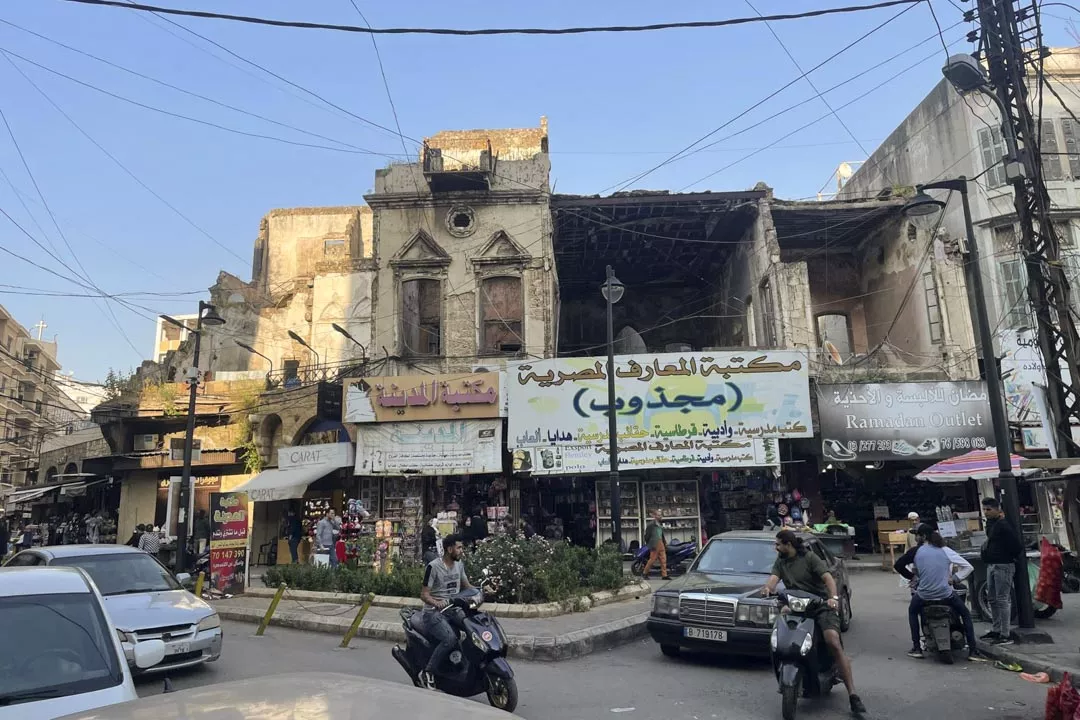
Throughout the economic crisis, the security forces have relied on longstanding coordination with civilians to mitigate violent crime in Tripoli, Lebanon’s second-largest city. There, security agencies – chief among them, the Army Intelligence Directorate – have invested in relationships with influential residents since at least the 1970s. Especially in lower-income areas, key informants include prominent religious figures, as well as local toughs (qabadayat), who wield pervasive influence in their neighbourhoods, typically as gang leaders. The Directorate also solicits information from ordinary people, who are encouraged to report suspicious activity to a contact.[1]
The hybrid networks are useful for policing. In some instances, investigators have been able to find and arrest criminal suspects in lower-income areas – where many residents are tacitly or even openly hostile to the state – with help from qabadayat.[2] The security agencies also look to these informal civilian networks (especially among religious figures) to monitor militant Islamist groups, which have historically viewed Tripoli’s poorer districts as fertile ground for recruitment.[3]
The agencies turn to hybrid networks to help manage gang violence as well. For decades, armed gangs have proliferated in Tripoli, often running protection rackets or the lucrative business in privately owned power generators, which supplement Lebanon’s deficient state electricity grid. A tacit code of conduct bars rivals from encroaching upon each other’s territory, but amid the economic crisis, gangs have been clashing over turf more frequently.[4] When gang violence erupts, the security agencies often intervene to sponsor what is known as a “tribal solution” – a settlement between the parties that avoids official legal channels. The resulting arrangement frequently sees the aggrieved party receive compensation (typically money), while the offender escapes serious punishment from the state. Local politicians and religious institutions often support these arrangements directly.[5]
[1] “In every suburb, people know that there is a guy from the Army Intelligence Directorate, and – if they see something – they should let him know”. Crisis Group interview, political analyst, Tripoli, 16 April 2024.
[2] Historically, the security forces have sown resentment in Tripoli’s poorer neighbourhoods by cracking down on such infractions as building housing without a permit. Raphaël Lefèvre, “The Socio-political Undercurrent of Lebanon’s Salafi Militancy”, Carnegie Endowment for International Peace, 1 March 2018; and “Conflict Analysis: Tripoli”, Center for Operational Analysis and Research, November 2021.
[3] Crisis Group interviews, lawyer and civil society activist, Tripoli, May 2023; resident, Tripoli, April 2023.
[4] See, for example, “One dead, four injured in disputes connected to generator operators in Beirut and Tripoli”, L’Orient Today, 11 February 2023; and “Man shot in Tripoli amid clashes between two families”, L’Orient Today, 18 December 2022.
[5] It is even alleged that, on occasion, prominent political figures have paid blood money to smooth over tensions after gang disputes turned deadly. For example, see, “Under Mikati’s auspices, Saad al-Masry returns”, al-Diyar, 10 October 2013 [Arabic]. Prominent Tripoli politicians, rather than parties, have long generated electoral appeal by brokering interactions between the city’s communities and the central state. Over time, various political elites have invested in their own relationships with the qabadayat, who can efficiently mobilise voters on election day. In return, these politician-sponsors allegedly offer political and legal cover for the qabadayat’s various illegal activities, using their personal contacts to ensure that their chosen qabadayat (and their associates) avoid anything more than light punishment for offences. “Several politicians [in Tripoli] try to use their position by providing the means to access justice as a basis for power”, said a Tripoli-based political analyst. Crisis Group interview, Tripoli, 11 May 2023.
CRISIS GROUP / David Wood
As the security forces began to struggle nationwide from October 2019 onward, observers worried that Tripoli could descend into chaos, potentially either yielding to uncontrolled gang violence or becoming a Sunni Islamist statelet, given its lengthy history of both organised crime and religious militancy.[1] But neither scenario has come to pass, despite deepening poverty in the city.[2] Instead, when clashes involving criminal gangs or personal disputes have occurred, the LAF (and sometimes other agencies, such as the ISF’s Information Division) have typically intervened using techniques like those described above to restore calm with reasonable efficiency. Their extensive intelligence networks, meanwhile, seem to have helped them keep jihadist groups at bay.
But there are downsides to the strategy, including that they tolerate a measure of impunity. While some of the hybrid security work could be considered normal police intelligence gathering, deep coordination with qabadayat in particular risks emboldening thugs in their illicit, and often violent, activities. In February 2023, for example, a gang running neighbourhood generators attempted to expand its business by squeezing out existing operators in Abi Samra, a historically quiet, middle-class neighbourhood, in violation of the informal code of conduct among generator operators. The resulting clash left one person dead.[3] The Army Intelligence Directorate swiftly brokered a settlement, whereby the offending group paid “blood money” to the deceased’s family and, soon thereafter, the killer was released from prison.[4] While this arrangement prevented further bloodshed, it also allowed the encroaching gang to run generators in the disputed area.[5]
[1] “Conflict Analysis: Tripoli”, op. cit.
[2] Some analysts argue, persuasively, that militant recruitment cannot be explained by poverty alone. Every recruit seems to have individual circumstances (including but not exclusively socio-economic status) that lead to embracing militancy. Sam Heller, “The Mysterious Pipeline for ISIS Recruits from Northern Lebanon”, The Century Foundation, 14 November 2022.
[3] Crisis Group interviews, senior security officers, Tripoli, May-November 2023.
[4] The murderer was released from custody just two months later – to the sound of celebratory gunfire on his return to Abi Samra. Crisis Group interviews, local political figure and activist, Abi Samra, May 2023; security forces officer, Abi Samra, April 2023. Dar al-Iftah, a local Sunni religious institution, reportedly supported the mediation. Crisis Group interviews, lawyer, Abi Samra, April 2023; generator employee, Abi Samra, May 2023; and generator owner, Tripoli, May 2023.
[5] Attempts at turf expansion have not always succeeded. In May 2023, gunfire erupted in the affluent suburb of Maarad, allegedly after a gang tried to shake down a business owner. The confrontation left one gang member dead and three more injured. Once again, a mediated settlement followed, and participants on both sides avoided lengthy jail time. Crisis Group interview, former political party official, Dam wel Ferez (Tripoli), June 2023. “Bloody clashes in Tripoli: one dead, three wounded”, Sawt al-Farah, 3 May 2023 [Arabic].
Hybrid security arrangements … risk tarnishing the reputations of the security forces.
Hybrid security arrangements also risk tarnishing the reputations of the security forces. In Tripoli, qabadayat have caused resentment among residents who bear the brunt of their business practices. Locals blame endemic corruption for the city’s exorbitant generator fees, which tend to be higher than elsewhere in northern Lebanon.[1] The security forces’ cooperation with qabadayat in policing has led to rumours that some officers are profiting from these dealings, though there is no evidence of any such wrongdoing.[2] No major media outlet has investigated these claims, perhaps partly due to Lebanon’s far-reaching defamation laws, which would favour the security agencies. But such murmurings could undermine respect for these agencies in the affected neighbourhoods, despite official anti-corruption pledges.[3] For the time being, however, the decades-long coordination with the qabadayat persists, and has even deepened during the economic crisis.
Though Tripoli has not descended into widespread chaos, as some had feared, underlying factors persist that make Tripoli a hotbed of crime – and, potentially, Islamist militancy. Desperately weak before, public services have now almost completely fallen away in the city’s poorest areas, leaving many residents bereft.[4] Indeed, a resident described becoming a qabaday as one of the few avenues left for social advancement, driving a spike in gang recruitment during the crisis.[5] Meanwhile, institutions that used to help counteract Islamist militancy, including the national Sunni body Dar al-Fatwa, face funding shortages.[6] A Tripoli-based analyst worried that his city will eventually pay the price for years of neglect and inequality:
[1] A local activist said, “In Anfeh [a village near Tripoli], electricity from generators costs consumers 60 cents per kilowatt, but in Tripoli it’s $1.60. How can this be? The answer is corruption”. Crisis Group interview, Tripoli, 11 May 2023.
[2] Crisis Group interviews, civil society activist, Tripoli, October 2023; security official, Abi Samra (Tripoli), April 2023.
[3] LAF Commander Aoun (who became Lebanon’s president in January) and several senior intelligence figures have insisted that LAF members suspected of corruption face trial. Officers from other security agencies have been accused of similar corrupt practices in Tripoli. Crisis Group telephone interview, Lebanese journalist, 19 July 2024.
[4] In Tripoli’s poorest areas, children often drop out of school by the age of fourteen. “Vulnerable to extremism”, Lebanon Now, 21 December 2021. “For me, the biggest [security] problem is the new generation, the kids who are barely spending any time in school”, said a Tripoli-based analyst. “These young people have … no vision for their futures. In these circumstances, a radical group could recruit them”. Crisis Group interview, Tripoli, 11 May 2023.
[5] Crisis Group interviews, security officials, October-November 2023; municipal council member, Tripoli, March 2024; and political activist, Tripoli, March 2024.
[6] Indeed, in some cases qabadayat in Tripoli have adopted elements of Islamist militancy. Lefèvre, “The Socio-political Undercurrent of Lebanon’s Salafi Militancy”, op. cit. While its popular appeal has declined for now, Tripoli has witnessed recurrent spikes in militant mobilisation over decades. “Who knows when the next wave will come?”, an academic queried. Crisis Group telephone interview, 23 August 2024.
What do you do with the brainwashing of the past ten to fifteen years? You have young men out there who used to have a beard [ie, militant Islamist affiliations] and now they have a tattoo [ie, criminal gang affiliations]. What do they become: terrorists or thugs?[1]
[1] Crisis Group interview, Tripoli, 16 April 2024.
Like many governments before, Lebanon’s new cabinet has pledged to deliver sustainable security for Tripoli.[1] Yet, as the economic crisis drags on, Lebanon’s second-largest city will continue to rely on a motley crew of thugs to help protect public safety. It will often be at their mercy as well.
[1] “Salam arrives in Tripoli, underscores government’s commitment to preserve security in the city”, National News Agency, 25 March 2025.
CRISIS GROUP / David Wood
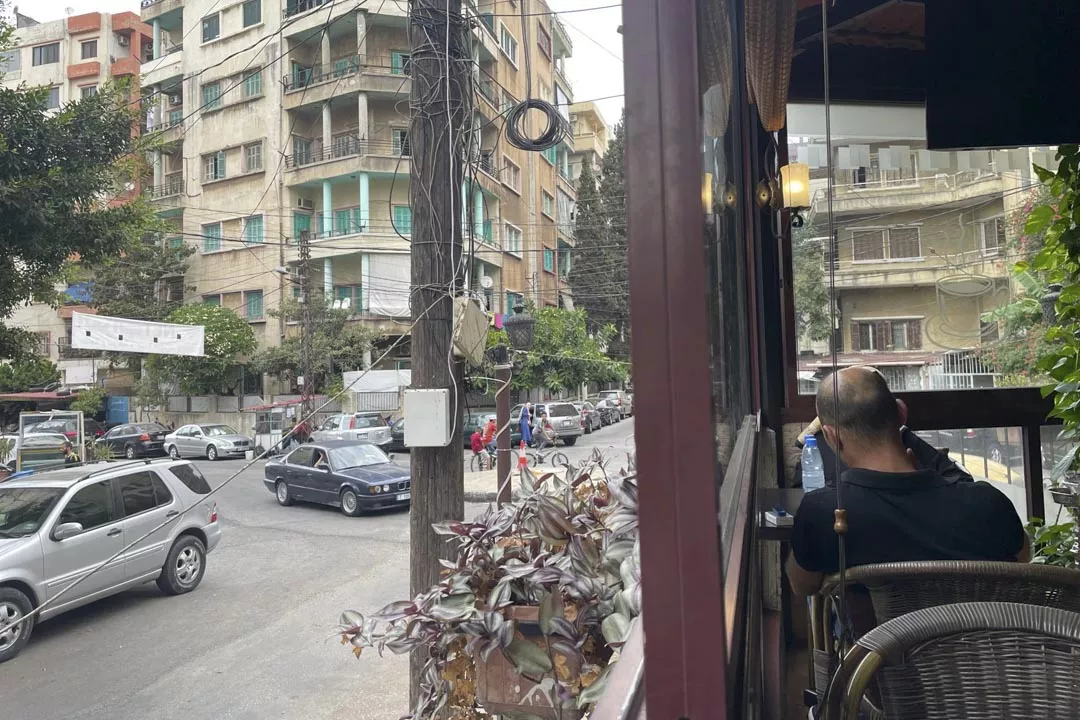
In Beirut’s Shiite-majority southern suburbs, informally called Dahiyeh, and in Sour (Tyre), a major coastal city in southern Lebanon, security agencies coordinate to varying degrees with the dominant political parties, Hizbollah and its main Shiite ally, the Amal Movement. Together known as “the Shiite duo”, the pair commands strong support among the Shiites of Lebanon, many of whom reside in Dahiyeh, the south and parts of the Bekaa Valley. Some foreign observers assume that Hizbollah (which is an armed group as well as a political party) polices all the areas where its supporters live, given that it has long functioned as a “state within a state” offering socio-economic benefits outside government institutions.[1] In fact, Hizbollah and Amal exercise varying influence over security matters, depending on who lives in the place in question. In places where large numbers of the Shiite residents belong to the powerful clans hailing from the Bekaa Valley, both parties will typically adopt a more hands-off approach, leaving policing to the state.
Such is the case in several parts of Beirut’s southern suburbs, where the Shiite duo is keen to avoid trouble with the Bekaa clans.[2] While these families tend to support one party or the other, they also strive to retain considerable autonomy in their own affairs, including in managing local conflict.[3] The clans’ prominence restricts the parties’ capacity – and appetite – to intervene in security matters. Observers suggest that the parties fear antagonising the clans, because they control numerous votes, not just inside the families, but outside as well.[4]
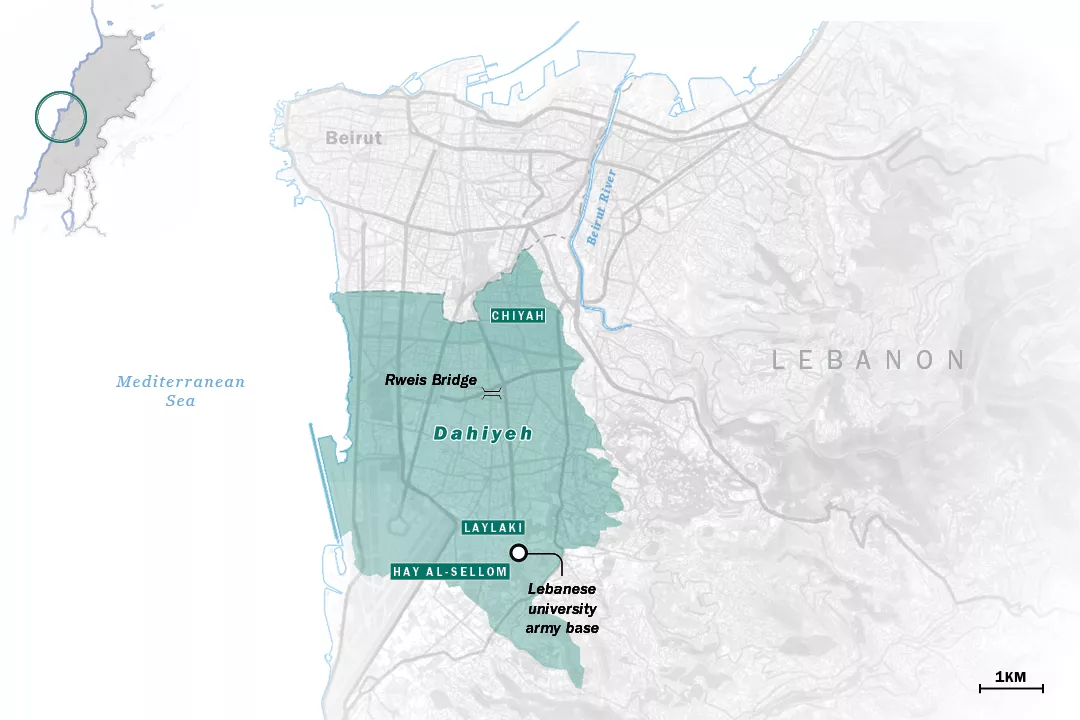
One area where the Bekaa clans rule the roost is Amal-aligned Laylaki, which lies deep within the capital’s southern suburbs.[5] The Zeaiter family – along with their main rivals, the Hjoulas, and other clans – predominate in local affairs and command considerable private arsenals, including heavy-grade weaponry.[6] “The Zeaiter family does not need protection from Amal or Hizbollah”, said a Zeaiter clan member. “They can protect themselves”.[7] Acknowledging this reality, Amal prefers to stay out of efforts to stop Laylaki’s regular street clashes, which often involve clan members.[8]
The security apparatus, headed by the LAF, typically intervenes in violence that erupts in Laylaki only if it reaches what officers deem a critical level or if it implicates a key interest. The LAF has a base inside the nearby Lebanese University campus, which enables it to deploy soldiers rapidly. By way of example, the LAF became involved in one incident that occurred in 2022, when a Zeaiter clan member allegedly murdered a soldier near Laylaki. The LAF immediately pursued the suspect, killing him after, according to the army, he shot at the soldiers giving chase. At the suspect’s funeral, Zeaiter family members angrily fired weapons skyward in a show of defiance. Given the potential for discord, the LAF often declines to quell smaller-scale clashes, where it considers the stakes to be low. “[The clans] fight over chickens sometimes”, said a military source.[9]
[1] Crisis Group interviews, March 2023-June 2025. On the “state within a state”, see, for example, Hanin Ghaddar, “Hezbollah has created parallel financial and welfare systems to manage the current crisis”, Washington Institute for Near East Policy, 9 December 2020.
[2] Crisis Group telephone interview, Lebanese political analyst, 8 May 2024.
[3] “Meeting the clans of Lebanon”, Al Jazeera, 18 August 2012.
[4] Various parties have courted the clans to pry them away from the Shiite duo. “Hezbollah’s rivals in eastern Lebanon race to influence votes of clans”, al-Sharq al-Awsat, 5 March 2022. Some of the larger clans possess extensive heavy weaponry, mostly obtained on the open market, which would pose serious risks to the parties’ members if they were to interfere too much in the clans’ affairs. “Lebanese drugs kingpin uses wife as ‘human shield’ to evade troops”, Arab News, 11 June 2022. A Lebanese analyst said the Shiite duo, by relying on the security agencies to contain major disturbances, avoids direct confrontations with the clans. Crisis Group telephone interview, 8 May 2024.
[5] The Zeaiter family controls the market for basic services in Laylaki, including subscriptions for electricity generators, internet and satellite television, either directly or by conferring permission on other operators. Crisis Group interviews, residents, Laylaki, August 2023.
[6] “Meeting the clans of Lebanon”, op. cit.
[7] Crisis Group interview, Laylaki, September 2023.
[8] “Heavy gunfire between rival families in Beirut’s southern suburbs”, L’Orient Today, 24 May 2023.
[9] Crisis Group telephone interview, August 2023.
Source: Mapbox, July 2025. CRISIS GROUP
Like Amal, Hizbollah also tries not to butt heads with the clans, even in parts of Dahiyeh where its political support is strong. For example, it usually refrains from policing actions in the area near the Rweis bridge, close to Laylaki.[1] In Hay al-Sellom, another Hizbollah-dominated district, residents say the group seems afraid of antagonising clans involved in crime, to the extent that it has sometimes declined to hand over evidence for official investigations.[2] As the latest Israel-Hizbollah war escalated, party members reportedly became more active – perhaps in an effort to appear engaged with the community at a time of duress – and apprehended thieves who were allegedly trying to loot valuables from abandoned buildings. After the war, residents said Hizbollah resumed its largely non-interventionist stance.[3]
By contrast, in parts of Dahiyeh where clans from the Bekaa are not dominant, Amal and Hizbollah typically coordinate with the state in local security matters. For instance, Amal works alongside the official authorities – led by the LAF – in Chiyah, a middle-class suburb to Dahiyeh’s north east. According to local sources, the security forces have historically handled cases of violent crime in the area, but subject to Amal’s approval when they entail large-scale raids or investigations.[4] According to Chiyah residents, Amal members have started actively policing the streets during the economic crisis, in response to pressure on the party to deal with rising crime rates.[5] Party members reportedly apprehend criminal suspects, sometimes beating them and other times handing them over to the authorities.[6]
[1] Clans near the Rweis bridge are reportedly involved in crime. A former resident claimed that, in 2021, the local ISF branch did not help when he reported that armed thieves had stolen his motorbike. When he turned to Hizbollah for assistance, a party member supposedly joked that even Hizbollah cadres had their motorbikes stolen in the area. Crisis Group interview, Beirut, April 2024.
[2] For example, in 2023 residents say Hizbollah refused to hand over security camera footage that might have helped solve a theft. Locals suspected that a clan member had committed the crime. Crisis Group interview, Hay al-Sellom, September 2023.
[3] Crisis Group interviews, Dahiyeh, February 2025. See also “Hizbollah units active in Dahiyeh”, al-Akhbar, 23 October 2024 [Arabic]. In March, a Dahiyeh resident noted that Hizbollah had erected more checkpoints in the area after the war. He speculated that the party mainly wanted to demonstrate to supporters that “it is taking care of the community”. He recalled that Hizbollah had temporarily run checkpoints in Dahiyeh at key previous moments, such as before the 2022 parliamentary elections and during religious festivals. Crisis Group telephone interview, 14 March 2025.
[4] A resident illustrated this dynamic with reference to a LAF raid, carried out long before the economic crisis, that seemingly did not have Amal’s blessing. Amal militiamen allegedly gathered on roofs and balconies overlooking the soldiers carrying out the unsanctioned arrest in a show of intimidation. “It taught the LAF a lesson: Never do that again”, said the resident. Crisis Group interview, Chiyah, September 2023. See also “Lebanese army command: Investigations are underway with the utmost seriousness and speed”, al-Jarida, 29 January 2008 [Arabic].
[5] In April 2022, the authorities announced a “security plan” for Dahiyeh in response to complaints about rising theft and drug trafficking. Despite claims of initial success, they reportedly scaled down the operation within months, saying the prisons had too few cells to hold all the detainees. “By name: Arresting criminal gangs responsible for drugs, theft and murder in Dahiyeh”, Al-Modon, 5 July 2022 [Arabic]; and “Crowds of detainees in Dahiyeh: A new security plan for the ‘gangland’”, Al-Modon, 20 July 2022 [Arabic].
[6] A Chiyah resident reported that Amal members continued to arrest thieves in the area during the most recent Israel-Hizbollah war. Crisis Group interview, Chiyah, February 2025.
In Dahiyeh areas where Hizbollah [runs] security, its brand of policing is intended not just to protect public safety but also to shield itself from scrutiny
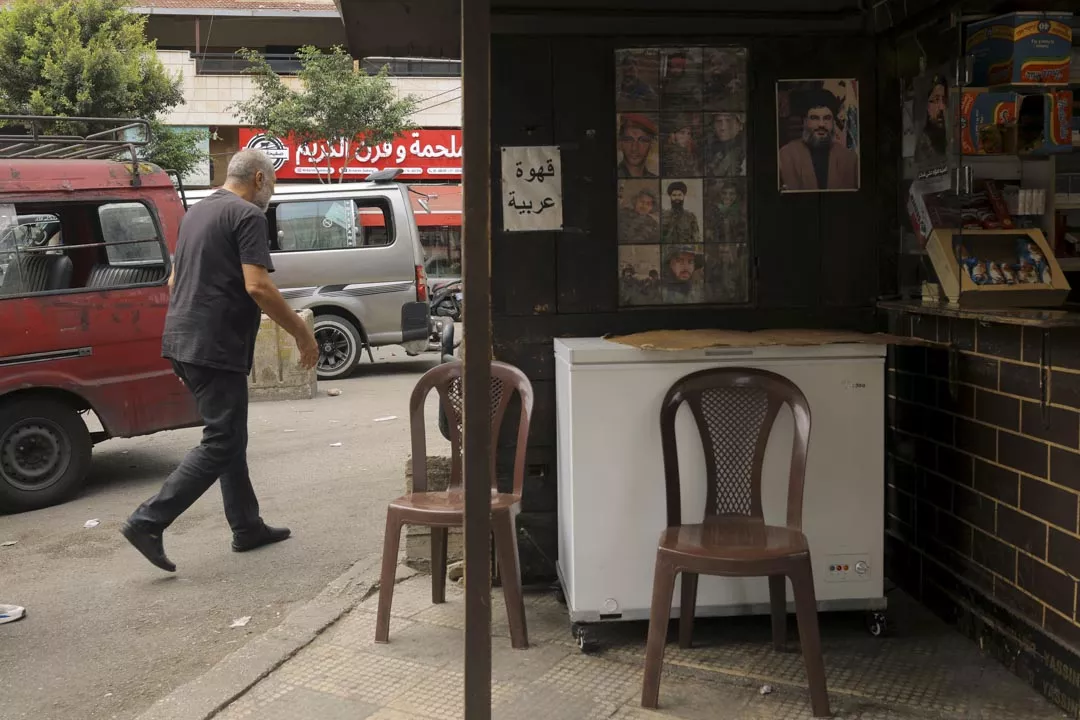
In Dahiyeh areas where Hizbollah does run security, its brand of policing is intended not just to protect public safety but also to shield itself from scrutiny. Cadres will sometimes stop traffic at checkpoints, interrogate people suspected of espionage or otherwise enforce the party’s will.[1] Their intervention can extend to removing anyone they consider suspicious from the area.[2] When it comes to crime, however, Hizbollah acts like Amal does in Chiyah, picking up suspects and turning them over to state officers.
The Shiite duo takes a stronger hand in security in Sour, which has historically been quiet, despite its location near the line of Hizbollah’s recurrent conflicts with Israel. Over time, Sour’s various communities have developed a robust model of coexistence, which revolves around shared interests, particularly in preserving the city’s appeal as a tourist destination. Though Sour is a Shiite-majority town, local authorities have long permitted the open sale of alcohol, for instance, likely because it helps attract visitors to the seaside bars and restaurants.[3] Crime rates in Sour remained low throughout Israel’s bombardment in 2023-2024, as well as after the ceasefire deal.[4] In Shiite-majority neighbourhoods, Hizbollah and Amal take the lead in resolving disputes, often without calling the security forces at all.[5] Yet even there, the duo’s sway has limits: residents of Amal-aligned areas said its cadres often steer clear of qabadayat who have started running small, mafia-style outfits in recent decades.[6]
[1] Property owners who wish to instal surveillance cameras, for instance, often must get the party’s approval. Crisis Group interview, Dahiyeh, September 2023.
[2] On several occasions, its members have stopped foreigners in Dahiyeh, ranging from journalists to a contingent of Dutch UNIFIL soldiers, for interrogation and transfer to the authorities. Importantly, such arrests do not risk antagonising local actors, such as the clans. “NOW journalist detained by Hezbollah released by General Security”, NOW Lebanon, 28 June 2021; “UNIFIL peacekeepers ‘briefly detained’ in Beirut’s southern suburbs”, L’Orient Today, 1 March 2024; and “‘Dutch armed group’ arrested by Hezbollah: Report”, Tasnim News Agency, 3 March 2024.
[3] “At the beach [in Sour], you can find a section for Hizbollah [supporters] and right next to it a section that serves alcohol”, a resident explained. Crisis Group telephone interview, April 2024. Representatives of Sour’s political parties expressed general willingness to work across sectarian lines to prevent local conflict. Crisis Group interviews, Sour, November 2023.
[4] Crisis Group interviews, Sour, February 2025.
[5] Crisis Group telephone interviews, Sour residents, April 2024.
[6] Ibid.
REUTERS / Amr Alfiky
During the economic crisis, the security apparatus has relied on a well-established hybrid regime to maintain order among Sour’s Palestinian refugees. For decades, Palestinians have lived in three official refugee camps in the Sour district – Bourj al-Shemali (established in 1948), al-Bass (1950s) and Rashidieh (1963) – all of which receive services from the UN Relief and Works Agency (UNRWA), which cares for Palestinian refugees. Over time, refugees also established more than ten unofficial settlements or “gatherings” in the area, which are illegal under Lebanese law and do not directly benefit from UNRWA’s offerings.[1]
Security arrangements vary between the camps and gatherings. The camps have both security committees and popular committees; the former handle security, while the latter focus on social welfare, in effect acting as a “mini-municipality”.[2] Generally, it is the camp security committees, which comprise Palestinians belonging to factions like Fatah, that work to resolve conflicts among residents, sometimes with support from the popular committees. The state coordinates with the security committees on major matters, but its personnel avoid entering the camps themselves.[3] In the gatherings, by contrast, the Lebanese authorities take primary responsibility for policing.[4]
[1] Some Palestinian refugees have chosen to establish gatherings on public or private land to avoid overcrowding and other problems in the UNRWA-run camps. In some cases, Palestinians of Bedouin origin wanted to live outside the camps for fear of losing their cattle. Residents of gatherings nonetheless face precarious living circumstances until today. Palestinian refugees cannot own real estate under Lebanese law, and responsibility for delivering basic services to gatherings often falls somewhere between the local municipality and UNRWA. Nora Stel, “Lebanon: Palestinian conditions in southern camps”, Jadaliyya, 29 November 2013. “The southern highway cuts through Shabriha camp, displacing its residents”, Janoubia, 23 January 2017 [Arabic].
[2] Crisis Group interview, popular committee member, Rashidieh camp, January 2024.
[3] In 1969, the LAF commander reached an understanding with Palestinian Liberation Organisation head Yasser Arafat, known as the Cairo Agreement, about the principles that would govern relations between the Lebanese state and Palestinian guerrillas present in the country. Under the deal, the LAF in effect ceded authority over Lebanon’s Palestinian refugee camps. The Lebanese security forces’ general policy of non-intervention has persisted until today, even though the government abrogated the Cairo Agreement in 1987. Taylor Long and Sari Hanafi, “Human (In)security: Palestinian Perceptions of Security in and around the Refugee Camps in Lebanon”, Conflict, Security and Development, vol. 10, no. 5 (2010).
[4] Crisis Group interview, popular committee member, Qasmiyeh (Sour), January 2024.
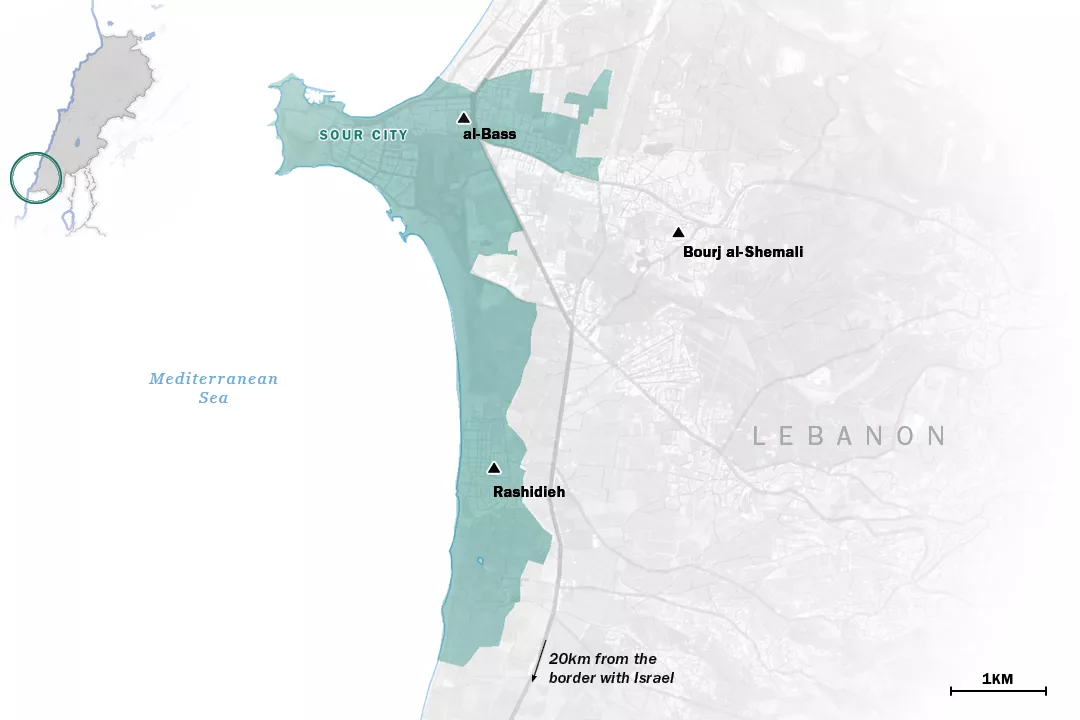
Source: Mapbox, July 2025. CRISIS GROUP
Whenever they can, security and popular committees work together to manage local conflict without involving the authorities. In various camps and gatherings, popular committee members reported that they typically resolve disputes over everyday matters like building violations and personal differences. In the camps, when disagreements become more serious, the security committees step in. They may intervene, for instance, when arguments blow up into armed clashes.[1] The security committees often contribute to informal settlements – even if violence has turned deadly and a camp resident has been imprisoned. A Fatah commander explained that, in cases of murder, the security committees tend to ease tensions by informal means. They often ensure the payment of “blood money” to the murder victim’s family and, in some cases, also provide financial support to the imprisoned party’s dependents.[2]
The Lebanese security agencies have developed ways to coordinate with the security committees on suspected criminal matters involving camp residents, without entering the camps themselves. For each camp, the security forces assign a liaison officer to work with the camp’s security committee.[3] The above-referenced Fatah commander cited the example of a 2016 raid in which security committees arrested sixteen drug dealers in the camps and handed them over to state authorities.[4] Camp leaders stress that they always cooperate fully when disputes involving camp residents are brought before the official security agencies.[5]
Sour’s Palestinian camps and residential areas enjoy greater stability than other Palestinian communities of the same type in Lebanon. Several Lebanese security sources described the area’s camps as quiet and reported that their committees work well with the state’s liaison officer.[6] Most Lebanese residing nearby said relations with camp residents were harmonious, noting that Palestinians have boosted the local economy. Camp leaders have tried to preserve this reputation among Lebanese by moving swiftly to quell potential disputes.[7] “We will not accept any problem existing with anyone outside the camp”, the Fatah commander declared.[8]
[1] Crisis Group interview, al-Bass camp (Sour), January 2024.
[2] Crisis Group interview, Sour, January 2024.
[3] Crisis Group interview, Lebanese security source, Sour, January 2024.
[4] The Fatah commander offered another example, from 2024, when the state reportedly sent a letter thanking camp leaders for helping prevent celebratory gunfire during New Year’s celebrations. Crisis Group interview, Sour, January 2024.
[5] A popular committee member in Rashidieh camp recalled that it had acted merely as an advocate when a resident referred a property dispute to the ISF outside the camp. He reported that the committee sent a delegation to the police station and tried to help resolve the matter, but then deferred to the ISF’s adjudication. Crisis Group interview, Rashidieh camp (Sour), January 2024.
[6] “If a problem arises, we usually ask those parties to work on it, solve it and end it”, said a Lebanese army major working in the region. Crisis Group interview, Sour, January 2024.
[7] For instance, the Fatah commander claimed that the security committee had intervened to return a motorbike stolen from outside the camp, after repairing damage done to it. Crisis Group interview, Sour, January 2024.
[8] Crisis Group interview, Sour, January 2024.
The refugee settlements in Sour contrast sharply with Palestinian camps elsewhere in Lebanon that see many more armed clashes.
The refugee settlements in Sour contrast sharply with Palestinian camps elsewhere in Lebanon that see many more armed clashes. While the camp leadership is generally a settled matter in Sour’s camps, power dynamics are far more fluid in other locations, which can fuel discord.[1] On rare occasions, extreme violence has driven the Lebanese security agencies to abandon their general non-intervention policy and enter the camps. In 2007, the LAF launched an offensive in the Nahr al-Bared camp – with Palestinian leaders’ consent – after deadly firefights had erupted between soldiers and militant Islamists based inside.[2] In mid-2023, caretaker Prime Minister Najib Mikati threatened to deploy the LAF to another Palestinian refugee camp – Ain al-Helweh, just outside Sidon – if armed factions did not end weeks of confrontation.[3] Some Palestinian camps also endure spates of deadly gang-related violence.[4]
The longstanding hybrid security arrangements in Sour’s Palestinian camps and gatherings may be about to change. In May, the Palestinian Authority’s president, Mahmoud Abbas, jointly declared with President Aoun that the era of “weapons outside the control of the Lebanese state has ended”.[5] In the same month, the Salam government reportedly drafted a phased plan for removing weapons from Palestinian refugee camps throughout the country, which was originally scheduled to start in Beirut in mid-June.[6] The initiative is part of the effort to bring all military-grade weapons under the Lebanese state’s control, as the ceasefire deal requires. To date, the government has not explained how disarmament would affect coordination between Lebanese security agencies and Palestinian camp leaders – especially in view of the former’s decades-long policy of staying outside the camps.
[1] Crisis Group telephone interviews, Ain al-Helweh camp resident and Lebanese journalist, 17 June 2025.
[2] For background, see Crisis Group Middle East Report N°117, Lebanon’s Palestinian Dilemma: The Struggle over Nahr al-Bared, 1 March 2012; and Crisis Group Middle East Report N°84, Nurturing Instability: Lebanon’s Palestinian Refugee Camps, 19 February 2009. Following the clashes, the LAF has exercised more direct control of Nahr al-Bared, staffing checkpoints to impose stricter conditions for access. “Where we work: Nahr al-Bared camp”, UNRWA, December 2023. The Lebanese authorities also disarmed Palestinians in the Mieh Mieh camp, near Sidon, in 2019. “Palestinians camps in Lebanon: Reflecting on patterns of marginalisation, isolation and control”, The Public Source, 23 April 2021.
[3] “Mikati threatens army intervention if Ain al-Hilweh conflict not contained”, The National, 3 August 2023.
[4] For instance, deadly shootouts sometimes erupt between drug trafficking gangs in Beirut’s Palestinian refugee camps, including Shatila and Burj al-Barajneh. “Raids and arrests following armed clash”, Lebanese Armed Forces, 29 June 2025; and “Lebanese troops called in to halt drug turf war”, Arab News, 30 November 2022.
[5] “Are Palestinian groups in Lebanon about to give up their weapons?”, Al Jazeera, 26 May 2025.
[6] “Disarmament of Palestinian camps should begin mid-June”, L’Orient Today, 23 May 2025. Several Palestinian factions have refused to cooperate unless they receive various security and social guarantees from the Lebanese government. “Why Palestinians reject Lebanon’s push to disarm refugee camps”, The New Arab, 1 July 2025. In August, the LAF initiated disarmament by collecting a small truckload of weapons from a Beirut Palestinian refugee camp. In a statement, Hamas described the weapons handover as “an internal organisational matter within the (Palestinian Authority-aligned) Fatah Movement” unconnected with “the issue of Palestinian weapons in the camps”. “Palestinian factions begin handing over weapons at Beirut refugee camp”, Associated Press, 22 August 2025.
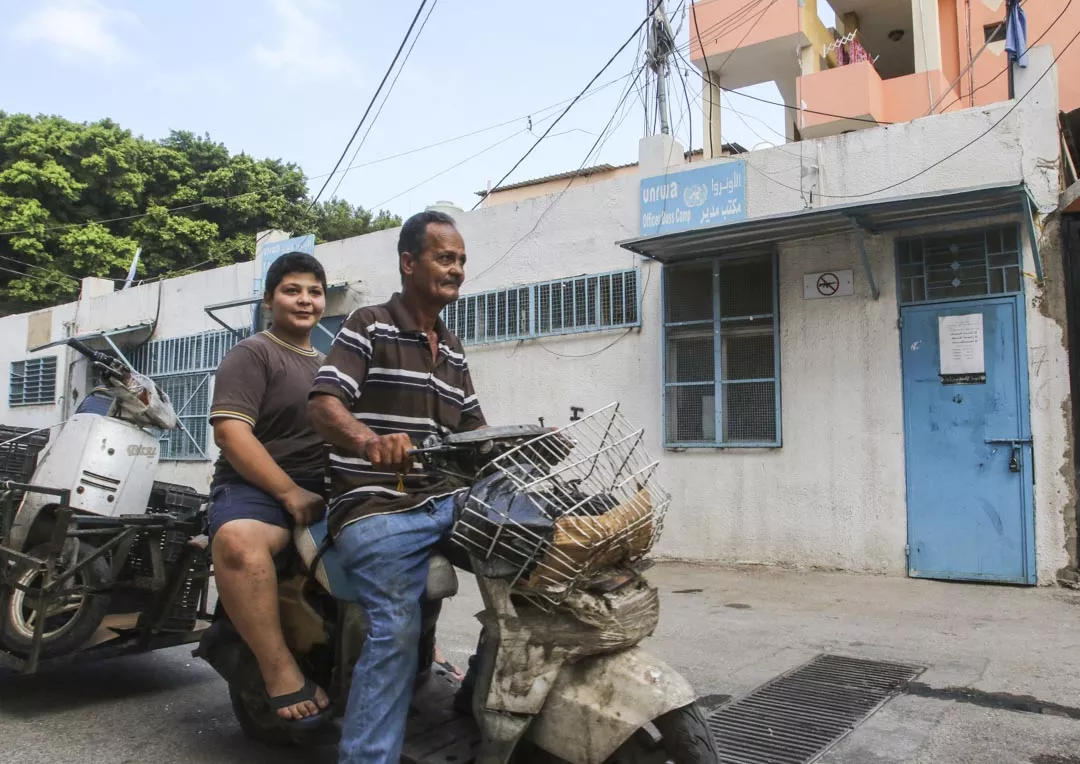
Mahmoud ZAYYAT / AFP
Syrian refugees in the central Bekaa Valley, in the district of Zahle, live under a different hybrid security regime from their Palestinian counterparts, which reflects their fundamentally different relationship with the Lebanese state. From 2011, as civil war drove well over a million Syrians into Lebanon, the government refused to allow the establishment of formal refugee camps like the UNRWA-supported camps for Palestinians.[1] As a result, most of the country’s Syrian refugees live in rented accommodations – either buildings in towns and villages or tents erected in informal settlements on privately owned open land.[2] While Lebanese authorities generally avoid entering the Palestinian camps, they regularly patrol Syrian refugees’ informal settlements, sometimes conducting raids and making arrests.[3]
All the major Lebanese security agencies maintain a network of contacts in the central Bekaa’s many informal settlements, which furnishes them with information about conflicts and illegal activity. Their usual interlocutor is the shawish, a sort of supervisor and decision-maker chosen from among the camp’s residents.[4] While specific roles can vary, a shawish generally informs the security agencies about comings and goings in the settlement and related matters.[5] Each security agency also liaises directly with residents, who can act as informants themselves.[6]
The shawish supports the security forces in various capacities. Sometimes, he or she provides intelligence to facilitate the state’s intervention. In 2022, a firefight erupted between residents of two settlements outside Bar Elias, which left one person dead and thirteen wounded.[7] According to a local shawish, he and the other shuwasha (plural of shawish) immediately informed their security contacts, allowing several agencies to make arrests.[8] On other occasions, the shawish acts on behalf of the security agencies to prevent trouble. In April 2024, for instance, a wave of anti-Syrian violence swept across Lebanon following the murder of Lebanese Forces official Pascal Sleiman, allegedly by a group of Syrian men.[9] Several shuwasha reported that they received calls from their security contacts, asking them to keep residents inside the settlements until things had calmed down.[10]
[1] Romola Sanyal, “A No-Camp Policy: Interrogating Informal Settlements in Lebanon”, Geoforum, vol. 84 (August 2017).
[2] “Lebanon: 2018-2021 – Syrian Crisis”, Shelter Projects, 2021. Some Syrian refugees receive rental assistance payments from the UN High Commissioner for Refugees and other aid organisations.
[3] See, for example, “Azzounieh crime wreaks havoc on Syrian camp in central Bekaa”, An-Nahar, 18 April 2024 [Arabic].
[4] No written rules govern the shawish’s role. Typically, the Lebanese landlord appoints the shawish. Maya El-Helou, “Refugee camps in Lebanon: Syrian women bodies as a site of structural violence”, The Legal Agenda, 18 December 2014. The shawish commands sweeping authority within each settlement, including the power to collect money for rent and basic services, as well as apportion job and education opportunities. Crisis Group interview, shawish, Bar Elias, October 2023. See also “Syrian refugee challenges traditions in community leader role”, UNHCR Lebanon, 4 June 2018.
[5] Sima Ghaddar, “Lebanon treats refugees as a security problem – and it doesn’t work”, The Century Foundation, 4 April 2017. One shawish, who runs a settlement outside Bar Elias, explained that his duties include informing the security forces about any person or organisation that wishes to enter the camp, as well as reporting any suspicions he harbours about illegal activities. Crisis Group interview, Bar Elias, October 2023.
[6] Crisis Group interview, local official, Bar Elias, October 2023.
[7] Crisis Group interviews, local official, Bar Elias, October 2023; shawish, Bar Elias, October 2023.
[8] According to the shawish, the Army Intelligence Directorate, State Security, the ISF and municipal police all intervened. Crisis Group interview, Bar Elias, October 2023.
[9] “The hostility Syrian refugees contend with in Lebanon”, Al Jazeera, 26 April 2024; and “Killing of party official fuels tensions in Lebanon”, Reuters, 9 April 2024.
[10] Crisis Group interviews, Bar Elias and Saadnayel, 14 April 2024.
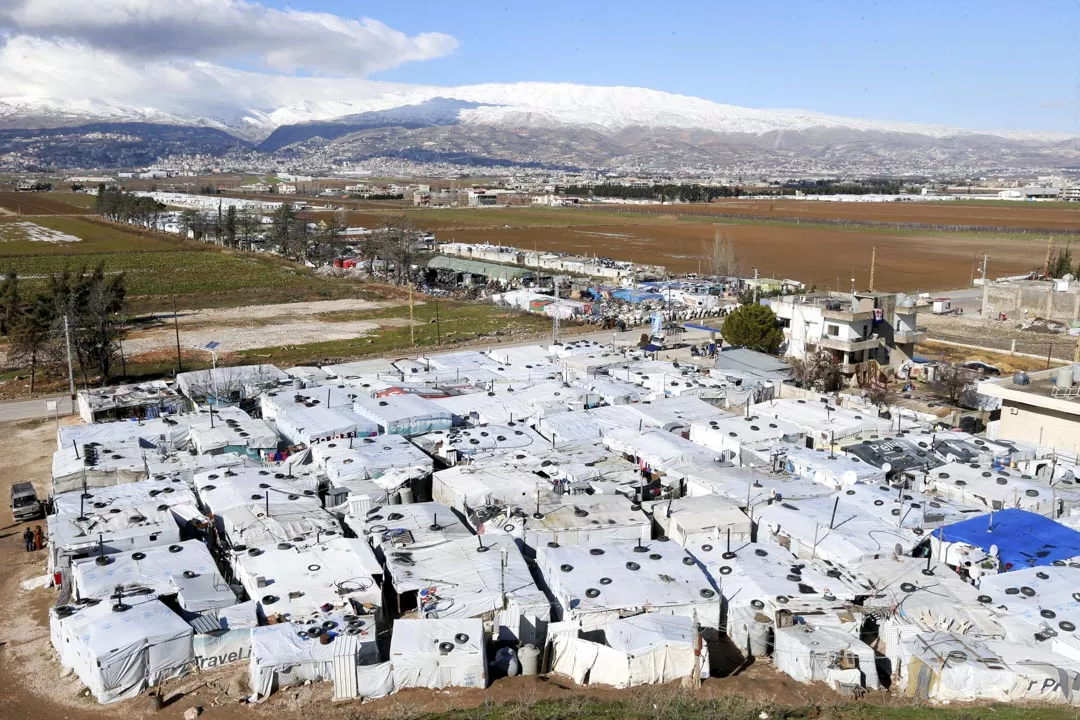
REUTERS / Mohamed Azakir
Within this hybrid security regime, Syrian refugees in the central Bekaa – and, where relevant, the Lebanese living nearby – resolve many disputes informally. The shawish may try to manage conflict by brokering “tribal” settlements between the parties.[1] One shawish explained that he has personally intervened to smooth over disputes between camp residents, often over a “lunch of reconciliation”.[2] Such solutions, while pragmatic, reinforce the privileged position of the shawish, despite some shuwasha facing accusations of abusing their power as the people de facto in charge of residents’ lives.[3] Informal resolutions can also solve problems that arise between Syrian refugees and Lebanese.[4] In Bar Elias, a Lebanese school owner recalled a clash that occurred in 2023, when Syrian refugees broke windows at his facility in anger. He agreed not to press charges against the offenders after receiving money from an NGO to cover the cost of repairs.[5]
To date, these hybrid structures have helped avoid major security incidents in the central Bekaa, but they may not stand up to rising pressure. Syrian refugees’ social position is precarious in the central Bekaa. Some Lebanese broadly welcome them, recognising the importance of cheap Syrian labour to the region’s agricultural economy, deriving income from Syrian tenants or crediting Syrian refugees’ presence for creating well-paid jobs in the aid sector (which often go to Lebanese).[6] But others express grievances about the socio-economic burden imposed by refugees, especially on supplies of water and electricity as well as access to other kinds of employment.[7] They may also represent commercial competition.[8] Syrian-run shops in Bar Elias, which generally charge lower prices, have been so successful that the town has largely replaced Zahle as the region’s main shopping destination.[9]
Should Lebanon’s economic crisis deepen further, resentment of Syrian refugees could grow more entrenched – and maybe turn ugly. If that happens, there are scenarios in which the security agencies’ ad hoc hybrid structures may prove unable to contain a volatile situation.
[1] Crisis Group interview, shawish, Bar Elias, October 2023.
[2] The shawish added that in October 2023, when he informed his security contacts about a fight between two residents, he was asked to find an amicable solution. Crisis Group interview, Bar Elias, October 2023.
[3] Sima Ghaddar, “Lebanon treats refugees as a security problem – and it doesn’t work”, The Century Foundation, 4 April 2017.
[4] In general, central Bekaa residents reported that conflict does not often arise between Lebanese and Syrians. A Bar Elias official claimed that such events happen rarely, and that it is more common for Syrian refugees to engage in conflict among themselves. In Zahle, a Lebanese businessman ascribed the calm to the distance between the town and Syrian refugee settlements. Crisis Group interview, Zahle, November 2023.
[5] Crisis Group interview, Bar Elias, October 2023.
[6] Nur Turkmani and Kanj Hamade, “Dynamics of Syrian Refugees in Lebanon’s Agricultural Sector”, Issam Fares Institute of Public Policy and International Affairs, January 2020, p. 11. Similarly, a Lebanese construction business owner in Zahle revealed that he hires only Syrian labourers, who demand a lower wage and – in his estimation – work harder than their Lebanese counterparts. Crisis Group interview, Zahle, April 2024. “There are 136 people from Bar Elias working with the NGOs, which means that 136 families make a living from [them]”, said a local official. Crisis Group interview, Bar Elias, October 2023.
[7] Even before the economic crisis, Lebanese business owners in Zahle were organising sit-ins to protest the growing competition from Syrian-run enterprises. Traders in Bar Elias reportedly staged similar demonstrations, but eventually acquiesced to the greater role of Syrians in commerce. “Zahle and Bar Elias: Municipality-led Evictions in Central Bekaa”, UNDP, September 2018.
[8] Crisis Group interview, local official, Bar Elias, October 2023. The Bekaa’s governor, Kamal Abou Jaoudeh, claimed that 1,700 of 2,000 businesses – or 85 per cent – in Bar Elias are run and (in effect) owned by Syrians. Crisis Group telephone interview, November 2023.
[9] Crisis Group interviews, Lebanese residents, Bar Elias and Zahle, October-November 2023. Even in Bar Elias, residents muse about the uncertain future of Lebanese working in trades, given growing Syrian domination. Crisis Group interviews, Bar Elias, October 2023.
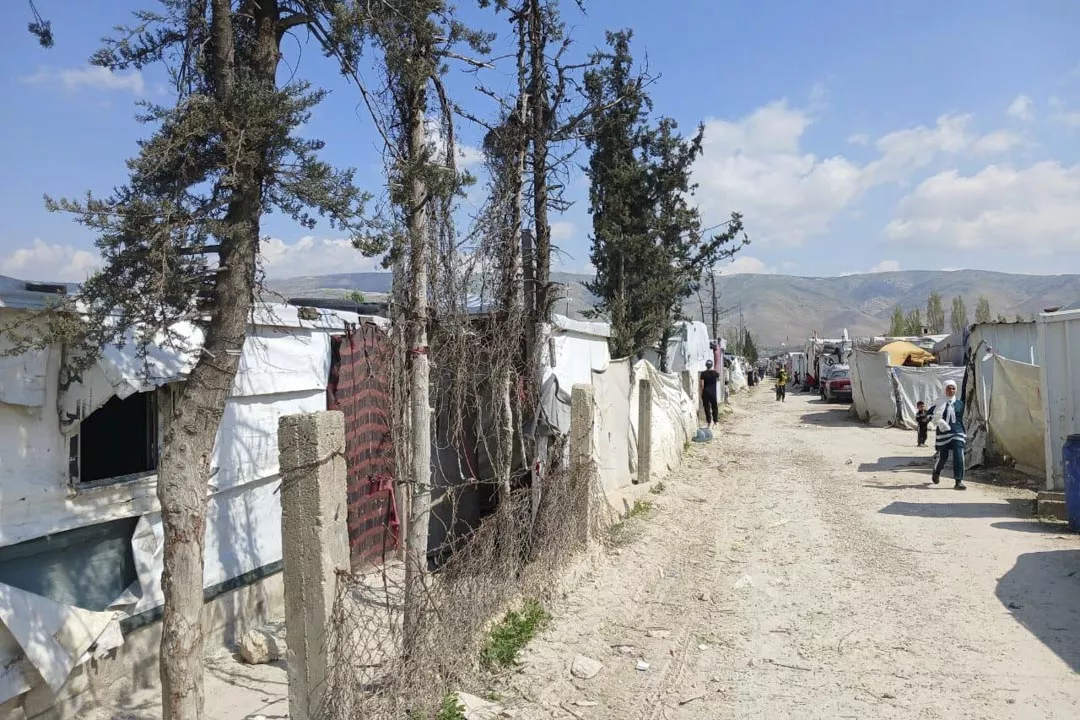
CRISIS GROUP / Raafat Nasser
As concern about crime has risen during the economic crisis, many Lebanese have taken matters into their own hands – at least to a degree. Some have taken individual precautions, such as installing surveillance cameras, buying guns or staying home at night.[1] But some communities have also devised collective responses to the perceived lack of security. Among these initiatives are neighbourhood patrols employing local young men and neighbourhood watches encouraging residents to report suspected crimes to the authorities.
[1] Crisis Group interview, private security company manager, Achrafieh (Beirut), 15 February 2024. See also “Qualitative Perspectives on Safety and Security in Lebanese Urban Spaces”, REACH, June 2024. Private gun ownership has increased from already high levels during the economic crisis, with Lebanese increasingly viewing firearms as necessary for personal safety. “‘A booming market’: Lebanese rush to buy weapons for personal security”, The National, 30 December 2021; and “‘We do the police’s job’: Protecting Lebanon’s most lawless towns”, Al Jazeera, 19 December 2021. Lebanese security agencies have repeatedly seized large shipments of illegal light weapons, some likely bound for criminals, but others for ordinary private citizens. “Turkish weapons: Volleys fired into Lebanese security and political arenas”, Nida al-Watan, 24 May 2024 [Arabic].
Achrafieh. In the generally affluent eastern Beirut district of Achrafieh, the authorities have permitted – or at least tolerated – several neighbourhood projects aimed at reducing petty crime.[1] Perspectives on how badly this effort is needed vary from place to place.[2] In Sodeco and Sassine, two of the district’s wealthier areas, most people report that crime has remained within acceptable limits.[3] Many residents of less affluent Geitawi, on the other hand, say theft has become commonplace during the crisis.[4] Some residents and business owners claim that public safety in Achrafieh began to erode in October 2019, with the onset of the economic crisis. They say thieves started stealing motorbikes, water pumps and other items, while overstretched police took much longer than before to respond to complaints.[5]
Against this backdrop, in November 2022, local MP Nadim Gemayel announced his support for an initiative, managed by the NGO Achrafieh 2020, to pay young men from the district to patrol its streets at night. The project, known as Eyes of Achrafieh, tasks participants with arresting criminal suspects.[6] Achrafieh 2020 engaged a private security company to oversee recruitment and conduct one-day “guidance sessions” for the selected participants.[7] The organisers insist that the watchmen carry only torches and batons. While authorised to use non-lethal force in making arrests, they must turn in the accused to the authorities.[8]
[1] Not all Achrafieh’s residents are wealthy. Many poorer (and often elderly) Lebanese live in Geitawi and neighbouring Karm al-Zeitoun, alongside Syrian refugees and migrant workers. “Mapping Migration in Beirut Municipality”, UN Habitat, 2018; “Geitawi urban snapshot”, Beirut Urban Lab, March 2021; and “Karm el-Zeitoun urban snapshot”, Beirut Urban Lab, March 2021.
[2] In August 2020, the disastrous explosion at the Beirut port tore through Achrafieh’s north, doing serious damage in some areas. Locals still point to reports that looters came from outside Achrafieh in the aftermath. “I have reported from Lebanon for years: What I saw at the Beirut port after the blast was total devastation”, Australian Broadcasting Corporation, 6 August 2020.
[3] Crisis Group interviews, Sassine, October 2023; Sodeco, February-May 2024.
[4] Crisis Group interviews, Geitawi, March 2024. A Geitawi resident claimed to have heard that, in early 2025, thieves had stolen at least eighteen scooters in Achrafieh in one day. Crisis Group interview, Geitawi, 4 February 2025.
[5] Crisis Group interviews, Geitawi, March-April 2024.
[6] “On patrol in Beirut, the crime-busting neighbourhood watchmen of Achrafieh”, The National, 25 November 2022.
[7] Crisis Group interview, Beirut, 15 February 2024.
[8] The project organiser claimed that the watchmen generally act as “scarecrows”, deterring petty crime by their mere presence. Crisis Group interview, Beirut, 26 February 2024.
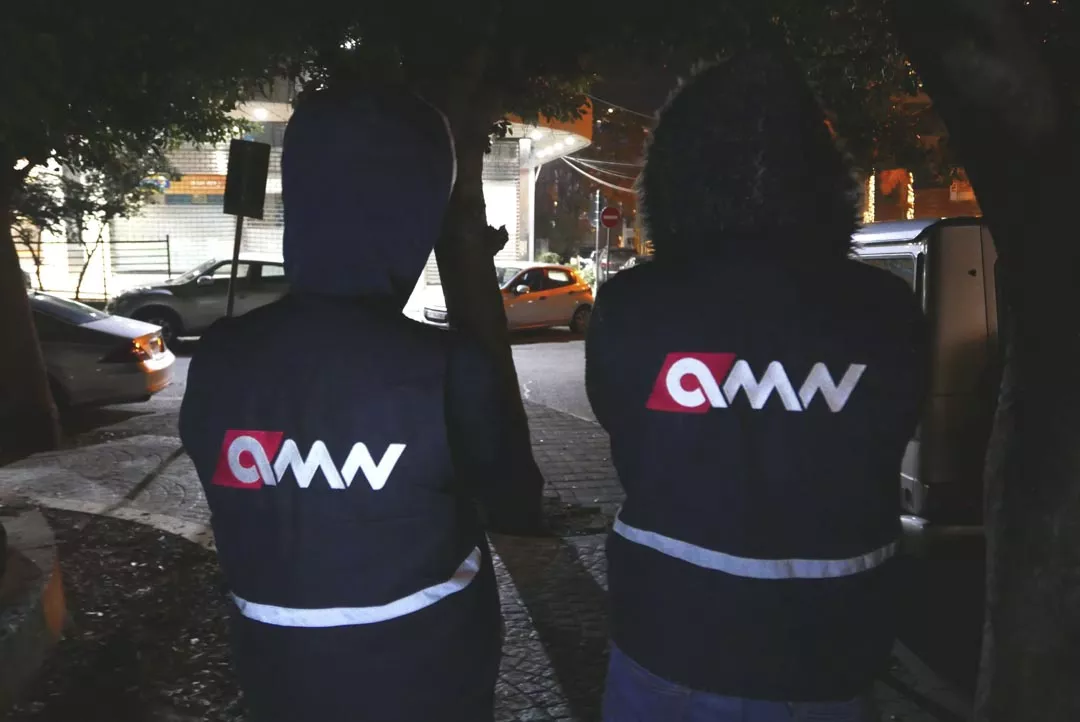
Sipa USA
According to organisers, the state security apparatus was wary of Eyes of Achrafieh at first, but eventually gave the project its blessing. Gemayel said the ISF was “very resistant” to the project when it began, “because they consider that only the state should run such initiatives”.[1] A project manager said his team overcame these objections by demonstrating professionalism, especially by coordinating closely with the ISF.[2] In parallel, Gemayel claimed, the ISF accepted that it had too few officers to patrol the streets without the project’s assistance.[3] The security apparatus has taken no steps to curtail the initiative.
Eyes of Achrafieh claims to have achieved immediate results in combating petty crime, but at first many residents dismissed it. In the project’s initial months, Gemayel said, watchmen approached 27 suspects – five of whom they arrested and handed over to the ISF. He asserted that the arrests, most of which occurred in the very first month, led to a district-wide reduction in theft.[4] A foreign diplomat, who sometimes works in the affluent Sursock neighbourhood, remarked soon after the project began that seeing young men patrolling the streets made her feel safer walking at night.[5] Yet many locals voiced doubts about whether crime had risen significantly in the patrolled areas, even amid the economic crisis, and thus questioned the project’s impact.[6]
[1] Crisis Group interview, Beirut, 20 October 2023.
[2] Crisis Group interview, Beirut, 15 February 2024.
[3] Crisis Group interview, Beirut, 20 October 2023.
[4] Ibid.
[5] Crisis Group interview, Sursock, 7 December 2022. In Geitawi, several people commended the project’s concept, though it never operated in their neighbourhood, saying watchful eyes were needed to deal with rising crime. Crisis Group interviews, Geitawi, 4 February 2025.
[6] Crisis Group interviews, Sodeco, March 2024. A store employee claimed that residents, often affiliated with the Lebanese Forces, already deal with the rare problems that arise. Crisis Group interview, Sodeco, 22 March 2024.
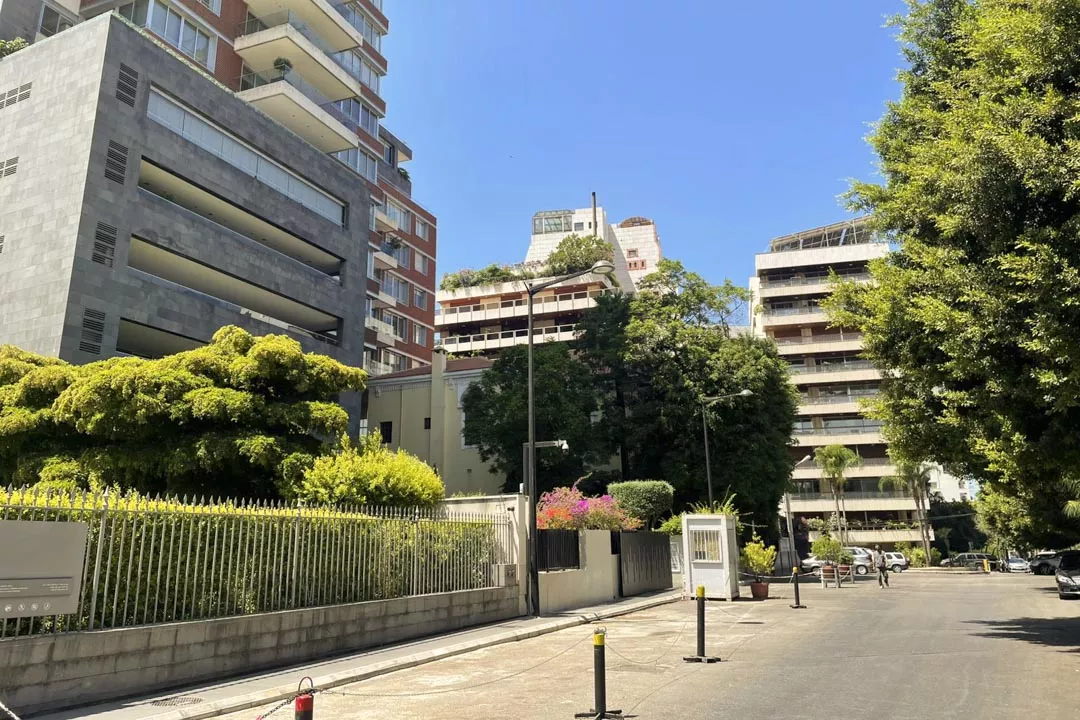
CRISIS GROUP / David Wood
Other residents found the Eyes of Achrafieh concept unnerving. Several locals reported discomfort with seeing young men from outside the security agencies policing the streets. A woman living in Geitawi said, “If I saw those guys, it would make me feel less safe than if they weren’t there”.[1] The unease was especially pronounced among Syrian refugees in the area, who fear that such initiatives might unfairly target them. Gemayel linked rising crime in Achrafieh with the increased Syrian presence, though he stressed that Syrians are not inherently more likely to commit crimes than Lebanese.[2] A project organiser blamed the impoverished circumstances of many Syrian refugees in Lebanon for pushing some to engage in petty theft.[3]
More generally, Eyes of Achrafieh’s critics allege that it harms intercommunal relations by reinforcing a “siege mentality” that has become increasingly apparent among Lebanese Christians.[4] A Lebanese political scientist argued that, since long before the economic crisis, many Christians have perceived a pressing need to keep external threats to Christian-majority areas at bay.[5] In explaining the Eyes of Achrafieh project, organisers repeatedly mentioned the district’s “borders”, the westernmost of which roughly follows the Green Line that once divided wartime Beirut into Christian and Muslim quarters.[6] Achrafieh residents frequently blamed thefts in the area on Syrian refugees, as well as on Lebanese Shiite and Palestinian inhabitants of Dahiyeh.[7] Many used blatantly anti-Muslim rhetoric.
Despite the mixed reception, Eyes of Achrafieh has proven resilient. The organisers suspended the initiative in mid-2023, as too few residents would pay for its continuation.[8] Yet it restarted in October 2024, when Israel massively escalated its war against Hizbollah, forcing hundreds of thousands of displaced from Shiite-majority areas to seek refuge in other districts, including Achrafieh.[9] Residents proved once again willing to fund the project after the ceasefire came into effect, as alarm swept Achrafieh over perceptions of rising crime.[10]
To date, the initiative has not extended to provide universal coverage for Achrafieh. In July, Eyes of Achrafieh claimed to be receiving $25 monthly payments from households in the affluent neighbourhoods of Sioufi, Tabaris, Furn al-Hayek and Sassine.[11] Months earlier, in February, a project organiser asserted that crimes were occurring only in those parts of Achrafieh where residents did not subscribe to his service. “We cannot be expected to help people without funding”, he said. “We need to pay our staff”.[12]
[1] Crisis Group interview, Geitawi, 28 March 2024. A foreign official described participants in Eyes of Achrafieh, whom he had seen personally, as “people that you would want to keep your daughter away from at night”. Crisis Group telephone interview, 21 February 2024.
[2] Crisis Group interview, Beirut, 20 October 2023.
[3] Crisis Group interview, Achrafieh, 15 February 2024.
[4] Observers have highlighted the rise of far-right Christian groups in Achrafieh during the economic crisis, while noting that, for now, they do not present a serious challenge to the area’s main political parties. “So that Achrafieh is not the end”, Asas Media, 18 December 2022 [Arabic].
[5] By contrast, the political scientist contended that unofficial security actors in Sunni communities typically focus on resolving internal disputes. Crisis Group telephone interview, 1 July 2022. A prominent Christian political activist, who advocates for splitting Lebanon into Swiss-style cantons, accused non-Christians of hypocrisy. “We know that Hizbollah has an army of a nation’s strength. We know that the Druze are very well organised and armed. Yet, if the Christians take a knife and so much as sharpen it, the other side cries foul. They take the moral high ground and denounce any attempt by us to protect ourselves”. Crisis Group interview, Beirut, 5 December 2022.
[6] “The Sodeco line of contact”, Al-Modon, 13 April 2015 [Arabic]. The initiative focused on Achrafieh’s western neighbourhoods like Sodeco, where it is supposedly easy for wrongdoers to commit a crime and flee to adjacent, predominantly Muslim areas.
[7] Crisis Group interviews, Achrafieh, March-April 2024. In February 2025, several Geitawi residents accused Hizbollah of encouraging theft in Achrafieh to sow chaos in a Christian-majority area for political purposes. Crisis Group interviews, Geitawi, 4 February 2025. This charge has also appeared in Lebanese media. “Strife between Christians and the displaced reflects Hizbollah’s need to deflect attention”, Nida al-Watan, 3 February 2025 [Arabic].
[8] Crisis Group interview, Nadim Gemayel, Beirut, 20 October 2023.
[9] An Eyes of Achrafieh organiser reported that, even at the height of the displacement crisis, when about 6,000 Shiites were living in the district, it saw no disturbances. Crisis Group interview, Achrafieh, 19 November 2024. Achrafieh hosted a far lower number of displaced than other Beirut neighbourhoods, such as those in western Beirut. “Massive displacement from Israel-Hezbollah war transforms Beirut’s famed commercial street”, Associated Press, 24 October 2024.
[10] An analyst has argued that Lebanese did not actually witness a spike in violent crime during this period but perceived one because several high-profile incidents had occurred within a few days. “Was January particularly deadly in Lebanon? Official figures say otherwise”, L’Orient Today, 5 February 2025. “Honestly, the area was safer during the war”, said a craftswoman based in Geitawi. “I used to leave work at 7pm. But now I leave earlier, because someone could suddenly approach with a knife and rob me”.
[11] Crisis Group interview, project organiser, Achrafieh, 4 February 2025.
[12] Crisis Group interview, Achrafieh, 4 February 2025. In February, a Geitawi resident predicted that the Lebanese Forces or Kataeb would start policing the neighbourhood if crime continued to rise. “The situation cannot continue like this”, he declared. Crisis Group interview, Geitawi, 4 February 2025.
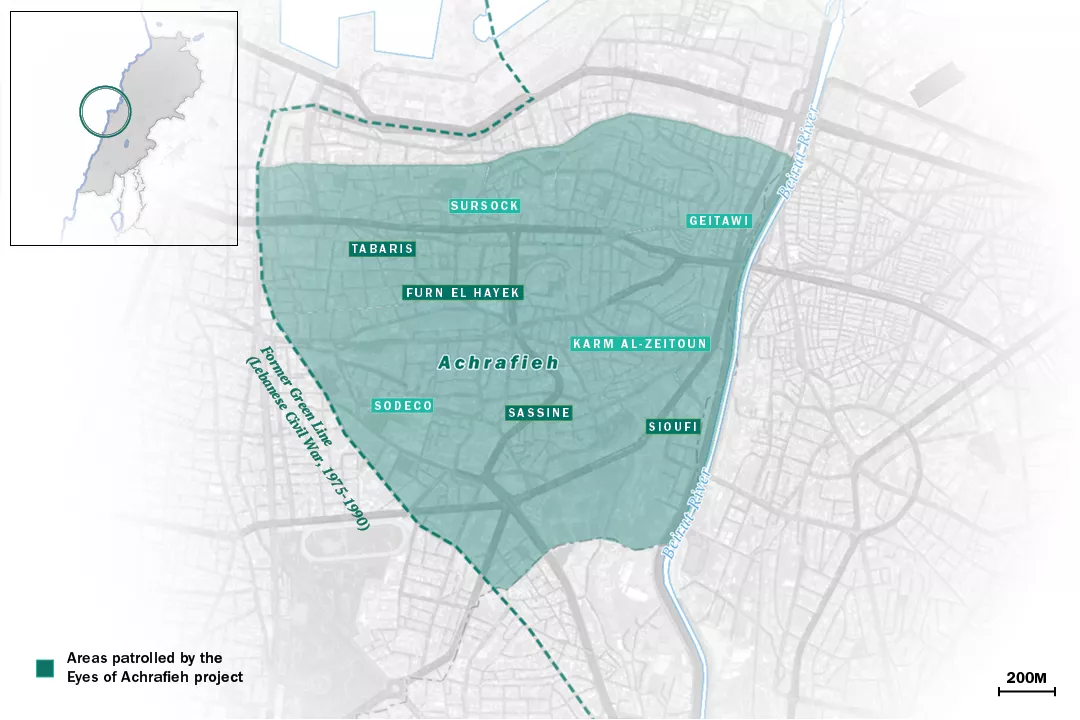
Source: Mapbox, July 2025. CRISIS GROUP
Northern Lebanon. Starting in 2021, several towns in Akkar – Lebanon’s impoverished northernmost governorate – pursued grassroots projects aimed at combating crime, but not all of them fared well. In the provincial capital, Halba, the town’s municipal police coordinated with civilian watchmen to conduct night-time patrols and staff checkpoints. But by 2024, the project in Halba had collapsed for lack of funds.[1]
Some towns with more resources than Halba have managed to keep putting patrols in the streets. In November 2022, the small northern village of Rachana, near Batroun, hired two men to stand guard overnight with informal permission from security authorities, according to a resident who helps run the initiative.[2] The concept proved popular in the area; neighbouring municipality Thoum secured funding to pay the municipal police to perform a similar service. According to the organiser who spoke to Crisis Group, Rachana’s night guards coordinate with municipal police in Thoum to report suspicious activity in the area.[3]
In those communities that did start patrols, several projects were marked by a lack of training or safeguards. Unlike the Eyes of Achrafieh project, which engaged a private security company to offer participants rudimentary instruction in patrolling streets at night, the Halba watchmen said they had received no training from their partner, the municipal police. As with Eyes of Achrafieh, the participants in Halba were not authorised to carry weapons or take coercive action beyond detaining suspects and handing them over to the local ISF branch. But the night guards in Rachana (also untrained) did get guns, along with instructions to shoot in the air first when approaching a suspect. “After that, we leave it to their discretion”, said the Rachana resident. He added:
[1] Crisis Group telephone interview, 28 April 2024.
[2] “This is how municipalities in Batroun protect themselves from thieves and wrongdoers”, Nida al-Watan, 15 December 2022 [Arabic]. “We contacted both the ISF and Army Intelligence Directorate in Batroun after we had started the initiative”, said the Rachana resident. “In both cases, they said: ‘Fine, let us know if you need anything’. They are probably glad that someone is helping them do their job”. Crisis Group interview, Beirut, 24 January 2023. In many cases, ISF branches are expected to provide services for many localities. For instance, the ISF station in Batroun is responsible for 43 villages, including Rachana and Thoum, with a combined population of more than 60,000 residents. “Community Policing Approach at the Internal Security Forces Station in Batroun”, UNDP Lebanon, 5 May 2023.
[3] Crisis Group telephone interview, 28 April 2024.
We are willing to accept the small risk of something going wrong due to the lack of training for the guards. And if it did happen, I would say you should put the corrupt politicians in jail, not the guard. The guard wouldn’t need to do this work if the state’s security forces were performing their duties.[1]
[1] Crisis Group interview, Beirut, 24 January 2023.
Critics of the neighbourhood patrols worry that such projects recall the disastrous civil war era, when Lebanon splintered into parcels of territory controlled by sectarian militias.[1] To assuage such fears, Eyes of Achrafieh organisers held “guidance sessions” open to the public to make clear that the group was not secretly pursuing an autonomous political agenda.[2]
Still, some communities that have experimented with patrol initiatives have long histories of antipathy toward certain groups. In Achrafieh, the concern is anti-Muslim sentiment. In Sunni-majority Halba, there is a history of tensions with residents of Hosniyeh, a nearby village that deployed its own watchmen during the economic crisis. These fights are partly political in origin: in May 2008, for instance, over ten people were murdered inside the Halba branch office of the Syrian Social Nationalist Party (SSNP), which is the dominant party in Hosniyeh.[3] With plenty of rivalrous communities living cheek by jowl across Lebanon, it is not hard to imagine neighbourhood patrols evolving into armed units with political identities and particular enemies.
[1] “Beirut ‘neighbourhood watch’ echoes troubled past”, Reuters, 28 November 2022.
[2] “You need to remember that people have a lingering fear of autonomous security initiatives based on their memories of militias during the civil war”, he explained. Crisis Group interview, Achrafieh, 15 February 2024.
[3] “Lebanon’s Legacy of Political Violence”, ICTJ, September 2013. In Hosniyeh, the SSNP paid the watchmen’s wages. “‘We do the police’s job’: Protecting Lebanon’s most lawless towns”, op. cit.
In January 2024, several months after Eyes of Achrafieh temporarily suspended its patrols, local Lebanese Forces parliamentarian Ghassan Hasbani unveiled a mobile app called Report (Tabligh), which allows users to report suspected crimes in Achrafieh to the authorities.[1] The public’s tips go to police via a “dispatch centre” based in Hasbani’s office. An intermediary is necessary, Hasbani claimed, because many citizens do not know which agency to contact with a complaint.[2] Volunteer interns at Hasbani’s office designed the simple digital platform and field calls in the dispatch centre – all for free. Importantly, Hasbani distinguishes his “neighbourhood watch” initiative – which encourages citizens to report crimes they happen to witness – from projects like Eyes of Achrafieh, which put watchmen on patrol.[3]
According to Hasbani, the authorities appreciate receiving his initiative’s tips, as it allows them to allocate their stretched staff and money more efficiently. He claimed that his office runs the Report app in coordination with Lebanon’s four major security agencies, which generally support the project.[4] By April 2024, the mobile app reportedly had 2,000 registered subscribers. It had received reports of alleged offences such as drug trafficking and prostitution, as well as pollution and residential overcrowding. At that time, Hasbani revealed that the dispatch centre was forwarding all complaints to the Beirut governor’s office and the Army Intelligence Directorate, “due to major weaknesses in the police force in Beirut”.[5] Critics allege that the project pays undue attention to Syrian refugees, for instance reporting residency and work permit violations – an accusation that Hasbani categorically denies.[6]
[1] “Report (Tabligh)”, Office of Ghassan Hasbani MP, 2024; and “Lebanese digital neighbourhood watch app accused of anti-Syrian bias”, The New Arab, 19 January 2024.
[2] Crisis Group interview, Achrafieh, 3 April 2024.
[3] “I lived with a neighbourhood watch initiative [when I resided] in London”, said Hasbani. “We all had stickers on our houses; it became a normal part of life. … I believe that vigilance is an essential part of citizenship”. Crisis Group interview, Achrafieh, 3 April 2024.
[4] “It’s not as though we received some sort of official approval”, Hasbani conceded. “But we liaise with the relevant people for each agency in Achrafieh”. Crisis Group interview, Achrafieh, 3 April 2024.
[5] Crisis Group telephone interview, 23 April 2024.
[6] “Lebanese digital neighbourhood watch app accused of anti-Syrian bias”, The New Arab, 19 January 2024. Hasbani pointed out that his office had forwarded complaints about non-Syrians, claiming that, as of April 2024, 40 per cent of reports made via the mobile app related to suspects who were not Syrian. Crisis Group telephone interview, 23 April 2024.
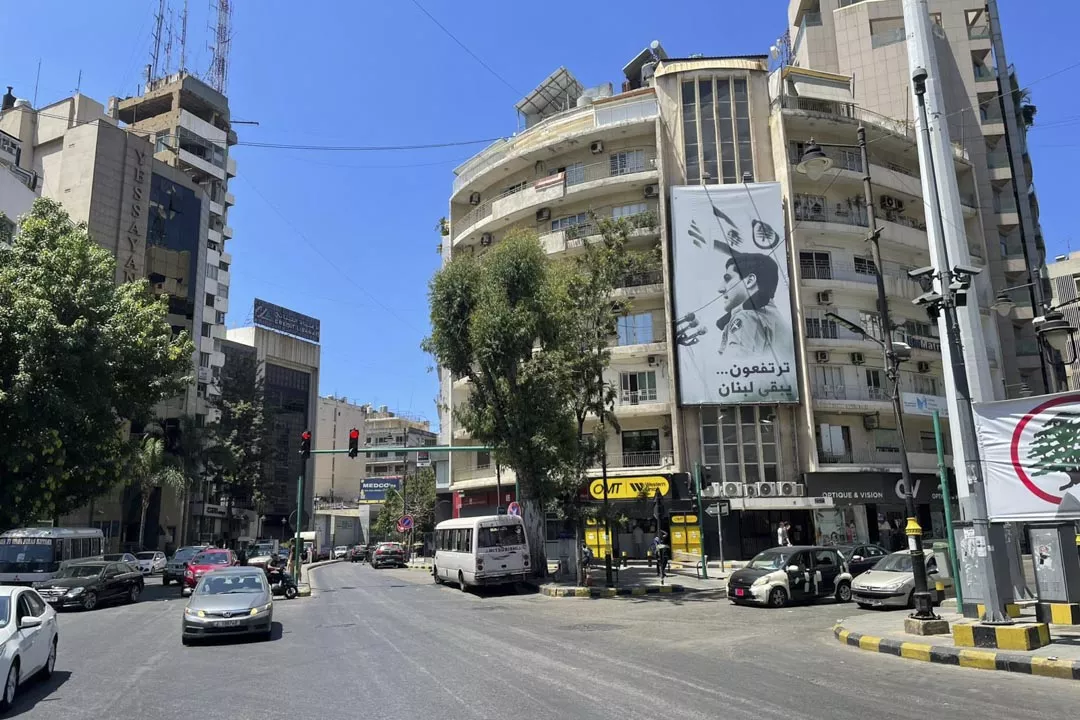
CRISIS GROUP / David Wood
As Lebanon’s economic crisis deepens, Lebanon’s security services have muddled through by relying on makeshift arrangements to retain staff and shift some of the policing burden off the ISF’s shoulders. In some areas, the authorities have deepened their reliance on hybrid structures that have existed for decades. In others, the security agencies have allowed citizens to create new grassroots initiatives aimed at combating crime. While these pragmatic solutions have worked reasonably well as stopgap measures, they are inadequate, may prove unsustainable and come at a cost.
Until Lebanon’s leaders tackle the economic crisis in earnest, the state’s ad hoc solutions will encounter persistent resource issues. In truth, such initiatives have never managed to cover security force personnel’s overall needs.[1] As noted, another issue is that that donor generosity, which has helped keep the most functional elements of the security services (particularly the LAF) afloat during the economic crisis, is not guaranteed to continue indefinitely.[2]
As for the hybrid structures, they are a mixed bag. Some are relatively benign arrangements that Beirut may not want to disturb, at least for now. For example, Lebanese authorities and residents alike are generally satisfied with how Sour’s Palestinian refugee camps handle security matters, via the well-established mechanism of the security and popular committees. In other cases, the state could incorporate positive aspects of new hybrid measures into official projects. For example, it could make sense for the ISF to facilitate neighbourhood watch schemes, like the politician Hasbani’s initiative in Achrafieh – though they should operate under state auspices lest they attract accusations of politicisation or other bias (as has been the case in Achrafieh).[3]
But other hybrid mechanisms are deeply concerning. Chief among these are longstanding policing deals that perversely empower thugs in certain areas, in exchange for maintaining a semblance of public order. Though pragmatic, these approaches may favour impunity for alleged criminals and could undermine public confidence in security agencies that sometimes work alongside rogue elements. During the crisis, neighbourhood patrols have emerged as a worrying new trend. These patrols come with big risks, such as reinforcing distrust and resentment within groups of Lebanese vis-à-vis others (for instance, Palestinian and Syrian refugees) and possibly laying the groundwork for today’s grassroots initiatives to become tomorrow’s autonomous militias. These arrangements also threaten to weaken the official security apparatus – encouraging the further enervation of state institutions.
[1] In January 2024, a U.S. official pointed out that monthly wage subsidies for security personnel were ever more inadequate, as the cost of living keeps going up. “$100 per month does not go very far in Lebanon these days”, he commented. Crisis Group interview, Awkar, 15 January 2024. By December 2024, the World Food Programme estimated that Lebanese households needed to spend around $450 per month to meet basic needs. “Food Security Analysis – Lebanon Market Monitor”, World Food Programme, January 2025. In May, Aoun asserted that recent increases in foreign aid for the security agencies are “still insufficient to meet the challenges facing Lebanon”. “The state can protect Lebanon from Israel, Aoun assures Hezbollah”, L’Orient Today, 1 May 2025.
[2] Indeed, donors have clearly expressed their reluctance to commit to “propping-up” measures, such as wage subsidies and food aid. Sam Heller, “Adopt a Ministry: How Foreign Aid Threatens Lebanon’s Institutions”, The Century Foundation, 7 November 2023.
[3] In late 2024, during Lebanon’s mass displacement crisis, the Lebanese Forces party established a hotline for Beirut residents to report “suspicious activity”. Crisis Group interview, Ghassan Hasbani, Achrafieh, 30 January 2025.
Foreign donors should keep insisting … that they will provide significant financial aid only if Lebanon’s leaders make fundamental changes.
The upshot, then, is that Lebanon needs to be able to pay for a better security system. To this end, as Crisis Group has previously argued, Beirut should make long-overdue governance and economic reforms and generally get Lebanon’s finances in better shape.[1] To motivate these reforms, foreign donors should keep insisting, as they have since October 2019, that they will provide significant financial aid only if Lebanon’s leaders make fundamental changes. If they do not, as donors recognise, the post-war economic order, grounded in scorruption and mismanagement, will be incapable of recovery.
For almost six years, Lebanese elites have met these demands with resistance, though today’s circumstances may offer a chance to change course. President Aoun has pledged to usher in the required economic reforms, and Lebanon’s new government has seen some of them through, including legislation for amending the country’s banking secrecy laws and restructuring its banking sector.[2]
Nevertheless, it appears that at least some political obstacles to an economic overhaul remain stubbornly in place. Parliament will need to pass new legislation on allocating losses from the economic crisis (known as the “financial gap law”), an unresolved issue that has divided Lebanese politicians, financial elites and ordinary depositors since the meltdown began. In May, two members of parliament’s finance and budget committee predicted that many politicians would baulk at supporting the deeply controversial law, especially in the lead-up to the May 2026 parliamentary elections.[3] If the country’s leaders spurn this chance at restoring public finances, then state institutions – including the security agencies – appear set to grow steadily weaker.[4]
But a better scenario is within reach. It would see Beirut taking on the challenge of reforms, and donors jumping in to help security agencies, many of which have been struggling just to survive, to regain lost capacity.
In doing so, donors may find that their assistance will go further if it is better coordinated with certain objectives in mind. Perhaps most important is to ensure that traditionally underdeveloped components get the support that they need to perform their assigned roles in the security architecture.[5] Major interventions aimed at improving policing will need to involve the ISF and municipal police, which both require considerable livelihood support and long-term capacity building. Donors should also support improved police investigations of gender-based violence claims, which have slipped amid the economic crisis. A key benefit of such efforts to build up under-performing institutions is that it could relieve pressure on the LAF, freeing it up to focus on its core functions, including vital work upholding the ceasefire with Israel.[6]
As it moves away from reliance on hybrid arrangements, the Lebanese government might also consider creative ways to leverage private investments in security measures that citizens made during the economic crisis. For example, many citizens have installed security cameras, some of which have a vantage on public spaces. Already, the police view this footage as valuable for conducting criminal investigations. But Lebanese digital rights activists complain about a lack of transparency in how security agencies handle recordings made by both public and privately owned cameras.[7] The state could address these concerns by introducing clear data protection regulations for the terms on which police can request access to video footage and how they treat what they collect. These guidelines might also help assuage fears about the government installing new surveillance cameras, which some citizens are demanding to combat crime.[8]
[1] Crisis Group Report, Managing Lebanon’s Compounding Crises, op. cit.
[2] “Aoun: Reforms in Lebanon’s interest priority over international will”, L’Orient Today, 14 April 2025; “Lebanon passes banking secrecy law in third attempt to meet IMF demands”, Reuters, 24 April 2025; “Lebanon passes banking restructuring law in key reform but gaps remain”, The New Arab, 31 July 2025.
[3] Crisis Group interviews, Beirut, May 2025. In a further complication, the bank restructuring law’s implementation is contingent on parliament passing the financial gap law. “Lebanon passes banking restructuring law in key reform but gaps remain”, The New Arab, 31 July 2025.
[4] Crisis Group Report, Managing Lebanon’s Compounding Crises, op. cit.
[5] Too often, foreign backers provide assistance based on personal relationships with officers in a given agency, rather than considering the security sector’s overall needs. See Simone Tholens, Ada Sophia Hahn and Jacob Boswall, “Recalibrating International Security Assistance to Lebanon: A Strategic Imperative”, European University Institute, March 2025.
[6] Heiko Wimmen and David Wood, “Reinforcing the Shaky Israel-Lebanon Ceasefire”, Crisis Group Commentary, 14 July 2025.
[7] Crisis Group telephone interview, digital rights activist, 14 March 2025. See also “Mapping Surveillance Cameras in Beirut on OpenStreetMap”, SMEX, 21 April 2020. A Tripoli resident explained that he has complied with several requests for footage from his building’s security cameras. “They are very polite and explain exactly why they need it”. Crisis Group interview, Tripoli, 16 April 2024.
[8] An Achrafieh resident, who runs a local NGO, argued that both neighbourhood patrols and security cameras are necessary to protect the area from crime. “You always need people on the streets. This helps prevent crime from happening; cameras just help you solve it”. Crisis Group interview, Achrafieh, 12 March 2024. See also “Qualitative Perspectives on Safety and Security in Lebanese Urban Spaces”, REACH, June 2024. In 2014, the Beirut municipality installed security cameras around the city, but controversy later emerged over which state agency was keeping the footage. “Who maintains control over surveillance cameras in Beirut?”, LBC Group, 28 May 2019.
With a fragile ceasefire in place, Lebanon sits before a window of opportunity. The country’s lawmakers have chosen a new president and prime minister from outside the traditional political class. Both have pledged to take serious action to address Lebanon’s multi-faceted crisis, including the economic collapse that has gutted the security apparatus. Donors stand ready to help Lebanon with significant aid, including to bolster the state security apparatus, but only if its leaders can demonstrate tangible progress on reform. The international good-will cannot be expected to last forever. If Lebanon’s politicians miss this chance, then donors could well turn their attention elsewhere, amid demands from many other countries competing for dwindling amounts of assistance. In those circumstances, Lebanese state institutions – including the embattled security agencies – would continue declining.
This outcome would not serve the Lebanese state or its outside partners, and much less the Lebanese people. The country has managed to avoid major domestic disturbances during both the economic crisis and the Israel-Hizbollah war. Nevertheless, the risk of turmoil or even conflict lurks just below the surface. Any number of factors – political interference, sectarian violence, wanton criminality or jihadist attacks, to name a few – could suddenly spark civil unrest. At present, the state is uncomfortably reliant on makeshift arrangements and hybrid security solutions to stand between the Lebanese people and these worrying threats. Both Lebanon and its partners should work assiduously toward the day when these can be replaced by a Lebanese security sector able to stand on its own two feet.
Beirut/Brussels, 27 August 2025


Leave a Reply