

Iran Sanctions Snapback at the UN
nalberti
Mon, 08/25/2025 – 17:22
Iran Sanctions Snapback at the UN
What is happening?
Ten years after the adoption of the Iran nuclear agreement (formally known as the Joint Comprehensive Plan of Action or JCPOA), the participants are approaching a crucial decision. Under the deal, the “snapback” mechanism, which allows participants to trigger a reimposition of sanctions suspended by the JCPOA, will lapse on 18 October (“termination day”). With the deal functionally in tatters, the three European participants (the E3, comprising France, Germany and the UK) have said they will pull the trigger rather than lose the capacity to reimpose sanctions, absent significant steps to reintroduce restrictions on, and monitoring of, Iran’s nuclear program. They have warned that unless Iran makes certain important concessions, they will initiate the multi-step snapback process by the end of the last week of August. E3-Iran contacts are under way but seem to be yielding little progress.
How does snapback work?
In July 2015, when Iran and six other countries agreed to the JCPOA, the UN Security Council unanimously endorsed the agreement. Resolution 2231 was the vehicle for both this endorsement and a powerful kill switch that allows Iran’s counterparties, the U.S., the UK, France, China and Russia – which along with Germany negotiated the deal in a group known as the P5+1 – to reimpose international sanctions if they deem Iran to be in breach of the JCPOA. Under the resolution, any JCPOA participant that claims there has been “significant non-performance of commitments” can trigger the restoration (or “snapback”) of six pre-JCPOA Security Council sanctions resolutions that were terminated as part of the 2015 agreement.
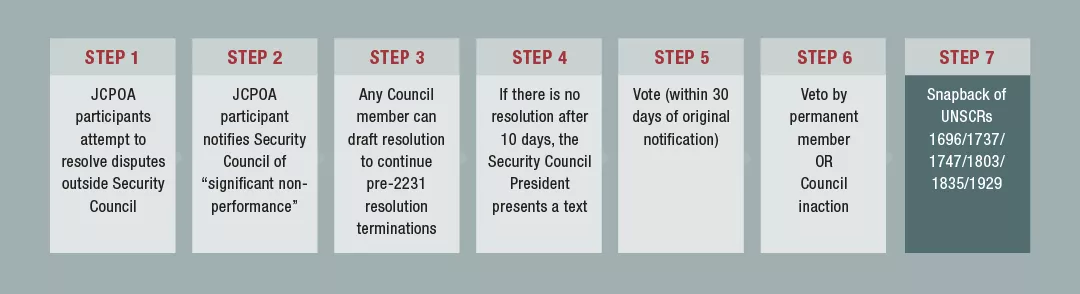
Snapback turns the usual logic of Security Council resolutions on its head. Usually, Council action requires nine votes, and no veto by any of the Council’s five permanent members, to pass. But snapback functions differently. Resolution 2231 empowers any “JCPOA participant state” (a defined term that includes Germany), acting by itself, to set in motion the process of restoring the suspended resolutions. In most scenarios, this process is impossible to stop. As outlined in Article 37 of the JCPOA and operational paragraphs 11-12 of Resolution 2231, the triggering process begins with a notification of non-performance submitted by any JCPOA participant state to the Security Council. From that point onward, Council members can propose a resolution to continue the termination of pre-2015 sanctions, which can be vetoed by any of the permanent members.
How did things get to this point?
Snapback is one of the JCPOA’s few remaining vestiges. The deal’s core bargain – in which the P5+1 agreed to support sanctions relief for Iran in return for Tehran agreeing to restrictions on its nuclear program – began to unravel following the 2018 U.S. withdrawal from the deal and the subsequent U.S. “maximum pressure” campaign. The latter restored and expanded unilateral U.S. sanctions. Following the advent of maximum pressure, key events unfolded along the following timeline:
-
In May 2019, after the Europeans failed to make up for the economic effects of the new and reimposed U.S. sanctions, the Islamic Republic began to breach its non-proliferation commitments under the JCPOA.
-
In January 2020, citing Iran’s dwindling compliance, the E3 collectively concluded that Iran was “not meeting its commitments under the JCPOA” and triggered the agreement’s Dispute Resolution Mechanism (DRM). At the same time, they also underscored their hope of resolving the impasse through “constructive diplomatic dialogue” within the JCPOA framework.
-
In July 2020, Iran cited “concerns regarding implementation issues” by the E3 of the JCPOA in its own invocation of the DRM.
-
In August 2020, the first Trump administration sought to trigger snapback under Resolution 2231. In practice, the effort was more or less ignored by the rest of the Security Council on the basis that, the U.S., having withdrawn, could no longer be regarded as a “participant” able to use the mechanism. But with Washington imposing punishing sanctions bilaterally, and Iran slipping further into non-compliance, the JCPOA nevertheless began to seem increasingly hollowed out.
-
In October 2020, UN restrictions on countries selling conventional arms to Iran or purchasing Iranian weaponry lapsed.
-
In January 2021, the administration of U.S. President Joe Biden took office and, after a period of internal deliberation, launched efforts to revive the JCPOA. But indirect negotiations in Vienna beginning in April 2021 (at which the deal’s remaining parties spoke directly to one another and the U.S. was nearby but not at the table) collapsed in September 2022. The failure to restore the JCPOA and deepening rifts among its now P4+1 participants – notably due to Russia’s war in Ukraine – have meant that the JCPOA parties have not collectively convened for over three years; various groupings of participants do continue to engage with each other, however.
-
In October 2023, UN restrictions on Iran’s missile program expired as part of the JCPOA’s “transition day”, including sanctions designations against a total of 84 persons and entities. Nevertheless, the EU and UK maintained their corresponding restrictions, citing Iran’s non-compliance with the JCPOA.
-
In the first part of 2025, Iran engaged in nuclear diplomacy with the second Trump administration. The latter held five rounds of talks with Tehran that were mediated by Oman in April and May, but these failed to yield a new agreement.
-
In June 2025, citing Iran’s lack of cooperation with the International Atomic Energy Agency (IAEA), the UN watchdog’s Board of Governors voted in favour of a resolution finding Iran in non-compliance with its safeguards commitments under the Nuclear Non-Proliferation Treaty.
-
On 13 June 2025, Israel launched an attack on Iran’s nuclear and military infrastructure, leading to nearly two weeks of fighting that also featured U.S. strikes on three Iranian nuclear facilities. Since then, Iran has suspended cooperation with the IAEA and there have been no international inspections of Iran’s nuclear sites. A sixth round of U.S.-Iran talks expected in mid-June was also scuppered, though the two sides reportedly remained in contact.
What are the E3 saying?
The E3 have announced their willingness to initiate the snapback process by the end of August. That would allow for the 30-day procedure to conclude before Russia, which is aligned with Iran in its opposition to snapback, assumes the rotational presidency of the Security Council at the start of October, giving it an opportunity to throw up procedural obstacles.
In the trio’s view, snapback is diplomatically justified and strategically necessary, given the JCPOA’s collapse and the absence of an alternative framework for restricting and monitoring Iran’s nuclear program. London, Paris and Berlin believe they made good-faith efforts following the 2018 U.S. withdrawal to salvage the agreement, including during more than a year of negotiations in Vienna to revive it in 2021-2022 – a failure they largely attribute to unworkable Iranian demands. (These efforts correspond to the first step of the snapback process illustrated in Chart 1 below.) The IAEA Board’s finding of Iran’s non-compliance with the Non-Proliferation Treaty adds to their case. Thus, the E3 take the position that snapback’s termination cannot be allowed to pass without either using the October deadline as leverage for Iranian concessions or, failing that, reinstating pre-2015 sanctions against Iran’s nuclear and military programs, along with additional measures described below.
The three European powers have also given Iran a temporary out. They have offered to extend the snapback deadline for six months as a one-time measure, which they could do through a Security Council resolution, if three main conditions are satisfied. The first is restoration of IAEA monitoring of Iran’s nuclear facilities. The second is accounting for Iran’s stockpile of uranium that has been enriched to near-weapons grade. (The status of this fissile material, of which Tehran was estimated to have around 400kg before the Israel-Iran conflict in June, remains unclear.) The third requirement is resumption of negotiations between Tehran and the Trump administration over the parameters of a new nuclear deal.
What is Iran’s view?
The Islamic Republic rejects the E3’s ability to trigger snapback, contending that they have “in effect abandoned any claims to JCPOA participant status”. In support of this position, Iran argues that the European powers failed to deliver the agreement’s anticipated economic dividends following the 2018 U.S. withdrawal and, more recently, assumed antagonistic positions toward Tehran during the war in June.
Moreover, in Tehran’s view, the European offer is not viable. For one thing, Iran has insisted that the U.S. guarantee that it will not strike the Islamic Republic during negotiations. But such a condition, if it is to be met at all, would likely be a function of engagement between Tehran and Washington. European countries cannot provide any such assurance on Washington’s behalf, and Tehran cannot receive it without engaging the U.S. As for the first and second conditions, while there may be room for greater engagement with the IAEA, Iran likely views the enriched uranium stockpile that has slipped below the international radar as one of its key leverage points. Here again, it is unlikely to give up this leverage for a six-month pause in snapback.
That said, if snapback is indeed triggered, Tehran will almost surely not leave it unanswered. Iranian officials have mooted the possibility of withdrawing from the Non-Proliferation Treaty (NPT) as a response to snapback, which under Article X requires three-month notice. This threat, however, is likely a maximalist position that leaves room for less sweeping but still significant steps to reduce Iran’s international non-proliferation commitments. For instance, Iran can choose to terminate its 1974 Comprehensive Safeguards Agreement with the IAEA, which sets the parameters for the agency’s access and oversight of nuclear material in Iran, without withdrawing from the NPT.
What are the implications?
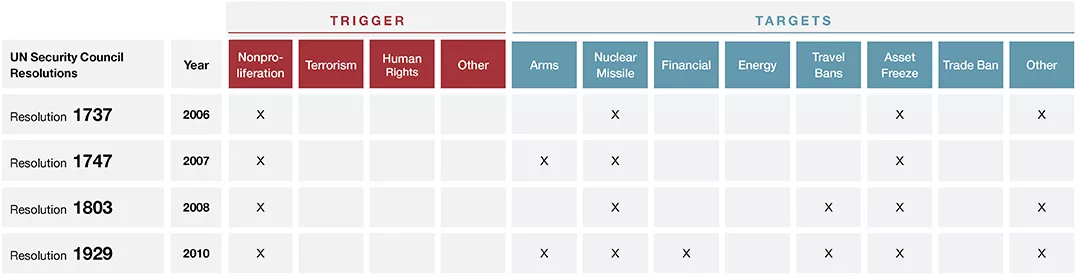
Execution of snapback restores the provisions of six UN Security Council resolutions passed between 2006 and 2010. These began with Resolution 1696 (2006), which required Iran to “suspend all enrichment-related and reprocessing activities”. Iran, then as now, maintained that it had a right to enrichment, and as the diplomatic impasse over its nuclear activities deepened, the Council approved a growing set of sanctions. These were monitored by a committee, established in 2006 and supported by a panel of eight experts that received its mandate four years later.
The emerging framework of UN resolutions was expansive in its reach (see Chart 2). Tehran was banned from procuring nuclear-related technology, while persons and entities linked to the nuclear program were designated for sanctions. It also faced significant restrictions on conventional weapons imports and ballistic missile development amounting to an arms embargo on items from tanks to aircraft. Individuals and entities with links to the Islamic Revolutionary Guard Corps were put on the sanctions list. Sanctions resolutions urged member states to inspect Iranian vessels for contraband. They also provided for the blacklisting of Iranian shipping companies, increased scrutiny of the Iranian financial sector, and expanded asset freezes or travel bans aimed at dozens of Iranian individuals and firms. (For further background and details of these measures, see Crisis Group’s 2013 Spider Web study and 2020 report on the snapback debate.)
Once the sanctions are reimposed, they are binding as a matter of international law. In practice, some states may shrug their shoulders at implementation requirements, but at least some are likely to apply them with rigour. European states are particularly likely to do so, given the hardening of regional attitudes toward Tehran over not only the nuclear file but also Iran’s provision of arms to Russia, its detention of several European nationals and concern about extraterritorial plots. Repealing the sanctions at the UN level would be impossible so long as one of the P5 countries that supports sanctions is prepared to veto a resolution that would lift the measures.
In Tehran, there may be a degree of resignation to, or downplaying of, the impact of restoring UN restrictions – especially given that their financial effects, as discussed, could pale in comparison to the extensive unilateral sanctions imposed by the U.S. They can hardly be dismissed as merely symbolic measures, however, given a combination of expansive scope and potential Western-led enforcement efforts. The fact that these measures are not easily reversible, given the difficulty of creating consensus among the Security Council’s permanent members, is also likely to compound the malaise around an economy already struggling with high inflation, currency woes and deepening infrastructure problems.
How might China and Russia react?
The E3 have discussed their plans for snapback with Washington and will have its blessing, but Russia and China are likely to be more critical. Tehran has been in bilateral and trilateral discussions with Moscow and Beijing in recent months, and it has likely done at least some preparatory coordination over snapback. Certainly, there is evidence that Russia and China have Tehran’s back in the multilateral sphere: both dissented from the E3-drafted June IAEA Board of Governors resolution. Russia has posited that the E3 have “no political, legal or procedural grounds” for triggering snapback, while China has warned that it could “only aggravate tensions and confrontations and further undermine diplomatic efforts”. Both countries have already circulated explanatory notes to the Security Council contesting a snapback invocation.
That the E3 are timing the conclusion of snapback before Russia takes the Security Council’s gavel in October reflects a preference for avoiding procedural sleight of hand to undermine it. But even if the E3 succeeds (which is likely, given that the process is hard to manipulate), Beijing and Moscow may still choose to confound the implementation and enforcement of the reimposed resolutions. One battleground could be reconstitution of the sanctions committee established by Resolution 1737, which was dissolved with the JCPOA’s entry into force in 2015. Council members, notably Russia, could attempt to stymie implementation or chip away at the legitimacy of revived UN sanctions by blocking the appointment of a chair for the 1737 committee or boycotting its consultations.
Russia and China could also work to frustrate efforts by Secretary-General António Guterres to appoint a new panel of experts (the old one also having lapsed in 2015) to monitor the sanctions restoration envisaged under snapback. Though the panel is meant to assist a sanctions committee, it is an independent entity under the Secretary-General’s auspices. Beijing and Moscow could block the selection of individual experts, as they have done with other UN-appointed panels. Sympathetic UN General Assembly members also could step in: they could work to hold up funds to appoint a new panel of experts via the Assembly’s Fifth Committee, which oversees the UN budget.
In theory, none of these disputes over monitoring and enforcement would affect the restored sanctions’ validity, but the surrounding debates might affect how UN members perceive the legitimacy of the sanctions and their readiness to enforce the measures. That said, a severe Iranian response to snapback that involves withdrawal from the NPT is unlikely to be positively received, even by states that oppose the E3’s move, including Russia and China.
What happens next?
The possibility of a diplomatic breakthrough before the E3’s snapback deadline seems slim and dwindling, despite last-minute discussions between the EU/E3 and Iran as well as Iran and the IAEA. In the event that the E3 proceed, the 30-day waiting period before the old resolutions kick back in could still offer a window for negotiations. The timing is in one sense auspicious, because it overlaps with the UN General Assembly’s annual high-level week, which will bring to New York senior leaders who could huddle over ways to head off execution. If any such effort is successful, it may suffice to pause the process. But even if that happens, the issue is likely to resurface before too long unless Washington and Tehran hammer out terms that eluded them before the June war and are likely to be even more difficult to find agreement on now.
As Crisis Group has noted elsewhere, reviving IAEA access and wrapping Iran’s suspended enrichment activities into a multinational nuclear consortium in return for sanctions relief could offer the most durable solution for addressing non-proliferation concerns. Non-aggression understandings between Iran and Israel could help pave the way for such a deal and lower the prospect of further regional turmoil. But to have any hope of success, this course of action will require engagement between what the E3 recognise as the two central protagonists: Iran and the U.S.
More for you
Grievance and Flawed Governance in Iran’s Baluchestan
Also available in Arabic, Persian, Farsi





Leave a Reply