

A Curse of Gold: Mining and Violence in Venezuela’s South
ccarrel
Tue, 07/29/2025 – 13:36

A Curse of Gold: Mining and Violence in Venezuela’s South
What’s new? Venezuelan government forces have raided numerous illegal gold mines in the country’s south in recent years, ostensibly to protect the environment. But the truth is that they are exploiting the mines for their own enrichment or allowing armed groups to do so in exchange for a cut of the profits.
Why does it matter? Rising gold prices have fuelled unchecked illegal mining, strengthening Venezuelan criminal enterprises, Colombian guerrilla groups and corrupt elites. The racket destroys fragile ecosystems while also triggering violence against local people and migrant workers, who have been subject to sexual abuse, child labour recruitment and even summary executions.
What should be done? Hard as it is to sway President Nicolás Maduro, foreign governments should use his proclaimed environmental concern and hunger for international legitimacy after the disputed 2024 election to press for curbs on illegal mining and the attendant violence. Buyers, particularly in the Middle East and Asia, should demand conflict-free gold.
Illegal mining in Venezuela’s southern states, Bolívar and Amazonas, is generating vast riches for criminal and armed groups that use violence to control parts of the countryside and the people who live there. Gold, seen as a safe asset in uncertain economic times, is fetching record prices on world markets. As mining the precious metal has become more profitable, the deposits have become highly coveted – even more so with the country suffering the effects of calamitous economic collapse and grinding political conflict. Small-scale miners, their numbers swollen by internal migration, labour at the mercy of whoever controls the mines. Though the Venezuelan military reportedly aims to stamp out illegal mining, informal pacts between these forces and Colombian guerrillas have allowed the latter to continue operating mines, while Venezuelan criminal syndicates have reached deeper into the forest to find more gold. Foreign capitals should capitalise on President Nicolás Maduro’s avowed interest in the environment and quest for international legitimacy to press Caracas into reducing violence and harm to the Amazon.
Illicit gold mining in Venezuela’s south has been rife for two decades and grown apace over the last ten years, as criminal groups and guerrillas have seized control of large parts of the states of Bolívar and Amazonas. Since 2022, the Venezuelan government has sent troops into the area, arguing it is acting to protect the environment and dislodge the illegal miners. But the armed forces do as they please with the mines, and they may have even have more latitude in the aftermath of the disputed 2024 election, with President Maduro depending heavily on the military after quashing what appears to have been an opposition landslide.
In practice, illicit mining has continued to proliferate in the south, harming the delicate ecosystem, while military incursions in the region have served primarily to rearrange the hierarchy of who controls the mines. In some cases, members of the armed forces have taken sole charge of the pits for their personal enrichment. Elsewhere, soldiers have allowed workers back into the mines in exchange for a “tax” or an arrangement to sell gold at below-market prices to the military. Overall, Venezuelan forces seem more inclined to allow Colombian guerrilla outfits, with whom they have a tacit alliance, to hang on to the mines. That said, Venezuelan criminal organisations – known as sistemas – have not been fully expelled from the region. When displaced, these crime rings move deeper into the jungle to dig new mines, inflicting fresh environmental damage, including deforestation.
The consequences of the mining boom have been dire.
The consequences of the mining boom have been dire. The mercury that is widely used in the region to separate gold from gold ore contaminates waterways and fish, a dietary staple. Miners – most of whom are men – endure brutal treatment, as do the communities they come from. Criminal and rebel groups controlling the mines set arbitrary rules; workers who defy them are severely punished. Accidents are common, as most miners lack any prior experience or training, and child labour is rampant. Criminal groups’ reach extends beyond the mines: sexual exploitation and human trafficking in surrounding areas is widespread. Meanwhile, Indigenous communities, which represent about half the population of Amazonas state, are divided over how to deal with illegal mining. Armed groups invade their lands or bribe leaders to let them park mining equipment there. Many communities have abandoned agriculture, their traditional livelihood, in favour of mining.
Conditions in Venezuela’s south will not change unless government forces shift from being predators to defending the rights of local communities and curtailing violence and the groups behind it. Military commanders are unlikely to heed calls from outside Venezuela to change the status quo. But President Maduro’s newfound interest in environmental conservation and his desire to restore his government’s legitimacy after the 2024 election could allow foreign governments to exercise a degree of influence over him and the armed forces. Foreign gold buyers, especially those in the Middle East and Asia, could reinforce efforts to persuade Caracas to take stronger action in the south by insisting on conflict-free supply of the metal. If international environmental groups can win greater access to the region as a result, it could open the way for humanitarian groups to work with vulnerable communities. Curbing the harm that gold mining has done to the region, its ecosystem and its people is up to Venezuela’s government. Foreign voices should seek out whatever means they can find of sending this message.
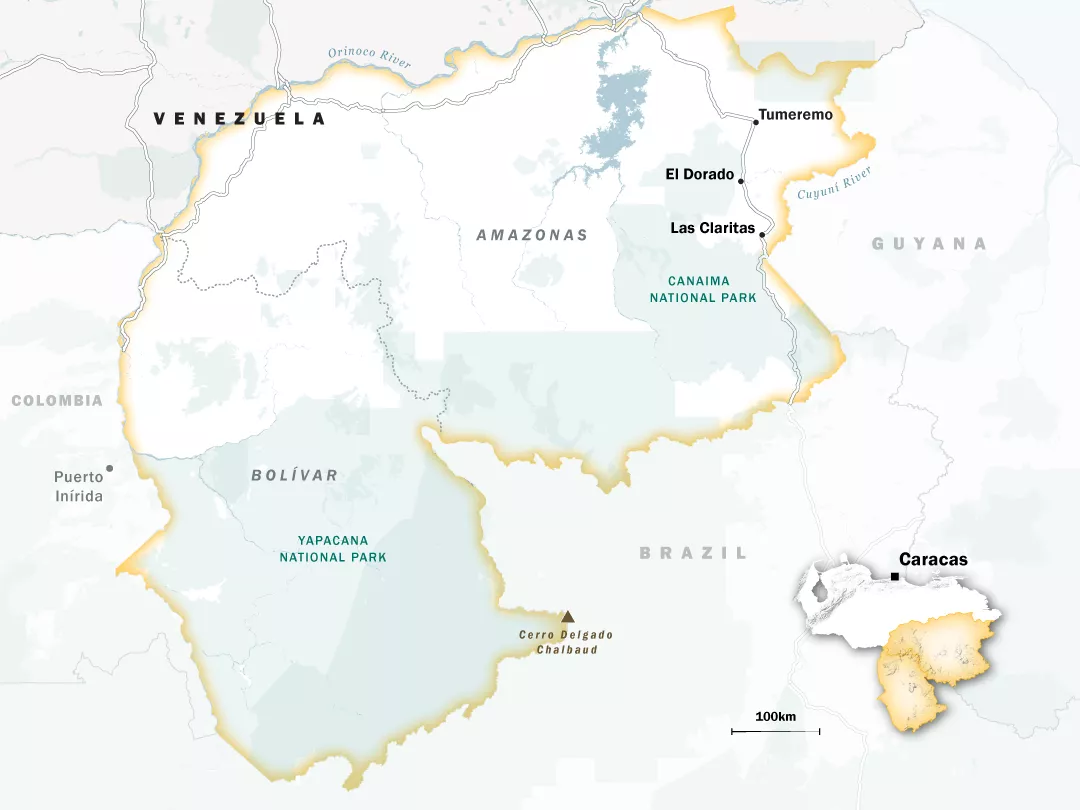
Source: OpenStreetMap, July 2025. CRISIS GROUP
Mining in the states of Amazonas and Bolívar has grown over the past two decades under the tutelage of myriad armed groups. Informal as well as state-run mining has taken place for a long time in the region (see Section IV), but the recent boom owes a great deal to these outfits, which have established control of numerous local communities and migrant populations, who provide cheap and – in the eyes of their overlords – disposable manual labour. Armed groups hold strategic positions along the borders with Colombia, Brazil and Guyana, where they also oversee drug trafficking routes, often in collaboration with state forces.[1]
[1] Crisis Group Latin America Report N°73, Gold and Grief in Venezuela’s Violent South, 28 February 2019.
For the past twenty years, the states of Bolívar and Amazonas have witnessed violent competition among armed and criminal groups to exploit Venezuela’s untapped gold and other mineral deposits.[1] Informal mines run by local people and state-led projects have existed in the region since the 19th century, albeit at a small scale. Mining activity grew after gold prospectors, mostly Brazilian adventurers and Colombians fleeing conflict, began arriving in the early 2000s, settling in Yapacana National Park in Amazonas, despite a 1989 ban on mining in the state. Not long thereafter, a collection of entrepreneurial armed groups showed up as well. By 2010, units from Colombian guerrilla organisations – including the Revolutionary Armed Forces of Colombia (FARC) and the National Liberation Army (ELN) – as well as Venezuelan criminal outfits had joined the gold rush. A few years later, as the national economy collapsed and the price of gold rose, hard-up Venezuelans flocked to the area from big cities. Illegal mines multiplied across the south, causing widespread ecological damage. Toxic mercury polluted the region’s rivers, sickening residents of waterside towns.[2]
Ten years ago, the state of Amazonas also became a refuge for FARC dissident factions such as the Acacio Medina front, which never entered the guerrilla group’s negotiations with the Colombian government that culminated in the 2016 peace agreement. The front is now part of the Segunda Marquetalia, a breakaway faction led by former FARC negotiator Iván Márquez.[3] “Those who were there did not accept any peace [deal]”, a gold miner said of the FARC groups in Amazonas.[4]
The dissident group grew at a steady clip by enlisting local recruits. It cemented territorial control with protection rackets, demanding payment in gold from miners and forcing Indigenous communities to allow access to their territory. In exchange, the guerrillas kept order and enforced rudimentary justice, punishing thieves and sex offenders.[5] For some communities, the tradeoff has been worth it. “Essentially, they provide protection from criminals”, noted a manager of an illegal gold mine.[6]
[1] Ibid.
[2] “Bosques en desaparición: Deforestación en Venezuela 2016-2021”, Clima21 and Observatorio Venezolano de Derechos Ambientales (OVDH), August 2022.
[3] Márquez, a former FARC commander, abandoned the peace process in 2019, alleging that the Colombian state had betrayed the terms of the 2016 accord. He became leader of Segunda Marquetalia, which claims to represent the FARC’s original revolutionary ideals. Cindy Morales Castillo, “La historia de la Segunda Marquetalia, la disidencia de FARC que inició un proceso de paz”, El Espectador, 9 February 2024.
[4] Crisis Group interview, gold miner, October 2024.
[5] The FARC dissident faction Acacio Medina comprises several hundred recruits and is active in all seven municipalities of Amazonas state. Led by alias Jhon 40, and with Miguel Díaz Sanmartín, alias Julián Chollo, managing field operations, the group employs FARC rebel rhetoric, claiming to be protecting the vulnerable, to legitimise their territorial control while they engage in illegal gold mining, drug trafficking and extortion.
[6] Crisis Group interview, manager of illegal gold mine, October 2024.
Both [the Segunda Marquetalia and the ELN] hold the areas they occupy in a suffocating grip.
Sources told Crisis Group that the Segunda Marquetalia has been allied for years with rebels from the ELN, even sharing boats for drug shipments while divvying up territory and mines. “These fronts strengthened significantly through these non-aggression pacts”, said a Colombian law enforcement official.[1] Both groups hold the areas they occupy in a suffocating grip. They determine who has access to the area, shake down miners and local businesses, and oversee mining operations.[2] Their version of justice is often extreme. In one Indigenous community, the ELN has punished violent behaviour, such as sexual assault, with summary executions.[3] In the mines of Yapacana, those who break the rules are offered a choice. “Sometimes young people find themselves in trouble, facing only two options: join the guerrilla forces or be killed”, an Indigenous miner said.[4]
The armed groups also recruit local youths, particularly from Indigenous communities, to collect extortion payments and transport drugs produced in Colombia, mainly to Brazil. These recruits are also sent as fighters to active conflict zones in Colombia’s Arauca, Guaviare and Cauca departments, while Colombian guerrillas head in the opposite direction to Amazonas, where they enjoy amenities unavailable at the front, including refrigerators, television and more comfortable accommodation.[5] Alongside threats and violence, Colombian armed groups also use patronage to dominate mining towns and camps, seeking to win support by paying teachers’ salaries, building schools and transporting the sick to medical facilities.[6]
[1] Crisis Group interview, state official, Puerto Inírida, September 2024. See also Gustavo Montes Arias, “La alianza entre ELN y disidencias para explotar tierras raras en la Amazonía”, El Espectador, 7 April 2025.
[2] Crisis Group interviews, gold miners and community representatives, 2021, 2024 and 2025.
[3] Crisis Group interviews, community leaders, October 2024.
[4] Crisis Group interview, Indigenous miner, December 2024.
[5] Bram Ebus, “In Venezuela, Colombian guerrillas recruit Indigenous youth”, Amazon Underworld, 20 August 2023.
[6] Bram Ebus, “A Rebel Playing Field”, Crisis Group Commentary, 28 April 2021.

CRISIS GROUP / Bram Ebus
Venezuelan criminal organisations known as sistemas have dominated illegal mining in Bolívar, the country’s largest state, for over a decade.[1] Previously referred to as pranes or sindicatos, these groups emerged from within the prison system or evolved out of trade unions, mainly in the construction sector. The sistemas, some comprised of hundreds of members, either demand a share of the gold dug from mines run by illegal operators or manage mines themselves.[2] They also engage in other illicit businesses, including fuel and drug trafficking, as well as sexual exploitation of women.[3] Increasingly, they also extract extortion payments from other local enterprises.[4] For example, food vendors in the municipality of El Callao told Crisis Group they were paying $100 per month to sistemas, while processing mills were surrendering 20 per cent of their gold-bearing sand.[5]
Akin to guerrilla groups, Venezuelan sistemas use violence and strategic philanthropy to tighten their grip on mining regions. Locals who live in the town of Guasipati, in Bolívar, described a hamlet nearby called Camature as the groups’ preferred site for executions and other forms of violent retribution.[6] Recently, however, many local crime bosses have attempted to win residents’ allegiance through charity. “El Negro Fabio”, leader of the Sistema de la F, which operates around the border town of El Dorado, supports organisations that invest in community projects. He also sponsors football teams and holds events, including performances by Colombian pop stars, at his El Dorado headquarters.[7]
[1] Research conducted in 2023 showed sistemas active in nine of Bolívar’s eleven municipalities. See “Crime and Corruption in the Shadows of the World’s Largest Rainforest”, Amazon Underworld Crisis, 3 August 2023; and Group Report, Gold and Grief in Venezuela’s Violent South, op. cit.
[2] Security constraints make it impossible to piece together a definitive list of the criminal organisations working in Venezuela’s south. Crisis Group fieldwork has established that one of the more powerful sistemas is Tren de Guayana, led by Ronny Matón. It controls most mines in El Callao and Roscio municipalities in Bolívar state. Matón, who also dominates mines around Guasipati, expanded his influence after the fall of El Callao’s previous crime boss, known as Toto. Sistema de la F, led by alias El Negro Fabio, operates mostly in the border town of El Dorado. Organización R, led by Eduardo José Natera Balboa – alias Run or El Pelón – has been active in Sifontes and El Callao, Bolívar, since 2008. El Sindicato de las Claritas, also known as El Sindicato de Juancho, and El Sindicato del Perú also work in the area. The criminal organisation Tren de Aragua controls parts of this region, too; Yohan José Romero, known as “Johan Petrica”, runs several mining areas in a town near one of the country’s largest gold deposits, called Las Claritas, near the Brazilian border. Romero arrived in Bolívar in 2015. The U.S. State Department offered a $4 million reward for information leading to his arrest in 2024. Ronna Rísquez, “Gold, drugs and violence: The Aragua Train in Venezuela’s mining arc”, Invisibles, 2024; Crisis Group interviews, community leader, Brazil, March 2025; Crisis Group telephone interview, Venezuelan crime researcher, March 2025; “Reward for Information: Yohan Jose Romero, a/k/a ‘Johan Petrica’”, press release, U.S. State Department, 11 July 2024; Crisis Group interview, Brazilian state official, Brasilia, March 2025; Jorge Benezra, “El Negro Fabio encontró su Dorado”, Armando.info, 25 June 2023.
[3] Crisis Group Report, Gold and Grief in Venezuela’s Violent South, op. cit. Crisis Group interviews, humanitarian officials and community leaders, October and December 2024; April 2025.
[4] Crisis Group interview, business owner, November 2024.
[5] Crisis Group interview, miner, November 2024.
[6] Crisis Group interview, miner, November 2024.
[7] Crisis Group interview, Indigenous leader, September 2024. See also “El ‘Negro Fabio’ encontró su Dorado”, op. cit.
Locals say sistemas [Venezuelan criminal organisations] are … crossing the border into Guyana, where they are raiding mining camps.
Locals say sistemas are now also crossing the border into Guyana, where they are raiding mining camps. A Guyanese businessman working on the frontier told Crisis Group that Venezuelan gangs extort and rob riverboats and gold miners. “Whatever you have in your boat, they take it as they like”, he said.[1] Residents say a new armed group, composed of former Colombian guerrillas and new recruits, is making its presence felt along the Venezuela-Guyana border, particularly near the town of San Martín de Turumbán. The group uses names including the Hugo Chávez Frías Organisation and the Socio-Revolutionary Movement.[2] Indigenous leaders say the group collects payment from those heading up the Cuyuní River into mining areas in Guyana and Venezuela.[3]
Tensions between Guyana and Venezuela escalated in February, when six Guyanese soldiers were shot and injured on the border. The attack appears to have stemmed from a miscalculation by members of a Venezuelan sistema who were intent on extorting fuel transporters but were unaware that Guyanese officers were following the boat.[4] On 15 May, violence flared up again when the Guyanese military announced that gunmen had carried out three separate attacks across a river marking the border with Venezuela within 24 hours.[5]
[1] Crisis Group telephone interview, Guyanese businessman, February 2025.
[2] Hugo Chávez Frías, who served as president of Venezuela between 1999 and his death in 2013, inaugurated what he called the Bolivarian Revolution, ostensibly aimed at lifting up the poor and downtrodden. These groups “come with a political discourse about helping miners and farmers, but behind this lie other intentions; they want to take over Indigenous land”, a community leader said. Communities complain of losing ancestral hunting and agricultural lands to guerrilla camps. “They are here mainly for the minerals, gold and diamonds”, said an Indigenous leader. Crisis Group telephone interviews, community representatives, 2024 and 2025.
[3] Crisis Group telephone interviews, community representatives and Guyanese miners, 2025.
[4] Phil Gunson, “Venezuela Presses Territorial Claims as Dispute with Guayana Heats Up”, Crisis Group Commentary, 8 April 2025; Khadidja Ba, “Six soldiers wounded in exchange of gunfire with men on Venezuelan bank of Cuyuni”, Stabroek News, 18 February 2025.
[5] “Guyana soldiers attacked three times in 24 hours amid tensions with Venezuela”, The Guardian, 15 May 2025.
From its illicit, informal and small-scale beginnings, mining for gold and other precious metals in southern Venezuela has undergone a boom in recent years as the state has wrestled with economic collapse and a precipitous fiscal decline. Operating under a new legal framework since 2016, mining and mineral exports nevertheless remain afflicted by a great deal of violence. Moreover, much of the mining activity is still illegal.
The current legal framework regulating mining in southern Venezuela was established in 2016, under the label Orinoco Mining Arc. Its aim has been to attract foreign investors by offering joint ventures with state companies, often backed by military protection.[1] Caracas hoped that mining would partially compensate for the collapse of the oil sector, which had been the fiscal and commercial backbone of the country for decades, as well as the sharp contraction of the economy as a whole, particularly during an extended bout of hyperinflation lasting from 2016 to 2020.[2] After a short reprieve, inflation has returned to triple digits in 2025, while the gold price has hit an all-time high of $110 a gram.[3]
Despite the veil of legality accorded by the Arc to the mining industry, Venezuela’s formal gold production still tends to rely on buying from unregulated mines, most of which are under the control of non-state armed groups, and through companies owned by individuals under investigation for corruption. Transparency in contracts and production data is striking by its absence. The Ministry of Eco-Mining Development provides an incomplete list of companies operating in the Arc, but no information is available about contract terms, output levels, export figures or the true beneficiaries of mining consortia, making it easy to launder illegally mined gold through official channels.[4]
[1] The Orinoco Mining Arc decree, issued by President Maduro in February 2016, established an area spanning 12 per cent of Venezuela’s territory for extraction of valuable minerals, primarily gold, diamonds and coltan. The decree opened the region to foreign investment for gold extraction and processing and allows for two types of mining partnerships: alliances between private or community enterprises and the state; and joint ventures where the state maintains at least 55 per cent ownership. Foreign investment, however, has faltered due to political turmoil, economic collapse and a lack of security guarantees. There is no public registry of these partnerships. “Gaceta Oficial de la República Bolivariana de Venezuela”, N°40.855, Decreto N°2.248, 24 February 2016; Crisis Group Latin America Report, Gold and Grief in Venezuela’s Violent South, op. cit.; “El Arco Minero: la corporación de la molienda”, RunRun.es, Correo del Caroní and Transparencia Venezuela, September 2022.
[2] “Venezuela: The Rise and Fall of a Petrostate”, Council on Foreign Relations, 31 July 2024.
[3] Antonio María Delgado, “Sanctions, currency collapse fan fear of hyperinflation surge in Venezuela”, Miami Herald, 8 July 2025; “Blackouts, 162% inflation remind Venezuelans of worst of crisis”, Bloomberg, 7 May 2025.
[4] Ibid.; “Explotación de oro en Venezuela”, Transparencia Venezuela, 2025.
CRISIS GROUP / Bram Ebus
Data giving an accurate account of how much gold mining is occurring legally or in violation of national legislation is also exceptionally hard to come by. Estimates of Venezuela’s annual gold production vary widely. U.S. sources placed output in 2021 at approximately 75 tonnes, whereas the Organisation for Economic Cooperation and Development (OECD) provided a more conservative assessment of 25 to 37.5 tonnes.[1] Mining in the state of Amazonas was prohibited in 1989, so the only formal mining industries are in Bolívar state. Meanwhile, a 2022 study by the local chapter of Transparency International found that around a quarter of Venezuela’s gold production reaches the Central Bank, nearly 9 per cent goes to the National Treasury (a state body in charge of financial planning and management) and 36 per cent is channelled to alliances between private corporations and Venezuela’s state-run mining corporation, Minerven, while about 30 per cent is in the hands of organised crime.[2]
Media and civil society organisations have tried to assemble a truthful portrait of Venezuelan mining based on the fragments of information to hand. In 2016, the government announced the creation of 42 public-private alliances focused on small- and medium-scale mining, including three gold processing plants. Three years later, the state announced the existence of 17 projects, including investments from companies in Türkiye, Canada, Palestine, China and the Republic of Congo, and pledged to instal 60 gold recovery plants in southern Bolívar.[3] At the same time, the government constructed cyanide processing facilities in Bolívar to extract gold from what is called “concentrate”.[4]
With Venezuela in the throes of an economic meltdown, Maduro also promised to channel revenues from gold mines to each state governor who supports the government. As a result, local administrations now have majority stakes in joint ventures with foreign investors in the zone. These are typically small companies or private firms controlled by high-ranking military officers.[5] Otherwise, information is sparse. Vice President Delcy Rodríguez acknowledged the existence of 21 active gold processing plants in 2020 – the last official reference to the number of these facilities. Venezuelan journalists who visited the area in 2022 nevertheless identified at least 41 companies operating in the region that did not appear in the official listings.[6]
[1] “Gold Flows from Venezuela: Supporting Due Diligence on the Production and Trade of Gold in Venezuela”, Organisation for Economic Cooperation and Development, 2021.
[2] “Arco Minero del Orinoco, la legalización de lo ilícito”, Transparencia Venezuela, September 2023.
[3] “Minería Ilegal de Oro: impactos sobre los derechos humanos y la biodiversidad en la Amazonía. Seis países reportan”, Centro de Educación e Información de Bolivia, Fundación Pachamama, Fundación para el Debido Proceso, Fundación Gaia Amazonas, Hutukara Association, Monitoring of the Andean Amazon Project, People in Need, Sociedad Peruana de Derecho Ambiental and SOS Orinoco, 2024.
[4] Concentrate is made of enriched sands that have previously been processed with mercury but still contain gold, which is extracted via a process called cyanide heap leaching.
[5] Paul Dobson, “Venezuela unveils first gold processing complex in Mining Arc”, Venezuela Analysis, 25 November 2019; “Maduro anuncia adjudicación de minas de oro a los estados para financiar sus presupuestos”, Voz de América, 16 October 2019.
[6] Many of these companies, the reporters found, have no tax registration and it is unclear if they are a state or private firm, or a joint venture. “El Arco Minero: la corporación de la molienda”, RunRun.es and Correo del Caroni, September 2022.
Even those companies that have a licence to extract gold are often in violation of basic legal requirements.
Even those companies that have a licence to extract gold are often in violation of basic legal requirements. Miners, for example, often use the banned toxic substance mercury in extraction. The companies also fail to conduct socio-environmental impact studies or to consult with Indigenous groups prior to starting work, thus flouting two provisions in the Venezuelan constitution.[1] Many of the mines sit in environmentally protected areas and, though mining is banned throughout Amazonas, plenty of extraction is happening in the state.[2]
If ascertaining how many formal companies are operating in the region and how much they are producing is hard, establishing exactly how much gold is being extracted illegally is almost impossible. Illegal gold mining in southern Venezuela is estimated to have expanded to cover 140,000 hectares in 2023, marking a 59,000-hectare increase since 2018.[3] Venezuela is now reportedly home to over 30 per cent of the illegal mining sites in the Amazon basin.[4] Independent observers agree that the majority of the gold mining in the country’s south occurs outside any legal framework, in mines that have no licence and are generally run by criminal or armed groups. Reports go on to indicate that the line dividing legal from illegal mining in the Venezuelan south is blurry, with established companies serving mainly as façades for obtaining ore from illegal mines, while gold that has been acquired illicitly is processed by the state and private industries.[5]
[1] Crisis Group interviews, human rights advocate, March 2024; miners and environmental experts, November 2024. See also “Venezuela: Violent Abuses in Illegal Gold Mines”, Human Rights Watch, 4 February 2020.
[2] Lorena Meléndez, “Desafíos ambientales para Venezuela en 2023: controlar la minería ilegal en la Amazonía y mitigar riesgo de deslaves”, Mongabay, 13 January 2023.
[3] Crisis Group analysis of data from Amazon Mining Watch.
[4] “Amazonia under Pressure”, Rede Amazónica de Informação Socioambiental Georreferenciada, 2018.
[5] “These initiatives operate under a cloak of secrecy, without public information being made available and are enveloped by state corruption. There is great opacity regarding the origin and methods of obtaining gold, and the activity is dominated by violent criminal networks”. “Land Market and Illegalities: The Deep Roots of Deforestation in the Amazon”, Science Panel for the Amazon, 2023. The Panel is convened under the auspices of the UN Sustainable Development Solutions Network.
Gold production in Venezuela has been the target of U.S. sanctions since 2018, which were introduced as part of an effort to starve President Maduro’s government of revenue.[1] In October 2023, the sanctions were lifted temporarily, but since January 2024 buying gold from the state-run mining company Minerven or its affiliates has once again been prohibited.[2]
Export flows of gold have not stopped, however. Channelled through Venezuela’s Central Bank, these reach international buyers, primarily in the United Arab Emirates, Iran and Türkiye.[3] Some shipments to Iran have reportedly been bartered for petrol.[4] In one notable case, Ugandan authorities seized but later released 7.4 tonnes of Venezuelan gold en route to the African Gold Refinery company in 2019, while warning that they would confiscate future shipments as a result of U.S. sanctions.[5]
Beyond sanctions, activists worldwide have tried to find ways to limit flows of illegally mined gold to global markets.[6] But it is difficult to distinguish legitimate from illegitimate gold once it enters the supply chain. Unlike in the case of diamonds, the trace elements identifying gold’s origin are easily masked by smelting metals from different sources, opening multiple pathways for illegally mined gold to reach world markets. The fact that Venezuela’s southern mining districts have porous borders with Colombia, Brazil and Guyana – all countries whose mining sectors have weak oversight – also enabled Venezuelan gold to enter legitimate supply chains elsewhere.
The trafficking that originates in the Colombian border town of Puerto Inírida is one example. Residents of the town regularly cross into Amazonas state in Venezuela to sell basic goods and return with illegally mined gold. Venezuelan gold then receives “legal” status through registration as a Colombian artisanal mining output. Sales are laundered through small pawn shops and informal financial networks.[7] Law enforcement officials told Crisis Group that they often avoid interfering with these activities, fearing community backlash.[8] Gold that cannot be infiltrated into the legal supply chain in small border towns because of regulatory limits on what miners can declare is moved to larger Colombian cities – namely, Bogotá, Cali or Medellín.[9]
[1] Since 2018, the U.S. has repeatedly imposed sanctions related to gold mining in Venezuela. On 1 November of that year, President Donald Trump signed Executive Order 13850, which applied to people working in the Venezuelan gold sector and prohibited U.S. persons from dealing with companies like Minerven. In 2019, the U.S. targeted the state-owned company Minerven, which had its assets blocked. Between October 2023 and January 2024, the sanctions against Minerven were lifted, as part of President Joe Biden’s attempt to negotiate wider access to international trade for Venezuela, hoping that political conditions in the country would improve. Noting that no clear progress had been made in that regard, on 29 January 2024 the U.S. Treasury Department’s Office of Foreign Assets Controls revoked Minerven’s General License 43. “Sanctions against Venezuelan Gold Sector”, press release, U.S. Department of State, 19 March 2019. “US government ends authorization to deal with sanctioned party in Venezuelan mining sector and warns that US sanctions targeting Venezuela may be reimposed soon”, Sanctions News, 21 February 2024.
[2] “Executive Order 13850”, U.S. Treasury Department, 2018.
[3] Jay Weaver, “Alex Saab, the key man in U.S.-Venezuela prisoner swap, made millions from Maduro regime”, Miami Herald, 20 December 2023.
[4] “Aseguradora afirma que Irán traficó oro desde Venezuela con avión retenido en Argentina”, RunRun.es, 2022.
[5] Elias Biryabarema, “Uganda returns seized gold consignment to African Gold Refinery”, Reuters, 28 March 2019.
[6] The campaign draws inspiration from the Kimberley Process, an international, government-led certification scheme launched in 2003 to prevent the trade in conflict diamonds – rough diamonds used by rebel groups to finance insurgencies. It facilitates the legitimate trade of rough diamonds by requiring participating countries – currently 96 – to control exports and imports through a system of warranties, shipments in tamper-proof containers and official certificates. The process is observed by both industry and civil society groups. “The Kimberley Process”, Global Witness, April 2013.
[7] Crisis Group interviews, gold traffickers, pawnshop personnel and law enforcement officials, 2024.
[8] Crisis Group interview, law enforcement official, October 2024.
[9] In Colombia, small-scale miners are legally limited to producing 35g of gold per month. This regulatory cap yields a maximum annual production of 420g of gold per miner. One method that gold traffickers employ to legalise illegal gold, in this case coming from Venezuela, is registering large numbers of small-scale miners and falsely declaring gold production.
Smugglers … ship gold south to Brazil, where it is laundered through Brazilian trading schemes in order to integrate the product into the legal supply chain.
Smugglers also ship gold south to Brazil, where it is laundered through Brazilian trading schemes in order to integrate the product into the legal supply chain.[1] In Brazil’s Roraima state, authorities have recorded hundreds of kilograms of gold sold to licenced buyers and registered by law even though there are no legal mines in the region.[2] Additional smuggling routes traverse Guyana and Suriname – both of which are home to sizeable, poorly regulated gold industries.[3] Large quantities of gold then move through Caribbean transit points such as Aruba, Curaçao and the Dominican Republic en route to markets like the U.S.[4] Sophisticated laundering operations enable Venezuelan gold to reach European destinations including Belgium and Switzerland.[5]
Drug trafficking routes in southern Venezuela pass through the same remote jungle terrain, with profits from the narcotics trade frequently laundered through investments in the gold industry.[6] Drug shipments move by river and air through southern Venezuela. Large cocaine and marijuana shipments accumulate on Venezuela’s side of the border with Brazil before boat owners and traffickers, known locally as traquetos, cross via the Río Negro corridor in the Amazon, especially through an area known as “the head of the dog”.[7] Brazilian authorities confirm that substantial volumes of trafficked drugs flow across the Río Negro and have reported armed confrontations with well-equipped Colombian trafficking groups operating from Venezuela. “The criminals bring with them heavy security support”, a senior law enforcement official noted.[8]
The huge Amazon expanses that the gold and drugs cross are difficult to police. Brazilian officials criticise the lack of control of both river routes and airspace in Colombia and Venezuela.[9] They say many small aircraft depart from the Orinoco region, near the Colombian border in Bolívar state. Small planes also take off for Brazil and Central America from dozens of illegal airstrips in Amazonas.[10] Drugs are also moved in semi-submersibles, reportedly built in Guyana, which glide down the Orinoco out to sea to ships in international waters. “Criminal imagination knows no boundaries”, noted a senior Colombian law enforcement official.[11]
[1] Joseph Poliszuk, María de los Ángeles Ramírez and Eduardo Goulart, “Oro (de sangre) por alimentos”, Armando.info, 26 March 2023.
[2] Emily Costa and Valéria Oliveira, “Sem nenhum garimpo legal, RR exportou 771 kg de ouro em 3 anos; vendas dobraram nos últimos 2 meses”, G1, 7 December 2019.
[3] “Mercurio, Una Huella en la Selva”, InfoAmazonia, 2020.
[4] Joseph Poliszuk, “La suerte del gringo número 10”, Armando.info, 18 December 2024.
[5] “Smugglers’ Paradise”, InfoAmazonia, 23 July 2019. “Mercurio, Una Huella en la Selva”, op. cit.
[6] Crisis Group Latin America and Caribbean Report N°108, Curbing Violence in Latin America’s Drug Trafficking Hotspots, 11 March 2025.
[7] Ebus, “In Venezuela, Colombian guerrillas recruit Indigenous youth”, op. cit.
[8] Crisis Group interview, Brazilian law enforcement official, 2025.
[9] Crisis Group interviews, Brazilian law enforcement officials, 2024.
[10] Crisis Group interview, Brazilian law enforcement official, 2024.
[11] Crisis Group interview, Colombian law enforcement official, 2024.

CRISIS GROUP / Bram Ebus
The Venezuelan state has always kept an eye on the mining areas of Bolívar and Amazonas, albeit unevenly. The Venezuelan armed forces have deployed to protect industries – including mines belonging to the state company Minerven, which was established in the 1970s – and the companies that took advantage of the Mining Arc. But they also have a history of demanding kickbacks and engaging in illicit mining themselves.
For the most part, miners and the rest of the local population perceive Venezuelan forces as predatory. As wildcatters began digging for gold in Yapacana National Park in the early 2000s, Venezuela’s National Guard set up posts in the area; but instead of enforcing the law that protects national parks from economic activity, the troops extracted kickbacks.[1] As explorers, rebels and criminals settled in the country’s south over the past two decades, Venezuelan authorities tolerated the growth of illegal mining sites in exchange for a share of the revenue, a practice that persists.[2] In Yapacana, for example, the National Guard still has a checkpoint where it collects payments from miners and Colombian guerrillas.[3]
Since 2022, the Venezuelan government has shifted its strategy, embracing the cause of environmental conservation as grounds to crack down on illegal mines. After Maduro’s first appearance at the global climate conference COP27 in November 2022, he began adopting the language of environmental protection, calling for “stopping the destruction and initiating a process of recovery”, in an apparent reference to the Amazon rainforest.[4] Soon thereafter, the armed forces launched a long campaign in mining areas, claiming to close scores of illegal mines operating in territory under armed group control in Amazonas and Bolívar states.
[1] Crisis Group interviews, gold miners and community representatives, 2017, 2018, 2024 and 2025.
[2] “Gold Flows from Venezuela: Supporting Due Diligence on the Production and Trade of Gold in Venezuela”, op. cit.; “Report of the Independent International Fact-Finding Mission on the Bolivarian Republic of Venezuela”, UN Human Rights Council, 25 September 2020.
[3] Crisis Group interview, miner, December 2024.
[4] Fermín Koop, “COP27: Latin America edges towards unity on climate at Egypt summit”, Dialogue Earth, 10 November 2022.
The military operations [against illegal mining] … appear to have been mostly for public consumption.
The military operations, however, appear to have been mostly for public consumption. High-ranking military officers posted dramatic videos and photos on social media showing arrests of illegal miners, but satellite imagery detected no decrease in mining operations.[1] Fieldwork by Crisis Group has confirmed that digging for gold continues unimpeded. Venezuelan forces have either taken over the mines following the crackdown, installing proxies to run them for personal enrichment, or chosen which operators could resume mining in exchange for a “tax” of 20 per cent of production and the right to purchase an additional portion of the output at below-market rates.[2] In some cases, senior military officers have brought in their own mining equipment or transferred control of mines to non-state armed groups.[3]
Locals say government forces have a tacit alliance with Colombian armed groups, which allows mines run by these outfits to evade enforcement.[4] Some Colombian guerrillas, particularly the ELN, have historically had a close connection with Caracas, and several sources say they coordinate with Venezuelan state forces.[5] A former state official described meeting local ELN commanders in Amazonas state on at least two occasions, adding that the Venezuelan intelligence service SEBIN occasionally transported high-ranking rebels in cars belonging to the state.[6] Another former official in Amazonas revealed that ELN members could pass through Venezuelan National Guard checkpoints without interference and alleged that people in state institutions were on the guerrilla group’s payroll. “Their authority was above that of the state”.[7]
One way this alliance benefits Colombian armed groups is that guerrillas seem to get advance notice of state crackdowns, giving them time to relocate so as to avoid confrontations with the military.[8] As Venezuelan forces prepare to enter dense jungles surrounding gold pits, sources told Crisis Group, Colombian guerrilla groups often alert miners working with them of the impending raids. “They were the first to evacuate”, a miner noted, describing the procedure during one incursion. “They told us to leave before the military arrived”.[9] Miners often temporarily sink mining rafts to prevent the armed forces from seizing or destroying them; they also conceal equipment deeper into the jungle so that the soldiers will not find it.[10]
On the occasions when Venezuelan forces have decided to take over a mine operated by a guerrilla group, the rebels have sometimes responded by moving to an unoccupied area.[11] “The guerrillas didn’t stop their mining activity; they just relocated”, a Colombian state official explained.[12] With displaced miners and rebels seeking out new sites, mining in more isolated areas, such as Cunucunuma and Caridá, has grown.
[1] Tweet by GJ. Domingo Hernández Lárez, @dhernandezlarez, Venezuelan military officer, 8:05am, 2 June 2023; tweet by GD. Carlos Aigster Villamizar, @GDCaigster, Venezuelan military officer, 8:20am, 28 January 2024; and tweet by REDI N°2 “Los Andes”, @Redi_andes, Venezuelan army account, 6:47am, 30 January 2024. “Following Raid, Illegal Mining Camps Still Intact on Yapacana Tepui”, Amazon Conservation, 30 January 2023.
[2] Crisis Group interviews, gold miners, community representatives, law enforcement officials and diplomats, 2022-2025.
[3] Ibid.
[4] Crisis Group interviews, miners, December 2024.
[5] The ELN has an intimate relationship with Caracas. Since its founding in 1964, it has used the Venezuelan borderlands as a rear base for coordinating movements and treating wounded fighters. The ties between Caracas and the Colombian guerrillas came out into the open under Maduro’s predecessor Chávez, who welcomed the rebels into the country after the failed 2002 coup attempt against him. The ELN’s presence is especially notable along the border with Colombia, where the group on occasion functions as an extension of Venezuela’s military, confronting criminal groups that challenge state interests, refuse to pay kickbacks or overstep prescribed boundaries. These ties allegedly played a role in an outbreak of violence involving the ELN in the Colombian region of Catatumbo in early 2025, which, according to the UN, has affected over 90,000 people. Venezuela was an official companion of the FARC peace process and serves as guarantor country for several peace negotiations within Colombia’s “total peace” process, including the now-stalled talks between the ELN and the government. Crisis Group interviews, ELN member, community representatives in Amazonas state, gold miners, smugglers, humanitarian officials, diplomats, law enforcement and intelligence officials, 2017-2025. See also Crisis Group Latin America Report N°84, Disorder on the Border: Keeping the Peace between Colombia and Venezuela, 14 December 2020; “La violencia en Catatumbo ya afecta a 92,000 personas”, Noticias ONU, 7 March 2025; Elizabeth Dickinson, “La guerra por la frontera”, Razón Pública, 11 May 2025; Ebus, “A Rebel Playing Field: Colombian Guerrillas on the Venezuelan Border”, op. cit.; and Ebus, “In Venezuela, Colombian guerrillas recruit Indigenous youth”, op. cit.
[6] Crisis Group interview, former Venezuelan security official, 2025.
[7] Crisis Group telephone interview, former Venezuelan state official, 2025.
[8] Crisis Group interviews, gold miners, 2024.
[9] Crisis Group interview, community leader, October 2024. Several miners consulted by Crisis Group made the same accusation.
[10] Crisis Group interview, gold miner, October 2024.
[11] Crisis Group interviews, intelligence officials, gold miners, community representatives and diplomats, 2023-2025.
[12] Crisis Group interview, state official, September 2024.
Mines under the control of Venezuelan criminal groups appear to have become the main target of the armed forces.
Given the protection seemingly offered to rebel-run operations, mines under the control of Venezuelan criminal groups appear to have become the main target of the armed forces. The first major military intervention in Bolívar state, Operation Roraima, took place in October 2022.[1] An army contingent occupied the town of Tumeremo in Sifontes municipality before entering the Imataca Forest Reserve near the Guyanese border. State forces destroyed mining camps and detained miners alongside alleged members of Las 3R, a Venezuelan criminal group active in the area.[2] During these operations, the armed forces reported finding at least two mass graves containing human remains in mining zones; without any investigation being undertaken, it remains unclear who the victims were.[3]
A year later, the armed forces announced Operation Autana 2023, which targeted illegal miners in Yapacana National Park and nearby areas.[4] There were also reports of raids in early 2024 along the Cunucunuma River in Duida Marahuaka Park.[5] That said, the military interventions have not fully dislodged Venezuelan criminal groups. In Sifontes municipality alone, several sistemas remain active in the towns of Tumeremo, El Dorado and Las Claritas.[6]
Government forces have also bolstered their presence along mine access routes, often providing them with greater opportunities for extortion. In Sifontes municipality, soldiers at checkpoints charge miners $20 per person and $50 per metal detector.[7]
In some cases, the military has simply handed over mines it has seized to new groups. In Amazonas state, alias Jhon 40, commander of the FARC dissident group Acacio Medina, was allowed to run a mine and began selling gold at a fixed price under the market rate to state forces.[8] “The Venezuelan military is not here to protect the environment”, a member of the political opposition said. “They are here for their own profit”.[9] Having fled the country after the 2024 presidential election, after receiving threats for denouncing illegal mining on the radio, the opposition figure stated: “They didn’t remove people because of environmental concerns; they removed them so they could exploit the mines themselves, and they are doing it”.[10]
[1] “Desplegada en Bolívar Operación Roraima 2022 contra la minería ilegal”, El Universal, December 2022. “With Operation Roraima 2022, the FANB [Venezuelan army] is conducting missions to pursue and neutralise all criminal activity related to drug trafficking, illegal mining, and human trafficking”, an army commander wrote. Tweet by GJ. Domingo Hernández Lárez, @dhernandezlarez, Venezuelan army officer, 5:50pm, 7 November 2022.
[2] “Tumeremo: pugna por el territorio propicia militarización y posibles atropellos”, Provea, November 2022.
[3] “La FAN encuentra segunda fosa común en mina ilegal en Bolívar”, Correo del Caroní, November 2022.
[4] “FANB destroys equipment used for illegal mining in the Amazon”, Latin American News, 29 April 2023.
[5] “Venezuelan Armed Forces Crack Down on Illegal Mining in the Amazonas”, Organized Crime and Corruption Reporting Project, 9 February 2024.
[6] Crisis Group interviews, community representatives and business owners, 2024.
[7] Crisis Group interview, miner, November 2024.
[8] Crisis Group interview, international observer, 2025.
[9] Crisis Group interview, Venezuelan opposition member, Puerto Carreño, December 2024.
[10] Ibid.
Military takeovers frequently involve violence against informal miners.
Military takeovers frequently involve violence against informal miners. In one documented case, members of the Venezuelan army beat displaced miners with the flats of machete blades and held them captive in empty swimming pools under the burning sun for days at a time.[1] In another assault, in 2023, “they attacked with military-grade weapons”, a miner said. Mining pits became battlefields as miners tried to resist with sticks and stones, suffering fatalities. Wounded miners sought refuge in Puerto Inírida across the Colombian border.[2]
In the aftermath of the 2024 election, the alliance of mutual benefit between President Maduro and the military seems to have been consolidated. All the available evidence shows that opposition candidate Edmundo González won the presidential poll, but the electoral authorities declared Maduro the victor without offering proof.[3] Faced with protests on the streets and widespread international condemnation, the government responded with what the Inter-American Human Rights Commission called “state terrorism”, killing over two dozen people, arresting more than 1,500 and forcing González to flee to Spain, while opposition leader María Corina Machado went into hiding.[4] With its popular support dwindling, the government relies more heavily on the military to stay in power, making it hard for Maduro to press the armed forces to curb their predation in the south, particularly considering the profits it yields.
[1] Crisis Group interviews, observers, 2025.
[2] “Defensoría alerta sobre eventual llegada de desplazados desde Venezuela”, El Espectador, 17 September 2023.
[3] Phil Gunson, “Venezuela: What Next after Its Election Uproar?”, Crisis Group Commentary, 2 August 2024.
[4] Phil Gunson, “Venezuela: Last Rites for an Electoral Route out of Conflict?”, Crisis Group Commentary, 2 June 2025.
The expansion of illegal mining in Bolívar and Amazonas states has led to widespread violence against locals, particularly Indigenous communities, who find themselves at the mercy of armed groups, as well as environmental harm that threatens to destroy this part of the Amazon.

CRISIS GROUP / Bram Ebus
Locals report that state officials, guerrillas and criminal groups often perpetrate abuses, but the area’s remoteness means that mistreatment goes mostly unnoticed. Their testimonies are nevertheless corroborated by the UN Office of the High Commissioner for Human Rights and other organisations, which have documented that forced child labour, mass killings, disappearances and sexual violence are widespread in mining districts.[1] The renumeration mining offers drives many children to quit school: some schools lose half their students annually.[2] Sources report that children under ten are working in the mines.[3] An Indigenous miner described to Crisis Group how he began working at age fifteen in a combined gold and coltan mine in Amazonas state.[4] Mine collapses and negligent handling of equipment frequently lead to fatalities. An Indigenous leader recounted that five young people from her community had died in gold mines, allegedly due to accidents.[5]
A Venezuelan human rights institution documented ten cases of modern slavery. “Forms of labour and sexual exploitation were detected, including involuntary domestic servitude, labour trafficking, child labour, sexual slavery and commercial sexual exploitation of children”, its report states.[6] The report adds that forced labour is imposed as punishment and locals are required to transport people, weapons and goods under threat of harm to themselves or their families.
[1] “Venezuela: Violent Abuses in Illegal Gold Mines”, op. cit.; Clavel Rangel, “Fosas del silencio”, La Vida de Nos, 30 August 2019. “Independence of the justice system and access to justice in the Bolivarian Republic of Venezuela, including for violations of economic and social rights, and the situation of human rights in the Arco Minero del Orinoco region”, Report of the UN High Commissioner for Human Rights, 29 September 2020.
[2] Ebus, “In Venezuela, Colombian guerrillas recruit Indigenous youth”, op. cit.
[3] Crisis Group interview, Indigenous leader, September 2024.
[4] Crisis Group interview, Indigenous miner, Puerto Carreño, December 2024.
[5] Crisis Group interview, Indigenous leader, September 2024.
[6] “Esclavitud moderna en pueblos y comunidades indígenas en el estado Bolívar”, Centro de Derechos Humanos de la Universidad Católica Andrés Bello, February 2022.
[Young people recruited by guerrillas] work in the mines, collect extortion fees, execute non-compliant miners and traffic drugs across borders.
Guerrilla recruitment is rampant. Armed groups lure young people, including Indigenous teens aged thirteen to fifteen, winning their loyalty with gifts, payments for small tasks and even the promise of finding love.[1] These recruits work in the mines, collect extortion fees, execute non-compliant miners and traffic drugs across borders. One Warekena community collectively migrated to Colombia to protect its youth from being recruited.[2] The relative of a young man enlisted by a Colombian guerrilla group told Crisis Group that the outfit demanded a $4,000 fee for allowing him to return home.[3]
Criminal groups control the sex trade in mining regions, where clients pay about 2g of gold per encounter.[4] Some of the women are trafficked to the area; others arrive out of economic necessity.[5] Working mothers who do not have help caring for their children bring the kids to mining areas. At one site in Amazonas, a “camp” provides child care for sex workers. Many women contract malaria, which is endemic in southern Venezuela, as well as sexually transmitted diseases.[6] Armed groups, criminal gangs and miners reportedly rape sex workers and young recruits, including minors, on a frequent basis.[7] The Venezuelan National Guard subjects both men and women to invasive body searches: these individuals are forced to undress and jump while squatting as officials check for hidden gold to confiscate.[8] “There are no human rights in Venezuela”, a miner noted.[9]
[1] Crisis Group interview, humanitarian official, Puerto Inírida, October 2024.
[2] Ebus, “In Venezuela, Colombian guerrillas recruit Indigenous youth”, op. cit.
[3] Crisis Group telephone interview, victim’s relative, February 2025.
[4] Crisis Group interview, Indigenous leader, October 2024.
[5] Crisis Group interview, humanitarian officials, 2025.
[6] Crisis Group interview, humanitarian official, 2024.
[7] Crisis Group interview, state officials, 2024; humanitarian officials, 2025.
[8] Crisis Group interviews, miners and community representatives, Colombia-Venezuela borderlands, 2024.
[9] Crisis Group interview, gold miner, October 2024.
The gold industry has failed to alleviate local poverty. In Bolívar state, 82 per cent of the population was considered destitute in 2021. In mining municipalities like Roscio, El Callao and Sifontes, all in Bolívar, every household has experienced food insecurity.[1] “Revenues [from gold digging] are not invested in Tumeremo in any way, not in roads, water services, hospitals or social projects”, a community activist said. “The gold stays monopolised between the military and government, leaving nothing for the population”.[2]
Elementary infrastructure continues to deteriorate. Mining activity and the construction of processing plants have led to more widespread and frequent power outages. In the towns of Guasipati and El Callao, the residential water supply has dried up. The health care system remains precarious; there are ambulances, but they lack fuel, while clinics operate without medicine and basic supplies.[3] Formal employment remains scarce. “The only [formal] jobs available are as workers in supermarkets, which typically seek young people who can carry heavy loads and follow orders”, a local politician said.[4] Agriculture has declined due to fuel shortages, lack of financing and rising production costs.[5]
All the above means that residents struggle to meet their basic needs. Even so, humanitarian organisations that wish to operate in Venezuela’s southern mining districts face hurdles, as they must negotiate both political sensitivities and a web of state and non-state interests. “There’s a very sophisticated manipulation of humanitarian response”, an official noted, explaining that Caracas does not acknowledge problems such as forced displacement, violence by state agents and child labour. Aid organisations therefore cannot publicly mention these issues or directly assist affected populations.[1] Meanwhile, smaller organisations must broker access through local authorities. These humanitarian groups then become dependent on military officers’ discretion; they also must obtain approval from armed groups or criminal organisations to work in the field.[2]
Health challenges for locals are particularly acute. Diseases like tuberculosis often go untreated, especially in communities without health services. In Parimba B, Amazonas, fifteen tuberculosis patients from the Yanomami community struggled without care, leading a politician to warn at the end of 2024 that “this ethnic group will become extinct”.[3] Malaria linked to deforestation has reached epidemic levels in mining areas. Stagnant water in deforested mining pits lets mosquito larvae flourish, while miners live unprotected in nearby shacks.[4] Sexual and reproductive health care, including for sex workers, is mostly unavailable. Colombian border towns like Puerto Inírida and Puerto Carreño increasingly serve as health care destinations for Venezuelans. But this influx creates tensions: locals in Puerto Inírida complain about Venezuelans seeking fuel and food. “We chase them away every day”, said an Indigenous authority in one neighbourhood, citing concerns about theft by migrants.[5]
[1] Crisis Group interview, humanitarian official, 2025.
[2] Crisis Group interviews, humanitarian officials and experts on the humanitarian sector, October-November 2024; February, May and June 2025.
[3] Crisis Group interview, Venezuelan opposition member, Puerto Carreño, December 2024. The politician was referring to the Yanomami in Venezuela, not those who live in the Brazilian Amazon.
[4] “Investigadora: Estudios en Venezuela están demostrando cómo la deforestación promueve más malaria”, Aporrea, 7 October 2024.
[5] Crisis Group interview, Indigenous leader, Puerto Inírida, October 2024.
More than 1,500 Indigenous communities from 30 different ethnic groups reside in Bolívar and Amazonas states, and many face enormous pressure to acquiesce to mining activity in their territories. In interviews with Crisis Group, members of these communities said armed groups coerce or bribe Indigenous leaders to allow mining on their land or use it for camps and transit routes.[1] In Bolívar, Brazilian and Guyanese miners pressed Indigenous leaders to let them haul in misiles, equipment to build dredges, which scoop up gold-bearing sediments from the riverbeds.[2] Leaders of a town populated by the Piaroa people in Amazonas opposed the ELN’s attempts to seize a gold mine located within the community boundaries. Even so, the guerrilla group managed to bring in mining equipment and begin operations after bribing one of them.[3]
In this and other cases, Indigenous communities find themselves deeply divided, with some members aligning with mine operators and armed groups against their neighbours. On occasion, the arguments have turned ugly. Some of the Yekuana people in the Manapiare municipality, for example, are allied with miners; the feuding between factions has erupted into violence, including sexual assault. “The confrontation between Yekuana Indigenous brothers continues, eye for eye, tooth for tooth”, a leader said.[4] Indigenous leaders in Bolívar’s Gran Sabana municipality, bordering Brazil, also observed that illegal gold mining had sown division in their communities.[5] These disputes are made more heated by the fact that once mining is established, it can become a community’s only livelihood since environmental contamination often makes land unsuitable for farming.[6]
Indigenous groups also seek other means of capitalising on the mining boom, often by using control of access routes to mining areas. Sources told Crisis Group that over 50 Indigenous-operated checkpoints have been installed along the Orinoco River from San Fernando de Atabapo to the nearest mines in Yapacana National Park, charging fees to boats carrying people, fuel and supplies to gold mines. On occasion, payment is enforced through violence. “The Indigenous would shoot arrows at our boats”, a Colombian merchant reported.[7] At a riverside checkpoint known as Punto 33, witnesses have seen Indigenous people use firearms, while others make threats using bows and arrows until fees are paid.[8] Crisis Group has seen videos of boats with mounted guns, allegedly operated by Indigenous people, on the Orinoco leading to the Yapacana gold mine.[9] In the Río Mapiciare in Amazonas, an Indigenous community helps miners escape the pursuit of Venezuelan officers by an informal trail, or trocha, charging gold for passage.[10]
[1] Ebus, “A Rebel Playing Field: Colombian Guerrillas on the Venezuelan Border”, op. cit.
[2] Crisis Group interview, Indigenous leader, 2024. See also María Ramírez Cabello, “Armed groups threaten Indigenous lands in southern Venezuela”, Amazon Underworld, 6 August 2023.
[3] Crisis Group interview, Indigenous leader, December 2024.
[4] Video announcement by Yekuana community, viewed by Crisis Group in January 2025.
[5] Crisis Group interviews, community leaders and representatives, October 2024 and May 2025.
[6] Miners operating outside the law, who often use mercury to separate gold from ore, cause several sorts of lasting environmental harm, polluting the soil and rivers. Public health is at risk as both produce and fish can become severely contaminated.
[7] Crisis Group interview, mining merchant, Puerto Inírida, October 2024.
[8] Crisis Group interview, gold miner, October 2024.
[9] Crisis Group interview, intelligence officials, 2025.
[10] Crisis Group interview, humanitarian official, October 2024.
These operations almost universally employ harmful practices, using mercury and other chemicals to extract gold, severely polluting land and rivers. Mining activities have penetrated 27 of the 41 areas protected under what is called the Special Administration Regime in Venezuela’s Amazon region, despite explicit prohibitions.[1] Dozens of communities in the region face elevated risks of mercury exposure.[2]
Environmental oversight has collapsed. NGOs denounce the government’s failure to provide environmental data, while institutions responsible for protection have crumbled under budget cuts, mismanagement and corruption.[3] The government’s 2022 decision to lift restrictions on river mining threatens the waterways of Bolívar state, which provide 90 per cent of the country’s fresh water. Though few studies have examined how mercury pollution affects public health in southern Venezuela, it is well established that it has harmed people in illegal mining areas who have eaten contaminated fish.[4] Species like the freshwater dolphin show dangerous levels of mercury.[5]
[1] Areas under the Special Administration Regime in Venezuela are specially designated territories that operate under distinct legal, economic and administrative frameworks designed to promote environmental conservation or development through incentives like tax benefits and special regulations, often focused on sectors such as mining or border security. See “Minería Ilegal de Oro: impactos sobre los derechos humanos y la biodiversidad en la Amazonía – Seis países reportan”, SOS Orinoco, 21 October 2024.
[2] Corina Pons and María Ramírez, “How Venezuela turns its useless bank notes into gold”, Reuters, 21 February 2019.
[3] “Bosques en desaparición: Deforestación en Venezuela 2016-2021”, op. cit.
[4] “New WWF study: Health of Amazon population at risk due to dangerous mercury levels in fish from gold mining”, press release, World Wildlife Fund, 6 August 2020; “Opening the Black Box: Local Insights into the Formal and Informal Global Mercury Trade Revealed”, National Committee of the Netherlands, July 2020.
[5] Diana Durán, “The pink river dolphins of the Amazon have a warning for humans”, Washington Post, 9 May 2023.
Illegal mining … affects almost 30 rivers in southern Venezuela, a 106 per cent increase over six years.
Illegal mining now affects almost 30 rivers in southern Venezuela, a 106 per cent increase over six years. Mining rafts have been confirmed in sixteen waterways. The most affected river basins include the Cuyuní, the upper and lower Caroní, the Paragua, the Caura and the middle Orinoco.[1]
Pit mining, meanwhile, has reached even the Cerro Delgado Chalbaud, a mountain that is the Orinoco River’s source. “They destroyed the Orinoco’s birthplace, the garimpeiros [itinerant mine workers from Brazil] are there now”, an observer noted.[2] Deforestation nationwide has accelerated pristine forest loss, which is increasing at 170 per cent annually, and the most recent deforestation hotspots are concentrated within the Orinoco Mining Arc – including in nature reserves.[3] Of the 47 million hectares in the Venezuelan Amazon, about twenty million lie within protected areas. Yet over 22,000 hectares were razed within Caura, Canaima and Yapacana National Parks between 2017 and 2020, according to the latest figures available, largely to allow illegal gold mining.[4]
Mining operations have also breached Canaima National Park, a UNESCO World Heritage site.[5] Following civil society pressure, Venezuela voted in favour of a “reactive monitoring mission” by UNESCO and the International Union for Conservation of Nature, scheduled for December 2022. The foreign ministry nonetheless cancelled the visit later, citing bad weather, and it was never rescheduled. Insiders say the mining interests of high-ranking government officials are the real reason the monitoring mission was stopped from entering.[6]
[1] “Ríos entre la destrucción y el olvido: efectos del extractivismo minero en los ríos al sur de Venezuela”, Clima21 and OVDHA, December 2023.
[2] Crisis Group interview, Venezuelan opposition member, Puerto Carreño, December 2024.
[3] Luke Taylor, “Deforestation in Venezuela surges as gold miners ransack the Amazon”, New Scientist, 9 December 2022.
[4] “Deforestation Hotspots in the Venezuelan Amazon”, Monitoring of the Andes Amazon Program, 14 June 2022.
[5] “World Heritage Watch Report 2024”, World Heritage Watch, 2024.
[6] Crisis Group telephone interview, international observer, January 2025.
There is no quick fix for the problem of illegal mining in Venezuela. Influencing President Maduro’s government has long been an uphill battle, particularly for the U.S., Latin American neighbours and European powers. But his recent embrace of environmental causes as well as his interest in re-establishing legitimacy after the disputed 2024 election could present a means of swaying the Venezuelan authorities into acting. Maduro adopted the language of environmental concern to justify deploying the military in 2022, but rather than closing illegal mines the armed forces have largely allowed them to keep operating to the benefit of corrupt state officials. Mindful of this ruse, foreign capitals should press the government to honour its professed desire to limit the damage produced by extractive activities as a step toward restoring cordial relations and rebuilding trust with Caracas.
To start with, neighbouring countries, including fellow member states in the Amazon Cooperation Treaty Organization (ACTO), could urge Caracas to allow for international oversight in the mining areas in exchange for permitting greater Venezuelan participation in multinational cooperation mechanisms, including environmental summits and regional forums such as the Community of Latin American and Caribbean States. These efforts could start in the run-up to the COP30 summit that Brazil is hosting later in the year.
Foreign capitals should also take advantage of signals that Venezuela is willing to cooperate in transnational security strategies geared toward the Amazon. Caracas participated in a June meeting of the working group on public security run by ACTO, held in Leticia, Colombia, and has agreed to send staff to a new regional police centre in Manaus, Brazil, which was established following the 2023 Amazon summit’s final declaration and opened in June.[1] These spaces could open fresh diplomatic channels to advocate for improvement of social and environmental conditions in Bolívar and Amazonas.
Gold buyers in the Middle East and Asia could be crucial allies in pressing Venezuela to act more decisively to control illicit mining and curtail violence and human rights abuses. U.S. efforts to ban Venezuelan gold from global markets have largely failed, as it can easily be smelted with gold from other sources or laundered through false documentation to hide its origins. Initiatives by Aruba and Curaçao to halt exports of Venezuelan gold have altered trafficking routes, but the impact of these actions will be limited so long as mining operations continue to expand. But concerted pressure from buyers to certify that the gold reaching international markets is conflict-free could have far more traction with Caracas. Saudi Arabia and the United Arab Emirates, which are competing with the UK and Switzerland to become mineral trading hubs, should be leading voices in these efforts.[2]
[1] Crisis Group interviews, diplomats, June 2025. ACTO is an intergovernmental organisation established in 1995 by eight South American countries to promote sustainable development and cooperation in the Amazon region. “Governo Federal inaugura Centro de Cooperação Policial Internacional da Amazônia”, press release, Government of Brazil, 17 June 2025.
[2] “The Middle East’s strategic ascent: UAE and Saudia Arabia bolster global minerals supply chains”, Steel Radar, 17 February 2025.
Addressing the impact of illegal extractive industries should remain a matter of abiding international concern.
Meanwhile, addressing the impact of illegal extractive industries should remain a matter of abiding international concern. Colombia, as host of the 2024 COP16 on Biodiversity, proposed a global pact for critical minerals, including gold, that could foster increased transparency and supply chain due diligence, recognising that mining of the metal drives both ecological destruction and cycles of conflict.[1] For such an initiative to succeed, it will have to secure commitment from Middle Eastern and Asian buyers and explicitly address the problem of Venezuelan illegal gold infiltrating international markets.
Donors and the UN should also engage in diplomacy with Caracas to advocate for improved operating conditions for aid organisations in southern Venezuela. Aid to Venezuela’s mining districts is dwindling after several organisations closed their projects. Some limited access has been brokered by local humanitarian groups, at times with approval from non-state armed groups that, under certain conditions, allow civil society organisations to operate. Wherever possible, relief agencies should help feed schoolchildren and seek other ways of reducing the probability that minors will drop out to join the ranks of organised crime. The government also should allow civil society organisations to run cash and voucher assistance programs so that people in the region have access to economic opportunities beyond illegal mining. Lastly, it should permit them to roll out basic health care services in mining areas.
Over the longer term, Venezuela should look to bring under a legal umbrella all extractive projects that take place in areas where mining is allowed (ie, not environmentally or otherwise protected territories), giving the state final responsibility to mitigate abuses and violence surrounding the industry. While not a panacea, placing mining activities within a realistic legal framework would be a first step toward ensuring projects have appropriate permits, backed up by environmental impact assessments and community consent.[2] A formalised mining industry could help funnel gold reserves into state coffers instead of the hands of criminal and armed groups and corrupt state officials. It would also mean that Caracas could be held directly accountable for breaches of international mining standards, as the gold hypothetically would run through government-controlled supply chains.
But these are long-term goals at best, as conditions in Venezuela would need to undergo major change for a larger formalisation effort to be possible. Security is only one thing that needs improving. Investors could only exercise due diligence if there is reliable and publicly available information about how the industry operates. Caracas would need to guarantee that armed groups hiding behind fronts will not be able to acquire licences that would allow them to perpetuate the violence and human rights violations that are rife at present. Without firm commitments from the state to, at the very least, establish stronger, cleaner law enforcement as well as oversight of environmental degradation, current conditions around the mining industry could endure, albeit under the veneer of legitimate business.
[1] “Colombia to present proposal for new critical minerals pact at COP30”, Climate Change News, 31 October 2024; Mauricio Cabrera Leal, “La minería responsable puede promover los objetivos ambientales”, 16 December 2024.
[2] All extractive projects should be compelled to conduct “free, prior and informed consultation” with Indigenous people. “Free, Prior and Informed Consultation: Understand the Importance of ILO Convention 169 for Indigenous People”, Conectas, 9 August 2021.
The predicament afflicting the Venezuelan south is deeply interconnected with the crisis gripping the country at large: a political movement that came to power with a mandate to alleviate the poverty and deprivation of the masses has, over time, become a source of even greater misery. In Bolívar and Amazonas states, the country’s woes have taken a pernicious turn. The state has proven unable or unwilling to curtail the actions of armed and criminal groups that are exploiting Venezuela’s mineral riches, coercing and terrorising the local population, destroying the fabric of Indigenous communities and harming the environment, maybe irreparably. Furthermore, as the country’s economic plight and political conflict has worsened in recent years, the armed forces, in cahoots with corrupt politicians and state officials, have gone from witnessing this calamity while getting kickbacks to becoming a predator themselves.
There are few meaningful solutions to the dilemmas posed by mining that do not require Caracas to change the way it behaves in the south. With gold prices soaring, and another economic downturn looming in Venezuela, alleviating the violence and human rights abuses surrounding mining, and limiting the environmental destruction it causes, will be more crucial than ever. Latin American neighbours, above all those with Amazonian territory, as well as other foreign governments and leading players in gold markets should use whatever open diplomatic spaces and channels that exist to press Maduro to end these predatory practices and allow international aid organisations to help the communities at risk in Bolívar and Amazonas. Even though his government has been hard to bend in many other areas, every effort should be made to persuade Venezuelan officials to honour their homilies to environmental protection and the well-being of the country’s poorest.
Bogotá/Brussels, 29 July 2025





Leave a Reply