

European leaders warn that activist judges are hijacking democracy and paralyzing sovereign national policies to manage illegal migration.
In a nutshell
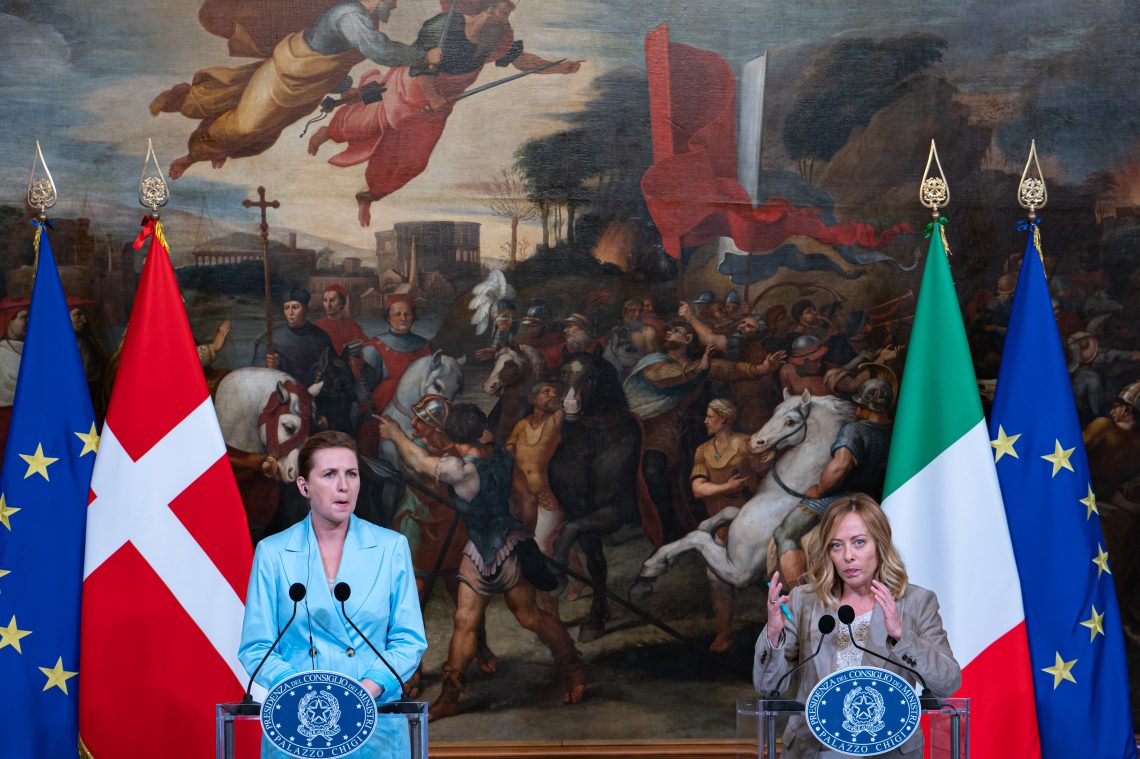
On May 22, following their deliberations in Rome, conservative Italian Prime Minister Giorgia Meloni and her Danish counterpart, Social Democrat Mette Frederiksen, urgently called for “a new and open discussion on the interpretation of the European Convention on Human Rights” (ECHR). In an open letter, which was also signed by the prime ministers of Belgium, Estonia, Latvia, Poland, Austria, the Czech Republic and the president of Lithuania, they criticized the European Court of Human Rights (ECtHR) interpretation of the ECHR.
“What was once right might not be the answer of tomorrow,” the letter reads. It must be investigated “whether the Court, in some cases, has extended the scope of the Convention too far as compared with the original intentions behind the Convention, thus shifting the balance between the interests which should be protected.” In particular, the signatories oppose the limitation of the powers of nation states to deport criminal migrants, even if they have been found guilty of serious offenses such as violent or drug-related crimes.
At the European Union summit on October 17 of last year, the 27 heads of state and government had already spoken out in favor of “decisive action at all levels to facilitate and accelerate returns” and called on the European Commission to prepare a new law to this effect as soon as possible. According to many member states, the EU asylum reform, which was only adopted in spring 2024, does little to solve this problem.
However, the letter from Rome goes further on one essential point. Against the background of the increasing weight of the courts, it refers to conflicts which have been smoldering for years between governments and parliaments on the one hand, and national and European courts on the other. These tensions regularly escalate when the division of powers between the legislative, executive and judicial branches at the national level is called into question or when national courts override the political decisions of their governments on the basis of European law.
Italy’s top court cites EU law to halt a government decision
The as-yet unresolved dispute over the Italian-Albanian migration agreement is a particularly blatant example. In November 2023, Ms. Meloni and Albanian Prime Minister Edi Rama signed a five-year agreement to set up two reception centers in Albanian cities Shengjin and Gjader, to be financed and managed by Italy. The costs so far incurred by Italy for the construction and operation of the two centers are estimated at around 800 million euros.
The Italian government wants to check the eligibility for asylum of migrants rescued in the Mediterranean in accelerated procedures. The deal also requires Albania to host migrants whose asylum applications have already been rejected in Italy and who are to be deported to their countries of origin. Rome had hoped the facilities would handle around 36,000 asylum and deportation procedures in Albania annually. However, the agreement has yet to achieve its purpose because the Italian judiciary has repeatedly declared the transfer of migrants to Albania illegal.
The Italian judges stated that the assessment of a “safe country of origin” is not the responsibility of the government, but of the courts.
To the applause of the left-wing opposition and various human rights organizations, Italy’s judges referred to a ruling by the European Court of Justice (ECJ) of October 4, 2024, according to which migrants may only be deported to countries of origin where the safety of all persons on the entire territory is guaranteed. These conditions are not met in Egypt, Bangladesh, Gambia, Ivory Coast and other jurisdictions that are often countries of origin for illegal migrants.
If a country is not consistently considered safe, asylum applications from persons from that country may not be automatically rejected under accelerated procedures nor may migrants be detained in third countries such as Albania without their individual situation being assessed.
Furthermore, the Italian judges stated that the assessment of a “safe country of origin” is not the responsibility of the government, but of the courts, which would make such determinations on the basis of the ECHR. The case was brought to the ECJ, and the outcome of the proceedings will be closely monitored.
A pan-European trend
Not only Italy, but governments in other EU member states as well as the United Kingdom are interested in offshore processing of asylum applications. Corresponding proposals, which were demanded by 15 EU member states in May 2024, are in line with the European trend and reflect the growing influence of anti-migration parties and voters wanting to maintain traditional cultural cohesiveness.
Denmark already has a law, in force since 2021, allowing asylum seekers to be transferred to third countries for processing.
In Germany in September 2024, the migration commissioner of the Scholz government proposed that asylum applications be processed in Rwanda. Current Chancellor Friedrich Merz recently pleaded for deportations to Syria, which is no more likely to be classified as a “safe country of origin” than Egypt or Bangladesh. Germany’s neighbor Austria on July 3 became the first EU country to deport a Syrian criminal to his homeland since the fall of the Assad regime.
In Greece, judges question the legality of pushbacks at the borders and criticize the conditions in the reception camps for migrants. And in Poland, the government is pushing back against domestic courts and the ECtHR, which object to stricter controls and repatriations at the border with Belarus.
Stumbling blocks and judicial activism
Andreas Khol, a constitutional lawyer and former president of Austria’s parliament, does not believe that a solution to these conflicts is in the offing: “All the ways currently being sought [by the EU] to put an end to the illegal immigration that has broken out over Europe under the pretext of seeking asylum (will) fail” as long as current EU laws remain unchanged. German legal scholar Frank Schorkopf in June said that none of the proposals recently put forward are anti-democratic.
To limit the power of activist judges, the European Parliament and the 27 member states would have to amend the Amsterdam Treaty, which is extremely unlikely. A revision of the ECHR would have to be approved by the 46 states of the Council of Europe.
The power of judges in the EU is based on the “ever closer union among the peoples of Europe” being anchored in the EU treaties, which enables the ECJ to interpret EU law creatively, resulting in its broader application instead of limiting itself to the text of the treaties. In other words, instead of applying the law, they are creating the law.

The real dilemma is that the ECJ treats European treaties like a constitution, eroding the democratic process. However, they are not constitutions. Rather, they are full of provisions that would be accepted as ordinary statutory law in any state. The consequence is that the member states are repeatedly subjected to legal regulations that they have rejected in the national democratic process.
This dilemma could be solved if all provisions of the treaties that have nothing to do with constitutionality were downgraded so that they could be updated through the democratic process. Until then, proposals of the type of Ms. Meloni’s and Ms. Frederiksen’s open letter will be legally ineffective.
The real dilemma is that the ECJ treats European treaties like a constitution, eroding the democratic process. However, they are not constitutions.
Unlike the ECJ, the ECtHR cannot impose sanctions because it does not have executive powers. A spectacular case is the ECtHR ruling of April 9, 2024. The group “Climate Seniors Switzerland” had sued their country at the ECtHR for allegedly insufficient climate protection measures after Swiss courts dismissed their lawsuit in three instances. According to the ECtHR, Switzerland, which is a member of the Council of Europe though not the EU, had violated their human rights. The Swiss parliament has rejected the verdict as “judicial activism.”
This is the first time that a court has unilaterally declared climate protection a human right, which is likely to result in further lawsuits. ECtHR judgments are final; Switzerland is now obliged to justify its climate policy to the Council of Europe. It is expected that the Climate Seniors and their allies will complain again to the ECtHR because they consider the reaction of the Swiss government to be insufficient.
Everyone is a judge
As far back as 1835, Alexis de Tocqueville predicted that: “There is hardly any political question in the United States that sooner or later does not turn into a judicial question … the spirit of the jurist, born inside the schools and courtrooms” then “infiltrates all of society.”
The growing power of the judiciary has become a global phenomenon since the second half of the 20th century. In specialist literature one reads of “legislators in robes,” a “judicial era” and the transformation of democracy into a “juristocracy.” Legal scholar Ran Hirschl names three primary aspects of this trend: the dramatic increase in the number and types of national and transnational courts and tribunals; the ever-growing significance of courts and judges in determining political and policy-making outcomes worldwide; and criticism of, resistance to and occasional backlash against expanded judicial power.
This development had started with the democratization processes after World War II in Europe, Asia, Africa and Latin America, and accelerated with the end of the Soviet regime.
Read more by Karl-Peter Schwarz
According to an international survey, national constitutions now protect an average of 48 rights, more than ever before. Some are declamatory, but most are justiciable. At the same time, judicial power has grown at the international level, of which the courts of the EU and the Council of Europe are the most striking, but by no means the only examples. Between 1985 and 2020, the number of international courts more than tripled.
The more the power of the courts grows, the more political actors try to influence the composition and activities of the courts. The resulting conflicts have led to constitutional disputes in Hungary, Poland and Israel, and in the U.S., where many believe courts are acting in political roles.
Scenarios
Likely: Judicial power grab stokes voter unrest
It is likely that the increasing power of the courts undermines trust in democracies and leads to further growth of populist parties and movements. As a result, the conflicts between the governments of the EU member states, which are coming under increasing pressure from their voters, and the EU institutions, which operate in a largely protected area, will intensify.
Possible: Special interest groups use judicial activism to promote their agendas
Democratically illegitimate pressure groups of social minorities will seek to instrumentalize the power of the judges who sympathize with their concerns against the will of the majority of voters. Centrifugal tendencies in the EU will increase if a reasonable balance between the legislative, executive and judicial powers is not achieved.
Unlikely: EU rules adjusted to reflect the will of the democratic electorate
A revision of the EU treaties and the Convention for the Protection of Human Rights and Fundamental Freedoms is extremely unlikely. And without changes to these agreements, the will of the citizens in countries around Europe will continue to be largely ignored, and the dilemma will continue unabated as no solution to resolve challenges such as illegal migration is permitted by courts.
Contact us today for tailored geopolitical insights and industry-specific advisory services.

Sign up for our newsletter
Receive insights from our experts every week in your inbox.




Leave a Reply