‘Already facing danger’: Scientists involved in Cop prep for the first time
Jonathan Watts
Planetary scientists have warned President Lula today that Cop30 must act decisively because the world is at a crossroads: protect people and life or the fossil fuel industry, writes my colleague Jon Watts.
“We are already facing danger,” they warn in a statement on the state of negotiations, which take place against a backdrop of “suffering for billions of people and rapidly approaching tipping points in the Amazon and the Tropical Coral Reef systems and many others.”
Emissions must start to bend next year, they say, and then continue to fall steadily in the decades ahead: “We need to start, now, to reduce CO2 emissions from fossil-fuels, by at least 5% per year. This must happen in order to have a chance to avoid unmanageable and extremely costly climate impacts affecting all people in the world.”
The signatories include several of the world’s leading authorities on planetary science, forests and oceans: Carlos Nobre from Science Panel of the Amazon; Fatima Denton of United Nations University; Johan Rockström of the Potsdam Institute for Climate Impact Research; Marina Hirota; Instituto Serrapilheira; Paulo Artaxo – Universidade de São Paulo; Piers Forster of the University of Leeds; and Thelma Krug, who is Chair of the COP30 Science Council.
They say this is the first time that a COP presidency has involved scientists in the preparation of a climate conference and then provided a pavilion for them to share their findings and opportunities to provide updates to the negotiators.
Bearing in mind the gravity of the threat, their latest report says action needs to be accelerated: “We need to be as close as possible to absolute zero fossil fuel emissions by 2040, the latest by 2045. This means globally no new fossil fuel investments, removing all subsidies from fossil fuels and a global plan on how to phase in renewable and low-carbon energy sources in a just way, and phase out fossil fuels quickly.”
They say finance – from developed to developing countries – is essential for the credibility of the Paris Agreement. “It must be predictable, grant-based and consistent with a just transition and equity,” they say. “Without scaling and reforming climate finance, developing countries cannot plan, cannot invest and cannot deliver the transitions needed for a shared survival.”
This is the first climate conference in the Amazon rainforest, which used to be one of the planet’s great climate stabilisers. The scientists warn this can no longer be taken for granted: “The only reason we can have an orderly phase out of fossil fuels is because we assume forests will continue to be a major carbon sink. Unfortunately we have increasing evidence that forests are turning from carbon sinks to carbon sources. This happens because forests are vulnerable to climate change causing more frequent and intense droughts, fires, heatwaves and land use conversion.”
To address this, they stress that Cop30 also needs to produce a roadmap that concurrently ends deforestation and phases out fossil fuels.
“The Roadmap on ending deforestation must include financial support, capacity building and robust monitoring. Forest protection cannot be used as offsets. Standing forests cannot be an excuse to keep burning fossil fuels.“
Key events
Turkey set to host the Cop31 climate conference, beating out Australia
Big news from Guardian Australia’s climate and environment editor Adam Morton:
Turkey is set to host the Cop31 climate conference after the Australian government dropped its push to hold the event in Adelaide at the last moment despite having launched a more than three-year campaign.
Independent sources confirmed to the Guardian that the fortnight-long event would be held in Turkey’s Mediterranean resort city of Antalya in November 2026, with the details of a deal being thrashed out between the countries’ climate ministers, Chris Bowen and Murat Kurum, at the Cop30 conference in Brazil this week.
They said Australia had proposed an arrangement under which it would take on the Cop presidency and lead the negotiations in return for backing down on the hosting venue.
The agreement was expected to include a separate leaders’ meeting being held in the Pacific. Pacific islands nations had been promised they would be co-hosts, and there would be a significant international focus on the threat the climate crisis poses to their survival, if Australia was successful.
Bowen and Kurum were meeting with the rest of the Western Europe and Others Group of countries, which has responsibility for nominating next year’s host, late on Wednesday. They earlier met with the Brazilian president, Luiz Inácio Lula da Silva.
The Australian prime minister, Anthony Albanese, signalled he had changed his messaging on hosting the world’s biggest climate meeting in a press conference in Perth late on Tuesday local time, when he said his government would not block Turkey’s bid if it was chosen.
His intervention came just hours after Bowen, the main driver of the Australian bid, declared in a public event and media interview at Cop30 that Australia was “in it to win it” on Cop31.
Under the UN’s consensus-based decision making, Cop31 would have defaulted to the UN climate headquarters in the German city of Bonn if the stand off between Turkey and Australia had not been resolved this week. The Germans did not want to host the negotiations, which attract tens of thousands of delegates and run alongside the world’s biggest green industry trade fair.
The Australians argued they had the declared support of at least 24 of the 28 members of the Western Europe and Others Group. But they said an unprecedented deadlock that forced the event to be held in Bonn could have undermined faith in the negotiations and someone needed to broker a deal to avoid that.
Turkey continued to maintain its desire to host the event despite significant pressure to withdraw. It had previously withdrawn from a previous bid to host Cop26, which was held in Glasgow.
UN climate negotiations can feel esoteric and removed from the real world. For a reminder of why they’re important, check out today’s installment of our ‘This is climate breakdown’ series. It features Ryan Kirkham, who had been the principal at Maui preparatory school for 13 years when the Maui wildfires ignited in 2023, killing 102 people in Lahaina and costing almost $3.3bn in insured damages. He shared his story with Raamin Hamid:
The power went out at about 5.30 that morning. It was knocked out all day; there were power lines and trees down across the roads. The first day of school was scheduled to be the very next day. I was at work. Teachers were getting their classrooms ready to welcome kids.
This was August, the middle of hurricane season. There was a big hurricane passing a couple hundred miles south of Hawaii. There were hurricane-force winds down in town. We had volleyball practice; we had enough daylight to practise in the gym. During practice, at about 3.30pm, I received a call from a parent at the school. She said: “Ryan, there’s a fire in town. We’ve lost our house. We barely got out alive.” Theirs was one of the first houses to go.
Then I received another call from another family. “Ryan, our whole neighbourhood just went up in flames.” Lahaina is small, but those houses are in different parts of Lahaina. In between those homes were several hundred other homes. I just went: “What is going on down in town?”
We sent the kids home. Just after, around 5pm, all our cellphones went out. There’s still no power, no communication, no information. I came home, slightly aware of what was starting. Before the phones went out, a few families had called and asked if they could come to our house. As we went to bed, they showed up. They were like: “We got evacuated. It was just precautionary. We think we’ll be able to go back in the morning, and everything will be there.” So they didn’t have much stuff packed.
We were setting up mattresses, and people were getting ready to sleep on couches. We had candles going everywhere. There was chatter about what was happening in town. We had five different sets of families in our house that night.
I was in bed, and at about 10.30pm, one of our kids came in and said: “Hey, Dad, there’s a police officer at the door and he wants to talk to you.” I went to the door. He said: “Hey, are you Ryan, the principal of Maui prep?” I said yes. He goes: “We got to open your school right now. We have to set it up as an evacuation centre because there’s buses on their way up to the school. You need to open everything up.”
My colleague Damian Carrington is keeping a close eye on concessions at Cop30. He writes:
If food queues are any measure of what is powering the delegates at Cop, the clear winner is ice cream.
Dharna Noor here on the bad news beat. Against the backdrop of Cop30 in Brazil, Donald Trump is proposing to axe protections for some animals and plants under the Endangered Species Act.
The administration, which have repeatedly called the climate crisis a “hoax” but have claimed they aim to protect nature, argues that current protections for endangered species are hampering economic development.
But environmental advocates say the proposal could send some of America’s most iconic plants and wildlife into a tailspin toward extinction. That includes monarch butterflies, sea turtles, and manatees.
Here’s a take from the executive director of the US-based green group Sierra Club, Loren Blackford: “The Trump administration is stopping at nothing in its quest to put corporate polluters over people, wildlife and the environment. After failing in their latest attempt to sell off our public lands, they now want to enable the wholesale destruction of wildlife habitat for a short-term boost in polluters’ bottom lines.
“These regulations attempt to undermine implementation of one of America’s bedrock environmental laws, and they could seal the fate of animals that, without these protections, would disappear from the earth. For decades, the Sierra Club has worked to defend this critical law, and we will use every tool at our disposal to stop this reckless administration from selling out our wildlife and wild places to corporations and billionaires.”
As the US refuses to send a delegation to Cop for the first time this year, a new analysis from the Guardian and non-profit newsroom ProPublica found that Donald Trump’s anti-climate agenda could result in 1.3m more deaths globally.
The story is from the always-excellent Sharon Lerner. Here’s a taste of the new piece:
New advances in environmental science are providing a detailed understanding of the human cost of the Trump administration’s approach to climate.
Increasing temperatures are already killing enormous numbers of people. A ProPublica and Guardian analysis that draws on sophisticated modeling by independent researchers found that Donald Trump’s “America First” agenda of expanding fossil fuels and decimating efforts to reduce emissions will add substantially to that toll, with the vast majority of deaths occurring outside the US.
Most of the people expected to die from soaring temperatures in the coming decades live in poor, hot countries in Africa and south Asia, according to recent research. Many of these countries emitted relatively little of the pollution that causes climate crisis – and are least prepared to cope with the increasing heat.
ProPublica and the Guardian’s analysis shows that extra greenhouse gases released in the next decade as a result of the president’s policies are expected to lead to as many as 1.3 million more temperature-related deaths worldwide as the earth heats in the 80 years after 2035. The actual number of people who die from heat will be much higher, but a warming planet will also result in fewer deaths from cold.
Read it in full.

Nina Lakhani
There is no climate justice without human rights.
Astrid Puentes Riaño, the UN Special Rapporteur on the human right to a clean, healthy and sustainable environment, has put together a handy list for negotiators on why they must under international law centre climate action around the protection of human rights and nature.
“Negotiations remain highly technical and focused on economic interests, but human rights and the right to a healthy environment mean putting people and nature at the centre,” Puentes told my colleague Nina Lakhani. “The International Court of Justice (ICJ) categorically concluded that the right to a healthy environment is a precondition and essential for the guarantee of all human rights, and fundamental for States to effectively fulfill other human rights. These obligations are non-negotiable.”
Here’s more from Puentes’ key human rights takeaways:
The human right to a clean, healthy and sustainable environment, recognised by the UN and 165 States, includes breathing clean air, having a safe climate, healthy biodiversity and ecosystems, enjoying safe and sustainable food, safe and sufficient water and non-toxic spaces, as well as the right to access information, public participation and access to justice.
The ICJ clearly concludes that States have an obligation to protect the environment and the climate system – and to implement measures with stringent due diligence to avoid further impacts. The obligation applies to all States, regardless of whether or not they are party to climate treaties.
The Advisory Opinions of the ICJ, the Tribunal for the Law of the Sea and the Inter-American Court of Human Rights clarify doubts regarding the legal obligations of States to address the climate crisis. Issues clarified therein should not continue to be opened up in negotiations.
It is imperative that the agreements at COP30, including those on just transition, adaptation and financing, move forward on the basis of international law. In order to take concrete action, it is essential to use the best available science provided by the IPCCC, as well as past agreements, including the recognition that fossil fuels are the root of the problem.
“We cannot afford to continue endless discussions on agreed points while millions of people continue to suffer from climate change, losing their lives, families and territories, with no solution in sight, including entire states in a situation of vulnerability due to circumstances for which they are not responsible,” Puentes said.
‘Already facing danger’: Scientists involved in Cop prep for the first time
Jonathan Watts
Planetary scientists have warned President Lula today that Cop30 must act decisively because the world is at a crossroads: protect people and life or the fossil fuel industry, writes my colleague Jon Watts.
“We are already facing danger,” they warn in a statement on the state of negotiations, which take place against a backdrop of “suffering for billions of people and rapidly approaching tipping points in the Amazon and the Tropical Coral Reef systems and many others.”
Emissions must start to bend next year, they say, and then continue to fall steadily in the decades ahead: “We need to start, now, to reduce CO2 emissions from fossil-fuels, by at least 5% per year. This must happen in order to have a chance to avoid unmanageable and extremely costly climate impacts affecting all people in the world.”
The signatories include several of the world’s leading authorities on planetary science, forests and oceans: Carlos Nobre from Science Panel of the Amazon; Fatima Denton of United Nations University; Johan Rockström of the Potsdam Institute for Climate Impact Research; Marina Hirota; Instituto Serrapilheira; Paulo Artaxo – Universidade de São Paulo; Piers Forster of the University of Leeds; and Thelma Krug, who is Chair of the COP30 Science Council.
They say this is the first time that a COP presidency has involved scientists in the preparation of a climate conference and then provided a pavilion for them to share their findings and opportunities to provide updates to the negotiators.
Bearing in mind the gravity of the threat, their latest report says action needs to be accelerated: “We need to be as close as possible to absolute zero fossil fuel emissions by 2040, the latest by 2045. This means globally no new fossil fuel investments, removing all subsidies from fossil fuels and a global plan on how to phase in renewable and low-carbon energy sources in a just way, and phase out fossil fuels quickly.”
They say finance – from developed to developing countries – is essential for the credibility of the Paris Agreement. “It must be predictable, grant-based and consistent with a just transition and equity,” they say. “Without scaling and reforming climate finance, developing countries cannot plan, cannot invest and cannot deliver the transitions needed for a shared survival.”
This is the first climate conference in the Amazon rainforest, which used to be one of the planet’s great climate stabilisers. The scientists warn this can no longer be taken for granted: “The only reason we can have an orderly phase out of fossil fuels is because we assume forests will continue to be a major carbon sink. Unfortunately we have increasing evidence that forests are turning from carbon sinks to carbon sources. This happens because forests are vulnerable to climate change causing more frequent and intense droughts, fires, heatwaves and land use conversion.”
To address this, they stress that Cop30 also needs to produce a roadmap that concurrently ends deforestation and phases out fossil fuels.
“The Roadmap on ending deforestation must include financial support, capacity building and robust monitoring. Forest protection cannot be used as offsets. Standing forests cannot be an excuse to keep burning fossil fuels.“
Some American activists who made the long journey to Cop30 are aiming to spotlight New York City’s mayor-elect Zohran Mamdani, who has much of the US left swooning.
The 34-year-old democratic socialist defeated centrist Andrew Cuomo in the mayoral general election earlier this month — a win that supporters say signals interest in bold climate policy.
A self-described ecosocialist, Mamdani was elected to the New York state legislature in 2020. He has been a vocal backer of policies to phase fossil fuels out of buildings and expand publicly-owned renewable energy, and has supported efforts to stop the buildout of a gas pipeline.
“Zohran’s leadership is inspiring and hopeful to us,” said Jamie Minden, executive director of youth-led climate organization Zero Hour. “He is leading by example, showing how elected officials in the United States must show up for our communities, because we are balanced on the knife’s edge of falling into a future of undisputed climate chaos.”
Data show New York City is the third-most emitting city on the planet. But on the campaign trail, Mamdani focused primarily on affordability issues. His environmental policies highlighted the ability to slash planet-warming pollution while lowering costs for New Yorkers.
“Another future is possible for our country and for the world, and it starts by following New York City Mayor-Elect Zohran Mamdani’s lead,” said said Keanu Arpels-Josiah, 20, lead organizer with youth-led climate group Fridays For Future NYC & USA.
Check out this story I wrote over the summer about how Mamdani connects climate policy to affordability at the link below.

Damian Carrington
From my colleague Damian Carrington:
Mary Robinson has been working on human rights and climate for almost 30 years. The former president of Ireland has again brought her customary moral clarity to a UN climate Cop, making the case for a phase out of fossil fuels.
“People already suffering from climate change need a phase out. The continuing increase in extreme weather events shows the alarming future ahead of us. And without it, millions more people will migrate, and some countries will cease to exist.
“Scientists urge a phase out. They can see we are approaching planetary tipping points from which there is no return.
“International law demands a phase out. July’s ICJ opinion is clear that countries have a legal responsibility to regulate the production, consumption and subsidy of fossil fuels to prevent foreseeable harm.
“The market expects a phase out. Investment in renewable energy is now double investment in fossil fuels.
“As Cop30 negotiations reach their climax, we call on all people who want a cleaner, healthier, safer future to make their voices heard – before it is too late.”

Ajit Niranjan
Germany has managed to annoy the Cop30 hosts after Chancellor Friedrich Merz contrasted his own country, which he described as “one of the most beautiful in the world”, with Brazil, writes my colleague Ajit Niranjan.
“Last week, I asked some journalists who were with me in Brazil: Who among you would like to stay here?” Merz said at a trade conference upon returning to Berlin last week. “No one raised their hand. Everyone was delighted to be back in Germany – and above all, to have left that place.”
A charitable reading of the statement in German media was that the gaffe-prone multimillionaire and former Blackrock board member was reminding Germans that they live good lives by global standards, despite serious challenges at home. In Brazil, where the remarks have gone viral in recent days, the comment has been interpreted as an “arrogant” swipe, drawing condemnation from the mayor of Belém and the governor of Pará state.
German negotiators and observers have since strived to smooth things over – praising the country that is hosting them for two weeks – while Brazilian President Luiz Inácio Lula da Silva hit back in softer terms.
“[Merz] should have gone to a bar in Belém, he should have danced, he should have tried the food in the state of Pará,” he said. “Because then he would have realized that Berlin doesn’t even provide him with 10% of the quality of life that the state of Pará and the city of Belém offer.”
A German government spokesperson on Wednesday sought to take the sting out of the comment. “When the Chancellor says we live in one of the most beautiful countries in the world, tbat does not mean other countries are not also very beautiful,” he said.
Damian Carrington
Cop30 is a place for Paris Agreement parties to flesh out their climate plans. But it is also a bit of a trade show for countries, trade groups, and NGOs. My intrepid colleague Damian Carrington, the Guardian environment editor, is continuing his analysis (read a previous installment here) of the pavilions at the climate talks. Here are his latest assessments:
Democratic Republic of the Congo: Huge! Like the enormous rainforest it hosts. Real plants too. Top job.
World Nuclear Association: Barren, empty. Like a fall-out zone.
Brazil: Fabulous forest vibe. But inexplicably no coffee stand. Did the UK pavilion steal it?
Japan: Like an Apple store, gadgets out on display. Cool, but fancy tech isn’t going to save us.
Sweden: Decent effort. But seriously, couldn’t Ikea have provided some funky furniture?
Planetary sciences: Bravo! A rare pavilion that is just lovely to look at. Unlike the climate science itself which gets uglier each day.
Finland: Uninspiring. But gets a mention for an excellent slogan: “Cool by Nature”
Brazil’s president Lula tries to use his charm to push negotiations forward
Jonathan Watts
President Lula has spent late morning and early afternoon at Cop30 looking for common ground, listening to concerns, and trying to use his charm to push forward a global roadmap to transition away from fossil fuels and end deforestation, reports Jon Watts from Brazil.
After flying into Belém around 10:20am, the Brazilian leader considered strategy with senior members of his negotiating team, including COP president André Corrêa do Lago and environment minister Marina Silva.
Emerging nations were his first priority in meeting with other delegations, including Brics allies China, India and Indonesia. It is unclear as yet how that gathering went, but this huge grouping will be one of the keys to success.
Another is The European Union, whose chief delegate – from Portugal – was invited in for another meeting. Brazil is hoping the EU will lead in rallying the climate funds needed to unlock an agreement in Belém.
After a private lunch, Lula was scheduled to meet with negotiators representing the Africa Group and Small Island States, who are most affected by the climate crisis and are often seen as its moral persuaders.
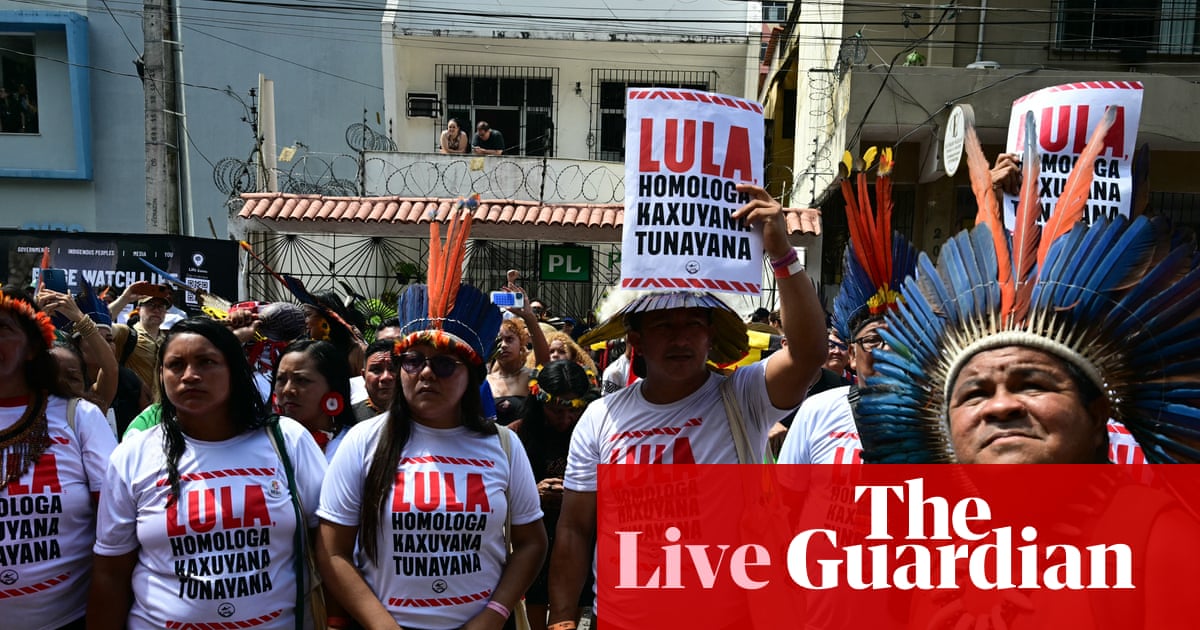
Following this, the Brazilian president is due to talk to representatives of indigenous groups and civil society. Among the achievements of this COP is a greater-than-ever representation of forest peoples inside the negotiating area and the announcement of land demarcation for ten indigenous territories. https://cop30.br/en/news-about-cop30/government-of-brazil-advances-in-the-demarcation-of-ten-indigenous-lands
Rumours have flown around all day that Lula might call a plenary and gauge support for a roadmap. But this is not on his schedule.
Later, there will be talks with business leaders. And hopefully, at the end of the day, a press briefing. We will keep you updated!
Cop president to the Guardian: ‘Not many countries are indifferent’ to fossil fuel phaseout
Oil-producing countries need to acknowledge the rise of clean energy, and rich countries will have to provide more assurances on finance if the chasm between negotiating nations at Cop30 is to be bridged, the president of the summit said in an exclusive interview with the Guardian’s Fiona Harvey.
André Corrêa do Lago, the veteran Brazilian climate diplomat in charge of the talks, said: “Developing countries are looking at developed countries as countries that could be much more generous in supporting them to be more sustainable. They could offer more finance, and technology.”
This does not necessarily involve an increase in the headline amount of money to be provided directly from rich world coffers, set last year at $300bn (£230bn) a year by 2035. It could also come from better use of existing finance, Corrêa do Lago added.
“You don’t need more money. You don’t need public money from developed countries. You need to leverage more dollars from each dollar that you have,” he said.
“They can offer not only more resources in banks, in multinational development banks; put more public money in funds like the green climate fund or the global environment facility, but there are an increasing number of alternatives like debt-for-nature swaps and other [instruments].”
The divide over the “transition away from fossil fuels” has emerged as the biggest faultline at the Cop30 talks, now entering their final days in Brazil. On Tuesday, more than 80 countries demanded a roadmap to the transition as a key outcome of the summit, in what some campaigners described as a “turning point”.
But they are likely to face stiff opposition from petrostates such as Saudi Arabia and others who are dependent on fossil fuels. Decisions at “conference of the party” meetings require consensus, so even a handful of states could scupper the roadmap proposal.
“Not only is [the divide] binary, but it is two extremes: one very favourable [to a phaseout] the other very unfavourable. There aren’t many countries that are indifferent,” said Corrêa do Lago.
Check out the full story from my colleagues Fiona Harvey and Jon Watts:
On Wednesday, Carbon Brief revealed the full list of 82 countries supporting some sort of roadmap on transitioning away from fossil fuels.
More than 20 are backing a declaration on the transition being circulated by Colombia. Latin American countries and the Environmental Integrity Group (Mexico, Liechtenstein, Monaco, the Republic of Korea, Switzerland, and Georgia) back a roadmap in official submissions to the UN climate body.
The EU, minus Poland and Italy, have also backed the roadmap and there have been supportive public statements from small island states, as well as the UK, Mongolia and others.