‘We will exterminate ourselves’ if we keep on extracting fossil fuels, activists say

Oliver Milman
An international group of activists here have issued impassioned pleas for a treaty to phase out fossil fuels, urging the Brazilian presidency of Cop30 to prod countries towards ending the era of coal, oil and gas that has caused the climate crisis.
The proposed Fossil Fuel Treaty is already backed by 17 countries and advocates in Belem said that countries needed to hurry up and act on the root cause of the climate crisis. In 2023, the Cop in Dubai resulted in countries vowing to “transition away” from fossil fuels, although there is little evidence of this happening as yet.
“If we continue to extract hydrocarbons from the Earth, we will exterminate ourselves,” said Olivia Bissa, president of the Chapra Nation in the Peruvian Amazon.
“We worry what will happen if we don’t have concrete action now. We as indigenous people in the Amazon are tired of being sacrificed by a group of powerful people who want to rule the planet. If we don’t do something together we will be complicit with ecocide and the assassination of humanity.”

Tzeporah Berman, chair of the Fossil Fuel Treaty Initiative, praised Luiz Inácio Lula da Silva for urging a fossil fuel phase out but criticized the Brazilian president for allowing a new oil drilling project near the mouth of the Amazon, pointing to a recent International Court of Justice ruling that demands countries address the climate crisis.
“We know fossil fuel production continues to rise, pushing the world past planetary limits and deepening inequality,” said Berman, singling out the US, Australia, Norway and Canada for ramping up oil and gas drilling since the Paris agreement a decade ago. A treaty to end all this would be a “major act of love and justice for our time,” she added.
Given the format of this Cop, and pushback that is already happening from Saudi Arabia and other big oil producers, it’s unclear what, if any, language on fossil fuel phase out will be included in this year’s agreement.
A major opponent of any such pact would be Donald Trump, who has called for the US, and the rest of the world, to “drill, baby, drill.” Crystal Cavalier, a Native American woman from North Carolina, is at Cop30, unlike the US government, and said a new treaty would at least put international pressure on the US to kick its fossil fuel habit.
“We are being targeted in sacrifice zones that are pushing our ecosystems to the brink,” she said. “Our current government is aggressively rolling back environmental protections.
“The Fossil Fuel treaty can be a tool, a pressure point that frontline communities can wield when their governments avoid accountability. We need external pressure in the US, we can’t do this alone. The US isn’t showing up, but the rest of the world can show up for us.”
Key events
Dharna Noor
Thousands of media professionals are at the United Nations climate talks in Brazil. Almost none of them appear to be from the four major US broadcasters, my colleagues Dharna Noor and Jonathan Watts write from Belém.
Nearly 4,000 members of the media registered to attend the global climate conference, known as Cop30, according to a preliminary list released by the United Nations climate body on Tuesday. But none of the “big four” US broadcasters – CBS, NBC, ABC, and Fox – appear to currently have teams present at the talks.
According to the list, no representatives from CBS, NBC, or Fox signed up to attend the talks. Two US staffers from ABC signed up to attend, and though they are reporting on the summit, it is unclear if they are in Brazil.
The big four television outlets also appear not to be covering the climate negotiations in a significant way. In a review of TV coverage of Cop30 shared exclusively with the Guardian, the non-profit Media Matters found that weekday morning and evening national news shows on ABC, CBS, and NBC had not covered Cop30 from 6 November through 11 November. Fox News aired two segments that totalled roughly five minutes of coverage, one of which promoted “anti-climate narratives”, Media Matters said.
The Guardian has contacted all four major broadcasters for comment.
It’s “unimaginable” that major western broadcasters would choose to sit out the talks, said Stefano Wrobleski, director of InfoAmazonia, a non-profit independent media outlet focused on the Amazonian region.
“I can’t see how or why an outlet with funds would choose not to come to Brazil for this,” he said. “We are here and we have a much smaller budget than the big outlets in the US.”

Ajit Niranjan
As European negotiators in Belém urge countries to raise their climate ambitions, their politicians at home have voted to lower their own.
The European Parliament voted on Thursday to cut planet-heating pollution by 90% by 2040 from 1990 levels and allow 5% of that to come from foreign carbon credits – a landmark plan that falls short of what its scientific advisors recommend.
MEPs in Strasbourg earlier today also backed proposals to weaken a delayed law to stop deforestation in supply chains and to restrict the scope of corporate green rules.
European countries are some of the biggest historical polluters of greenhouse gas but have long championed stronger action at UN climate summits. Yet in the last two years, the EU and many of its member states have begun to roll back and “simplify” ambitious climate policies under the banner of increasing the bloc’s competitiveness.
The EU’s 2040 target with room for carbon credits – a compromise solution that won over climate ministers last week, just in time for Cop30 – is among the most ambitious interim targets of any major polluter. But it falls short of the 90-95% domestic cuts recommended by the European Scientific Advisory Board on Climate Change.
Green campaigners were also angered by the vote to weaken the EU’s corporate sustainability rules – the first of several “omnibus” deregulation packages – which removes an obligation on companies to create climate transition plans. The requirement would have forced companies to explain how they plan to align their business practices with the Paris Agreement, which seeks to limit global heating to 1.5C (2.7F).
To obtain a majority in the Parliament’s plenary, the centre-right European People’s Party (EPP) voted with far-right parties that pro-EU centrists have traditionally shunned.
“While the world looks to Cop30, the EPP banded with the far right to make sure business actors no longer have to create and adhere to climate transition plans,” said Frances Verkamp, a corporate accountability campaigner at Friends of the Earth Europe.
“They betrayed their own promises by ignoring several moderate centre-left proposals,” she added. “If this is the dynamic, the centre-far right alliance on the next deregulation omnibuses will bulldoze protections for citizens and the environment.”
The positions adopted today will be negotiated with member states and the European Commission before final versions of the laws come into force.
‘We will exterminate ourselves’ if we keep on extracting fossil fuels, activists say
Oliver Milman
An international group of activists here have issued impassioned pleas for a treaty to phase out fossil fuels, urging the Brazilian presidency of Cop30 to prod countries towards ending the era of coal, oil and gas that has caused the climate crisis.
The proposed Fossil Fuel Treaty is already backed by 17 countries and advocates in Belem said that countries needed to hurry up and act on the root cause of the climate crisis. In 2023, the Cop in Dubai resulted in countries vowing to “transition away” from fossil fuels, although there is little evidence of this happening as yet.
“If we continue to extract hydrocarbons from the Earth, we will exterminate ourselves,” said Olivia Bissa, president of the Chapra Nation in the Peruvian Amazon.
“We worry what will happen if we don’t have concrete action now. We as indigenous people in the Amazon are tired of being sacrificed by a group of powerful people who want to rule the planet. If we don’t do something together we will be complicit with ecocide and the assassination of humanity.”
Tzeporah Berman, chair of the Fossil Fuel Treaty Initiative, praised Luiz Inácio Lula da Silva for urging a fossil fuel phase out but criticized the Brazilian president for allowing a new oil drilling project near the mouth of the Amazon, pointing to a recent International Court of Justice ruling that demands countries address the climate crisis.
“We know fossil fuel production continues to rise, pushing the world past planetary limits and deepening inequality,” said Berman, singling out the US, Australia, Norway and Canada for ramping up oil and gas drilling since the Paris agreement a decade ago. A treaty to end all this would be a “major act of love and justice for our time,” she added.
Given the format of this Cop, and pushback that is already happening from Saudi Arabia and other big oil producers, it’s unclear what, if any, language on fossil fuel phase out will be included in this year’s agreement.
A major opponent of any such pact would be Donald Trump, who has called for the US, and the rest of the world, to “drill, baby, drill.” Crystal Cavalier, a Native American woman from North Carolina, is at Cop30, unlike the US government, and said a new treaty would at least put international pressure on the US to kick its fossil fuel habit.
“We are being targeted in sacrifice zones that are pushing our ecosystems to the brink,” she said. “Our current government is aggressively rolling back environmental protections.
“The Fossil Fuel treaty can be a tool, a pressure point that frontline communities can wield when their governments avoid accountability. We need external pressure in the US, we can’t do this alone. The US isn’t showing up, but the rest of the world can show up for us.”
Hello, this is Ajit Niranjan here with you from Berlin – I’ll be taking over the blog for the rest of the day. As always, please send in tips and suggestions for what we should be covering to ajit.niranjan@theguardian.com.
Chloé Farand
A row over the definition of the term “gender” threatens to bog down pivotal talks at the Cop30 climate summit, writes Chloe Farand for the Guardian.
Before the UN talks in Brazil, hardline conservative states have pushed to define gender as “biological sex” over their concerns trans and non-binary people could be included in a major plan to ensure climate action addresses gender inequality and empowers women.
Gender rights advocates said the move would backslide on decade-old language within the UN system.
“These are unprecedented times to negotiate on gender equality and women’s empowerment,” said Lorena Aguilar, the executive director of the US-based Kaschak Institute for Social Justice for Women and Girls, and Costa Rica’s former vice minister for foreign affairs.
“There are some countries that want to push us back to 30 years ago. But we will not accept anything less than what we already have.”
Brazilians “optimistic” Cop30 will be first to finish on time since 2003

Damian Carrington
Optimism is an important part of the fight against climate change and the Brazilian presidency of Cop30 are a putting a lot of energy into creating good vibes, at least when it comes to finishing the summit on time, writes Guardian environment editor Damian Carrington. Cop meetings usually wildly overrun as decisions on difficult issues are pushed to the brink.
“We are positive and optimistic that we’ll be able to conclude on time, or with a very short delay, maybe five minutes, 10 minutes, on [Friday] 21st,” said Liliam Chagas, director for climate at Brazil’s foreign affairs ministry, on Wednesday.
She said the presidency had already fulfilled a promise to start on time, being just 30 minutes late. Haggling over what issues go on the agenda often pushes the actual start of negotiations into day two. Brazil solved this by hiking off tricky issues, like finance and fossil fuels, into consultations, which are still ongoing.
Cop president André Corrêa do Lago was also optimistic: “I am hoping that we’re going to end on the 21st – we will try hard. I think that we have some [good] indications. This is a [country]-driven process, and the countries have been very constructive. We’re having a very good mood among them.”
“There is a strong indication that everybody that is here wants to show the world that multilateralism works and that we’re all together to prove that,” he said.
However, history suggests a prompt finish is very unlikely. Only three of the previous 29 Cops have ended on time and the most recent was Cop9 in Milan in 2003. In the last decade, most Cops have overrun by 24 hours or more – last year’s, in Baku, was 36 hours over time.
The Associated Press has circulated this chart showing how projections for the temperature rise caused by climate breakdown have fallen over the past decade since the signing of the Paris Agreement.
The chart shows that the world is currently on track for about 2.6C (4.7F) of heating by the end of the century, which would still present dire prospects for humanity and the biosphere as we know it, but is a marked improvement on the 3.6C of heating expected ten years ago.
Half of Cop30 delegates obscured details of affiliations, warns Transparency International
More than half of all delegation members at Cop30 have withheld or obscured details of their affiliations, potentially concealing conflicts of interest and undermining trust in the Cop process, warns Transparency International.
According to the campaign group’s examination of the UNFCCC’s official list of registered participants, 54% of participants in national delegations either did not disclose the type of affiliation they have or selected a vague category such as “Guest” or “Other”.
Several national delegations – including Russia, Tanzania, South Africa, and Mexico – did not disclose the affiliation of any of their delegates holding a Party badge, highlighting a worrying lack of transparency even at the country level.
And multiple high polluters are included as guests in the Presidency’s ‘Host Country Delegation’.
“Transparency is the cornerstone of trust in global climate negotiations,” said Brice Böhmer, climate and environment lead at Transparency International.
Yet, at Cop30, thousands of delegates still do not share enough information, most from within national delegations. If Cop30 is indeed the Cop of truth, the lresidency and the UNFCCC Secretariat should now commit to reviewing and strengthening participant disclosure rules ahead of future summits, ensuring integrity and accountability at every level.
More than 5,000 fossil fuel lobbyists were given access to the UN climate summits over the past four years, according to research shared with the Guardian. But that number excludes executives and other company representatives on official country delegations participating directly in the confidential negotiations, and those attending as guests of governments, known as overflow delegates.
Dharna Noor
In recent years, activism from civil society has been repressed at Cop negotiations. This year, it is having a major comeback, writes Dharna Noor, Guardian US fossil fuels and climate reporter.
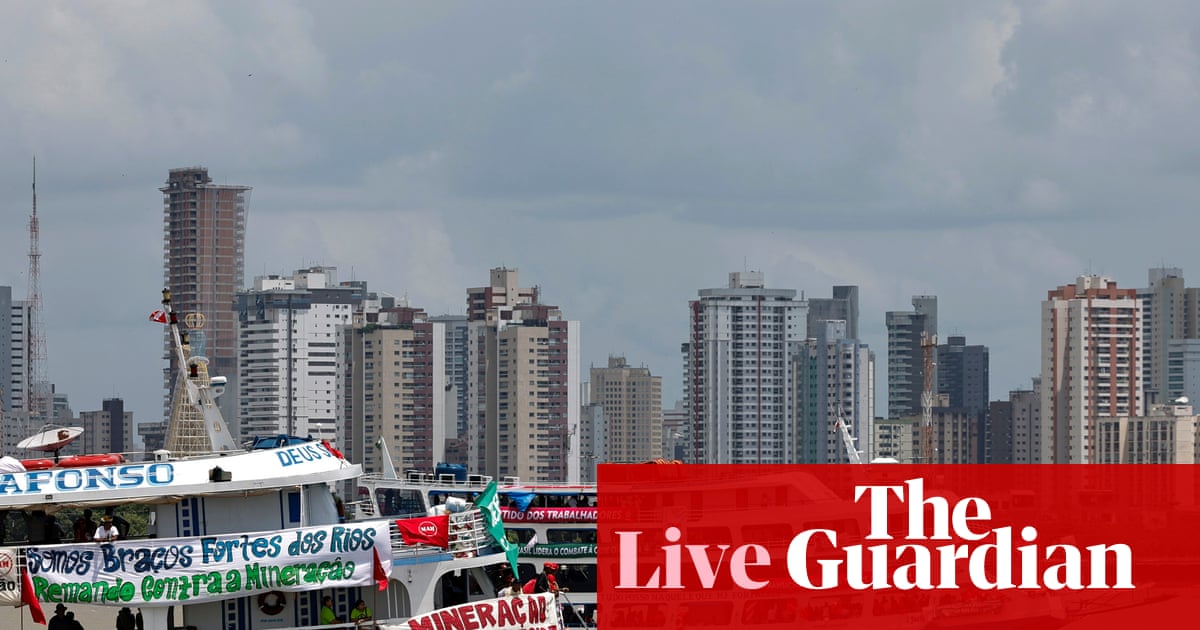
Inside and outside the venue, people are holding protests, marches, and speaking events – a group of organisations even held a massive boat parade yesterday.
On Thursday, I walked through the winding streets of Belém, past chicken vendors and bodybuilding gyms, to check out the Embaixada dos Povos, or People’s Embassy, where activists are pushing for more consideration of environmental justice in international climate action.
When I arrived this morning, advocates were holding a panel while onlookers furiously scribbled notes. All around them, banners were hung. “A resposta somos nos,” one read: “The answer is us.”
Damian Carrington
Flying is the most carbon polluting way to travel but on the eve of Cop30, the UN’s aviation body said it expected passenger flight numbers to triple by 2050, to 12.4 billion a year, writes Guardian environment editor Damian Carrington.
This is despite climate policy for international aviation already being judged “critically insufficient” by the independent Climate Action Tracker analysts, and aligned with a catastrophic 4C of global heating. The main climate policy of the UN International Civil Aviation Organization (ICAO) is a voluntary carbon offsetting scheme, widely seen as weak and ineffective, and yet to require an airline to buy any carbon credits.
Influence Map, a think tank working on lobbying, says that ICAO has been captured by the industry. For example, industry delegates outnumbered climate experts by 14 to one at the most recent “environmental protection” meeting of the ICAO. Non-fossil aviation fuels are much talked about but those made from plants or oil face serious challenges of sustainable supply and synthetic fuels – made using green electricity – are very expensive.
Aviation is not actually covered by the UN climate treaty that convenes the annual Cop summits. Responsibility for aviation – a huge fossil fuel user – was given to ICAO years ago, largely at the behest of Saudi Arabia and other petrostates.
However, ICAO has delivered a “formal statement” to Cop30 to note its “leadership on environmental protection”. The industry’s progress in cutting emissions was illustrated today in the Global Carbon Project’s new data: aviation emissions will rise by 6.8% in 2025.
Of course, no Cop summit is complete without criticism of the air miles clocked up by delegates. Right wing GB News estimated that “whinging” delegates flying to last year’s Cop in Azerbaijan caused “800 tonnes” of CO2 emissions. That seems a bit low to me, but either way the action resulting from UN climate summits, particularly Paris in 2015, has probably curbed the rise of CO2 emissions by billions of tonnes in my estimation. And their deep concern over aviation emissions didn’t stop GB News registering nine people to attend Cop30.

Fiona Harvey
The weather in Belem, driven by the surrounding Amazon rainforest, tends to follow a daily pattern, writes Fiona Harvey, Guardian environment editor.
The morning starts off sunny and hot, with clear blue skies smiling down on delegates hurrying into the vast conference centre, on the site of the former airport and runway. But in the afternoon, dark clouds gather and there is almost always heavy rain, sometimes with the added thrill of thunder and lightning in the early evening.
There are increasing signs that the Cop30 negotiations might follow the same template.
Brazil began Cop30 in great style, by settling the adoption of an agenda and thus allowing the work of the negotiators to formally begin – in contrast to the “agenda fights” that have marred previous UN climate meetings, when work was postponed for several days in some cases as countries could not even agree what should be on the agenda.
The agenda adoption was achieved by hiving off some of the most contentious issues into a separate stream of “presidency consultations”. These would look at whether and how the issues could be integrated into the formal agenda.
The four issues are: finance from rich to poor countries; trade; the biennial transparency reports, which countries must file under the Paris agreement, relating to their data on greenhouse gas emissions and progress on the Paris goals; and the key issue of how to address the large gap between the emissions cuts that are necessary to limit heating to 1.5C above pre-industrial levels, and the inadequate national climate plans, called nationally determined contributions (NDCs), that countries have so far set out.
On finance, many developing countries were dissatisfied with the results of Cop29, in which all countries agreed the “new collective quantified goal” of $1.3 trillion a year to flow to poor countries by 2035 to help them cut emissions and cope with the impacts of extreme weather. Of that goal, only $300bn will come directly from rich countries. Now, some developing countries wish to have an agenda item on Article 9.1 of the Paris agreement, which stipulates that the rich world must provide finance to the poor world, without giving much detail on how that should happen.
Some in the developing world interpret Article 9.1 as saying that rich country governments should be entirely responsible for climate finance, and would like the $300bn to come in the form of grants, rather than loans. Developed countries reject that interpretation and say the finance can come from a variety of sources, including from countries that were counted as developing in 1992 when the UN Framework Convention on Climate Change but which have subsequently seen substantial economic growth, in some cases driven by producing fossil fuels.
Trade is also a thorny subject, as the EU is introducing a carbon border adjustment mechanism which would place tariffs on imports of high-carbon goods such as steel, from countries that fail to put in place robust measures to green their industries. Many developing countries fear that they will be unfairly penalised.
Transparency is a long-running issue at Cops, as many countries resist any suggestion they should submit to monitoring as an affront to their national sovereignty. But without some form of standardised reporting, the data that is presented cannot be properly assessed, including both data on greenhouse gas emissions and the climate finance that is provided and received.
The issue of the NDCs is at the heart of these talks. According to the Paris agreement, all countries must submit a new NDC this year that ratchets up their commitments to cutting or curbing greenhouse gases, in line with the limit of 1.5C above pre-industrial temperatures that was set out in the Paris agreement and reaffirmed many times since.
Brazil has long insisted that the NDCs are separate to Cop30, and are a matter for the countries themselves – and that, technically, there is no mandate for discussing the NDCs at Cop. This is true at a technical level. But if a clear path cannot be found to staying within, or close as now possible, to 1.5C, and improving these NDCs by some means, then it is hard to see how Cop30 can be judged a success.
Work on these contentious issues, to mould each of them into some form of agenda item that can be formally discussed, or discard them altogether, has carried on since Monday in “presidency consultations”. They were supposed to finish on Wednesday afternoon, at a stocktake meeting.
But when the meeting began it was clear that agreement had not yet been reached. Brazil has now said the consultations will continue, potentially until Saturday. This will leave some of the thorniest issues at Cop to be decided in the packed second week of the talks.
Brazil must hope that more of the less tricky items of the 145 on its Cop agenda can be sorted in what remains of this week, to clear the decks for what could be a stormy second half.
Activists protested outside the Cop30 venue early on Thursday to demand greater flows of money to help developing countries’ efforts towards climate adaptation.
“Scaling adaptation finance in vulnerable regions requires urgent delivery of public, grant-based finance, not loans, speculative instruments, or market mechanisms,” said a statement by Demand Climate Justice, which organised the protest.
According to DCJ, the “adaptation gap”, the difference between the amount of money developing countries need to adapt to climate breakdown and the amount they are getting, stands at $310-365bn a year.
Lidy Nacpil, Asian Peoples’ movement on debt and development coordinator at the Global Campaign to Demand Climate Justice, said:
We are counting bodies in the thousands. Homes and lives taken year after year by intensifying super typhoons which are getting worse with each year due to climate change impacts. Adaptation is not just a framework for us – it’s life or death. And we need Adaptation Finance in the trillions NOW!”
Dharna Noor
Young people from around the world have come to Cop30 in full force, writes Dharna Noor, fossil fuels and climate reporter for Guardian US.
In the venue, I spoke with Nidya Al Khairi, a 24-year-old dancer. Nidya travelled from Indonesia for the climate conference, and she has been performing at events at her home country’s pavilion.
“I came here to inform the world of the culture of Indonesia,” she said. Check out her amazing outfit.
Brazil launches climate health action plan
Protecting health in a changing climate demands a whole of society approach, UN climate chief Simon Stiell told delegates at Cop30 at the launch of a new initiative placing health at the centre of global climate adaptation.
At the start of proceedings at the UN climate talks on Thursday, the host Brazil put forward the Belém Health Action Plan, a blueprint to help health ministries to respond to the effects of climate breakdown.
It also identifies children as a uniquely vulnerable group for the first time.
A document prepared by Brazil’s ministry of health about the plan says:
The climate crisis is a health crisis. Evidence linking heatwaves, floods, and droughts to disease outbreaks shows that climate change is putting lives at risk and overburdening health systems around the world. While health is beginning to gain space in climate policies — and vice versa — progress remains fragmented and underfunded.
As host country of Cop30 in Belém, Brazil seizes the opportunity to accelerate the trajectory from commitment to implementation and to engage UNFCCC Parties and the broader community in a global effort for climate and health action.
The plan was developed in collaboration with health ministries and research organisations around the world, including Oxford university’s Blavatnik School of Government’s children and climate initiative.
Alan Stein, director of the Children and Climate Initiative, said:
The Belém Health Action Plan’s recognition of the distinct needs of children is an important step in focussing international efforts.
While it is undeniable that children are the group most affected by climate change, we have yet to elucidate the precise mechanisms by which climate change induced extreme weather events affect different groups of children in specific ways and in particular locations. This detailed information is critical to inform the granular evidence necessary to develop appropriate adaption and mitigation actions to protect children. Our Initiative exists to develop this granular evidence around the globe.
Away from the official Cop30 negotiations, members of the Amazon’s indigenous communities were gathering in Belém’s university yesterday for the inauguration of a parallel People’s Summit.
Pictures filed by news agencies showed people dancing, singing and mingling at the event, on the grounds of the Federal University of Para, just a couple of miles from the conference centre where the UN climate summit is taking place.
The opening included small protests, singing and dancing, as well as speeches led by Indigenous communities from across the Amazon, according to a report by the Associated Press. “Here we are heard, here our voices are listened to,” Inés Antonia Santos Ribeiro, a professor at the university, was quoted as saying.
This year’s climate conference is the first being held in the Amazon rainforest, a symbolic choice by the host country, Brazil, in part to ensure that Indigenous peoples have a larger presence.
But some have nonetheless felt excluded from proceedings, frustrations which contributed to a fracas on Tuesday night when protesters tried to force their way in to the conference’s restricted, accredited delegates-only area.
Supporters of the protest used a press conference at the People’s Summit to defend the action, saying it was aimed at demonstrating the desperation of their fight for forest protection, according to a report by Reuters.
“It was an attempt to get the attention of the government and the U.N. that are in this space,” Auricelia, a member of the Arapiun community, was quoted as saying by the agency. The Arapiun are native to the region where Belém is located.
Joao Santiago, a professor at the Federal University of Para, was quoted as saying by AFP: “The Indigenous movement wanted to present its demands inside the blue zone but were not allowed in.”
Organised in parallel with the Cop30 summit, the People’s Summit is taking place from 12 to 16 November. Over the next two days, plenaries will be held to draft a letter to be delivered to the Cop 30 president André Corrêa do Lago, and submitted to conference delegates.
Then on Saturday it will be the starting point of a Global March for Climate Justice Now, with at least 15,000 people expected to take part.
This is Damien Gayle here, anchoring the Guardian’s Cop30 liveblog for the first half of the day. Belem is three hours behind, so it’s about 9am there and things are just starting to get going for the day.
If you have any suggestions for things taking place in Belém that you think we ought to be covering, then please do drop me a line at damien.gayle@theguardian.com.
Signs of gradual progress as developing countries call for just transition
Oliver Milman
There was a see-sawing element yesterday in Belem, between optimism and pessimism that we will ever crack this climate problem, writes Oliver Milman, environment reporter for Guardian US.
On one hand, the world is still failing badly to contain dangerous global heating, albeit not as badly as we were failing 10 years ago. The Climate Action Tracker report released overnight shows the planet is on course for a 2.6C temperature rise this century despite a flurry of new climate plans from governments, a scenario that would deny generations a world with functional agriculture, stable coastlines and non-lethal heat.
Countries are still drilling for oil and gas and burning it in vast quantities, despite promising to start kicking the habit. They are being egged on by the most powerful office in the world, the US presidency, despite an American absence here in Belem.
But yesterday also brought signs of progress, or at least hope. Developing countries, in the form of the G77 and China, called for a “just transition mechanism” to coordinate finance and help countries move towards a low-carbon future.
The UK won the unwanted “fossil of the day” award from climate activists for dismissing the need for the new mechanism and insisting that a just transition should remain a domestic issue.
Meanwhile, appropriately for a summit that has been called the “Cop of Truth” by Brazil’s president, 12 countries demanded governments, business and academia promote accurate information on the climate crisis and fight off climate denialism and attacks on science and journalism. It’s the first time such a move has been made against climate disinformation.
The larger, tectonic trends can look promising, too, if you squint a bit. Despite the backlash underway in the US, renewables will globally grow faster than any other type of energy in the next decade and will make the shift from fossil fuels “inevitable”, a major International Energy Agency report yesterday found.
We are getting there. If you can’t run, then walk or crawl as long as you’re moving forward, as Martin Luther King once reminded us. It would be helpful if the pace was picked up somewhat, though, which is something that activists will remind negotiators today in a series of different events and protests, including a call to halt oil drilling near here, at the mouth of the Amazon.
The “people’s summit” will be in full swing today, following the arrival of 200 vessels with 5,000 people aboard yesterday, calling for a just transition, an embrace of Indigenous rights and a rejection of half-measures. It will be another day of fluctuating moods in sweltering Belem.